Здравствуйте!
In our last lesson, we learned how to navigate by asking for and giving simple directions. This was an important step in learning how to interact with the world around you in Russian.
Today, we shift from speaking and listening to another crucial skill: reading. This lesson will help you synthesize the vocabulary and grammar you've accumulated over the past modules. Our goal is to read a short adapted Russian text and answer comprehension questions. This is a fundamental skill that will unlock your ability to engage with all sorts of Russian media, from websites and books to subtitles in games and movies.
A Strategy for Reading Russian Texts
When you encounter a new text, it can be tempting to look up every single word you don't know. This can be slow and frustrating. Instead, I recommend a three-step approach:
- Read for the Gist: Read through the text once without stopping. Try to get a general sense of the topic. Who is it about? What is happening? Don't worry about unknown words.
- Read for Detail: Read the text a second time more carefully. Now you can focus on the sentences you didn't understand. Try to guess the meaning of unknown words from the context before looking them up.
- Check Your Comprehension: Answer questions about the text to confirm you understood the key information.
Let's put this strategy into practice.
Guided Practice: A Story of an Unusual Friendship
We'll start with a video that guides you through the entire process: listening to a story, answering questions, and then breaking down the text line by line.
Check your Russian! Do you understand this A1 story?
The video 'Check your Russian! Do you understand this A1 story?' from the channel Be Fluent in Russian is perfectly structured for our goal today. It presents a simple story about a boy and a bird.
Please follow these steps: Listen to the story (00:50 – 02:00). Just listen and try to get the general idea. Pause the video and try to answer the questions below on your own. Watch the Q&A part of the video (02:00 – 04:11) to check your answers. Watch the detailed explanation (starting from 05:25) for any parts you found difficult. The presenter explains vocabulary and grammar, which is very helpful.
Here are the questions to think about after you listen to the story for the first time. Try to answer them in English.
- Who is the main character of the story?
- Where did the main character meet the bird?
- What did he bring for the bird every day?
- Who else started coming to the park to see the bird?
- How did the main character feel about his friendship with the bird?
After you've checked your answers and watched the explanation, you'll have a much clearer understanding of not just what the story says, but how it says it.
Independent Practice: "Anton is going to Russia"
Now it's your turn to apply the reading strategy on your own. The image below contains a short text, vocabulary, comprehension questions, and a full translation.

Here's your task:
- Cover the right side (the English translation) of the image.
- Read the Russian text "Антон едет в Россию" on the left.
- Try to answer the three Russian questions below the text.
- Finally, use the vocabulary list and the English translation to check your understanding and see how you did.
This exercise is a great way to build confidence, as all the tools you need to succeed are right there on the page.
Optional Practice: A Text About Football
If you have a few extra minutes and want to try another text, here is one about football. This connects to your interest in games and hobbies.
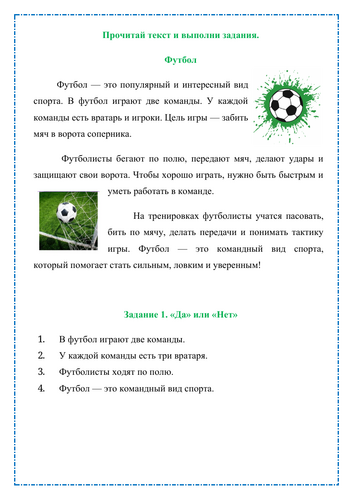
Read the text about футбол and then try the "Да" (Yes) or "Нет" (No) task at the bottom to check your understanding.
Conclusion
Great work today! You have successfully practiced reading comprehension, a skill that brings together everything you've learned. By reading, you see grammar and vocabulary in action, which is one of the best ways to reinforce your knowledge.
Key Takeaways:
- A good reading strategy is to read first for the general idea, then for details, and finally to check your understanding with questions.
- Context is your friend. Try to guess the meaning of new words before you look them up.
- Reading adapted texts is an excellent bridge to understanding more complex, authentic materials later on.
Preview of the next lesson:
In our next lesson, we will move to the learning outcome: Write a short paragraph about your daily routine or hobbies, using a variety of cases and tenses. The texts you read today are perfect models for the kind of writing you will be doing. You've seen how to build a simple narrative, and you'll use that as a foundation for creating your own.