Здравствуйте!
In our last lesson, we expanded your descriptive vocabulary, learning to use adjectives to describe people, places, and objects. You learned how to say "This is an interesting book" (Это интересная книга). Today, we'll take the next logical step: learning to compare things. This will allow you to express preferences and make more nuanced observations, like saying "This book is more interesting than that one."
Our goal for this lesson is to learn how to form and use simple comparative adjectives. We'll focus on some of the most common and useful forms, including лучше (better), больше (bigger/more), and интереснее (more interesting).
1. Two Ways to Compare in Russian
In Russian, just like in English, there are two main ways to make a comparison.
- The "long" way: Using the word for "more" (
более) or "less" (менее). This is similar to saying "more interesting" in English. - The "short" or "simple" way: Changing the adjective's ending or using a special irregular word. This is like changing "big" to "bigger" or "good" to "better".
The simple form is much more common in everyday conversation, so we will focus on mastering that today.
To get an overview of these concepts, let's watch a video.
Comparing Adjectives | Russian Language
Fedor from 'Be Fluent in Russian' will introduce how to form comparatives. Pay attention to the two main methods he presents.
Please watch from 00:34 to 03:40. First, he'll explain the 'более/менее' method. Then, he'll explain the more common method of adding the suffix '-ее' to form simple comparatives.
2. Forming Simple Comparatives
As you saw in the video, creating simple comparatives is straightforward for many adjectives. However, some of the most important ones are irregular and need to be memorized, much like "good" -> "better" in English.
The Regular Pattern: Adding -ее
For many adjectives, you form the comparative by dropping the ending (like -ый, -ая, -ое) and adding the suffix -ее (pronounced "-yey-e").
интере́сн**ый**(interesting) →интере́сн**ее**(more interesting)краси́в**ый**(beautiful) →краси́в**ее**(more beautiful)тру́дн**ый**(difficult) →трудн**ее**(more difficult)
This is a very common and productive pattern.
The Irregulars: The Ones You'll Use All the Time
Some of the most frequently used adjectives have special, irregular comparative forms. These don't follow the -ее rule and are essential to memorize.
Let's watch the next segment of the same video, which is dedicated to these irregulars.
Comparing Adjectives | Russian Language
Now, let's focus on the most important irregular forms. These are words you will hear and use constantly.
Watch from 04:27 to 06:12. Pay close attention to the pairs he presents, especially 'good/better' and 'bad/worse'.
Here is a summary of the most crucial irregular comparatives:
| Adjective | Meaning | Comparative | Meaning |
|---|---|---|---|
| хоро́ший | good | лу́чше | better |
| плохо́й | bad | ху́же | worse |
| большо́й | big | бо́льше | bigger, more |
| ма́ленький | small | ме́ньше | smaller, less |
| дорого́й | expensive | доро́же | more expensive |
| дешёвый | cheap | деше́вле | cheaper |
For a handy written reference of these irregulars, you can review the "Special & Irregular Forms" section of the article "Comparing Things in Russian".
Comparing Things in Russian: Comparative and Superlative ...
This article provides a clear list of the most common irregular comparatives. It's a great reference to bookmark for future practice.
Please read the section titled 'Special & Irregular Forms'. It begins right after the 'Superlatives in Russian' section.
3. Using Comparatives in Sentences
Now that you know how to form comparatives, how do you use them? The simplest way is with the word чем (than).
The structure is: Thing A + Comparative Adjective + чем + Thing B.
Москва́ **бо́льше**, **чем** Санкт-Петербу́рг.(Moscow is bigger than St. Petersburg.)Э́та зада́ча **трудне́е**, **чем** та.(This task is more difficult than that one.)Игра́ть в видеои́гры **интере́снее**, **чем** де́лать дома́шнее зада́ние.(Playing video games is more interesting than doing homework.)
Notice that the comparative form (e.g., бо́льше, трудне́е, интере́снее) does not change for gender or number. It's one form for everything, which makes it simple to use!
This image provides several excellent examples of this structure in action.
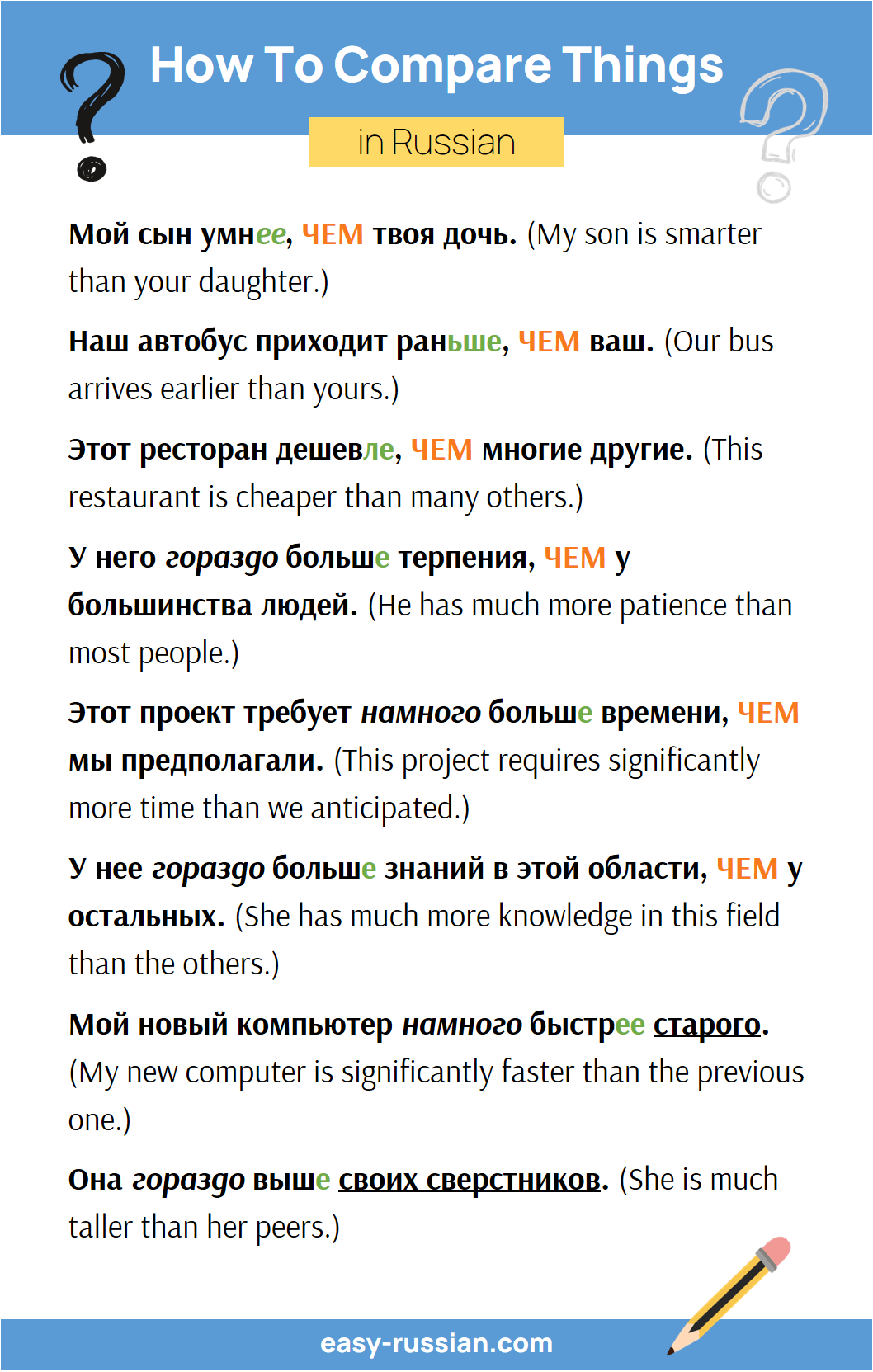
4. Practice
Let's put your new knowledge to the test. Complete the following sentences by filling in the blank with the correct comparative form of the adjective in parentheses.
- Э́та кни́га ___________ , чем тот фильм. (интере́сный)
- Ко́фе ___________ , чем чай. (хоро́ший)
- Мой но́вый телефо́н ___________ , чем ста́рый. (дорого́й)
- Зима́ в Росси́и ___________ , чем ле́то. (холо́дный -> холодне́е)
Click for answers
- Э́та кни́га интере́снее, чем тот фильм. (This book is more interesting than that film.)
- Ко́фе лу́чше, чем чай. (Coffee is better than tea.)
- Мой но́вый телефо́н доро́же, чем ста́рый. (My new phone is more expensive than the old one.)
- Зима́ в Росси́и холодне́е, чем ле́то. (Winter in Russia is colder than summer.)
Conclusion
Отлично! (Excellent!) You've just unlocked a major tool for expressing yourself in Russian. By learning to compare things, your descriptions can become much more specific and personal.
Key Takeaways:
- There are two ways to form comparatives, but the simple form (using suffixes or irregulars) is most common in speech.
- The regular pattern is to add -ее to the adjective stem (e.g.,
интере́сный→интере́снее). - A few crucial adjectives have irregular forms that must be memorized:
хоро́ший→лу́чше,плохо́й→ху́же,большо́й→бо́льше. - The standard way to build a comparison sentence is with
чем(than).
Preview of the next lesson:
Now that you can form comparisons, the next step is to state your opinions about them. In our next lesson, we will learn how to use the construction Я ду́маю, что... (I think that...), which will allow you to say things like, "I think this game is better than that one."