Здравствуйте!
In our last lesson, we focused on using vocabulary related to your interests—video games, movies, and art. You learned to say things like «Я люблю́ игра́ть в видеои́гры» (I love to play video games) and «Я хочу́ посмотре́ть фильм» (I want to watch a movie).
Today, we'll add a new layer of detail to your sentences. This lesson addresses the learning outcome: matching adjective endings to noun gender and number in the nominative case. You'll learn how to go from saying "a movie" (фильм) to "an interesting movie" (интере́сный фильм), which will make your Russian much more descriptive and expressive.
1. The Golden Rule: Adjective-Noun Agreement
In Russian, adjectives are not one-size-fits-all. They must "agree" with the noun they describe in three ways: gender, number, and case.
For today, we are only focusing on the nominative case, which is the case for the subject of a sentence. Think of it this way: the noun is the "boss," and the adjective must change its ending to match the noun's gender (masculine, feminine, neuter) and number (singular, plural).
Let's begin with a video that breaks down these changes clearly.
Russian Adjectives Broken Down for Beginners
The video 'Russian Adjectives Broken Down for Beginners' by Learn Russian with Ewa provides an excellent overview of the four basic forms an adjective can take in the nominative case.
Watch the introduction from 00:00 to 00:32 to get a quick summary of how adjective endings work.
The key idea is that we look at the last two letters of the adjective to determine its form. Let's see how this works for each gender.
2. Adjective Endings: Gender and Number
We'll continue with the same video, breaking it down by gender. As you watch, pay attention to the example phrases, especially those that relate to your interests, like интересный сериал (interesting series) or новые друзья (new friends).
Masculine Adjectives (Мужско́й род)
The masculine singular form is the "dictionary form" of an adjective. It most often ends in -ый or -ий. A small group of adjectives have a stressed ending -ой.
Russian Adjectives Broken Down for Beginners
Let's look at the masculine endings.
Watch from 00:32 to 02:46.
Examples:
но́в**ый** фильм(a new film)хоро́ш**ий** вопро́с(a good question)больш**о́й** успе́х(a big success)
Feminine Adjectives (Же́нский род)
Feminine adjectives are easy to spot: they almost always end in -ая.
Examples:
но́в**ая** рабо́та(a new job)интере́сн**ая** исто́рия(an interesting story)больш**а́я** соба́ка(a big dog)
Neuter Adjectives (Сре́дний род)
Neuter adjectives typically end in -ое.
Russian Adjectives Broken Down for Beginners
And here are the neuter endings.
Watch from 04:33 to 06:28.
Examples:
но́в**ое** зда́ние(a new building)интере́сн**ое** интервь́ю(an interesting interview)хоро́ш**ее** настрое́ние(a good mood)
Plural Adjectives (Мно́жественное число́)
Finally, for plural nouns of any gender, adjectives end in -ые or -ие.
Russian Adjectives Broken Down for Beginners
Lastly, let's look at the plural endings, which work for all genders.
Watch from 06:28 to 07:49.
Examples:
но́в**ые** друзья́(new friends)интере́сн**ые** иде́и(interesting ideas)хоро́ш**ие** но́вости(good news)
3. Understanding the Rules: Hard, Soft, and Spelling
You may have noticed that there are sometimes two possible endings (e.g., -ый or -ий for masculine). The choice depends on the last consonant of the adjective's "stem" (the part before the ending). While this might seem complex, it follows a few predictable rules, much like reaction rules in chemistry.
This article from Mango Languages has a fantastic table that organizes these rules clearly.
Adjectives in Russian: How to form them
To understand the rules for which ending to use, let's look at a helpful guide. It explains that the ending depends on the final consonant of the adjective's stem.
First, read the introduction under the heading 'How do adjectives agree with nouns in Russian?'. Then, focus on the section 'What are the endings for nominative adjectives in Russian?'. Study the table of endings and the explanation below it that shows how to use the table.
Here is a visual summary of those rules, which can be a great reference.
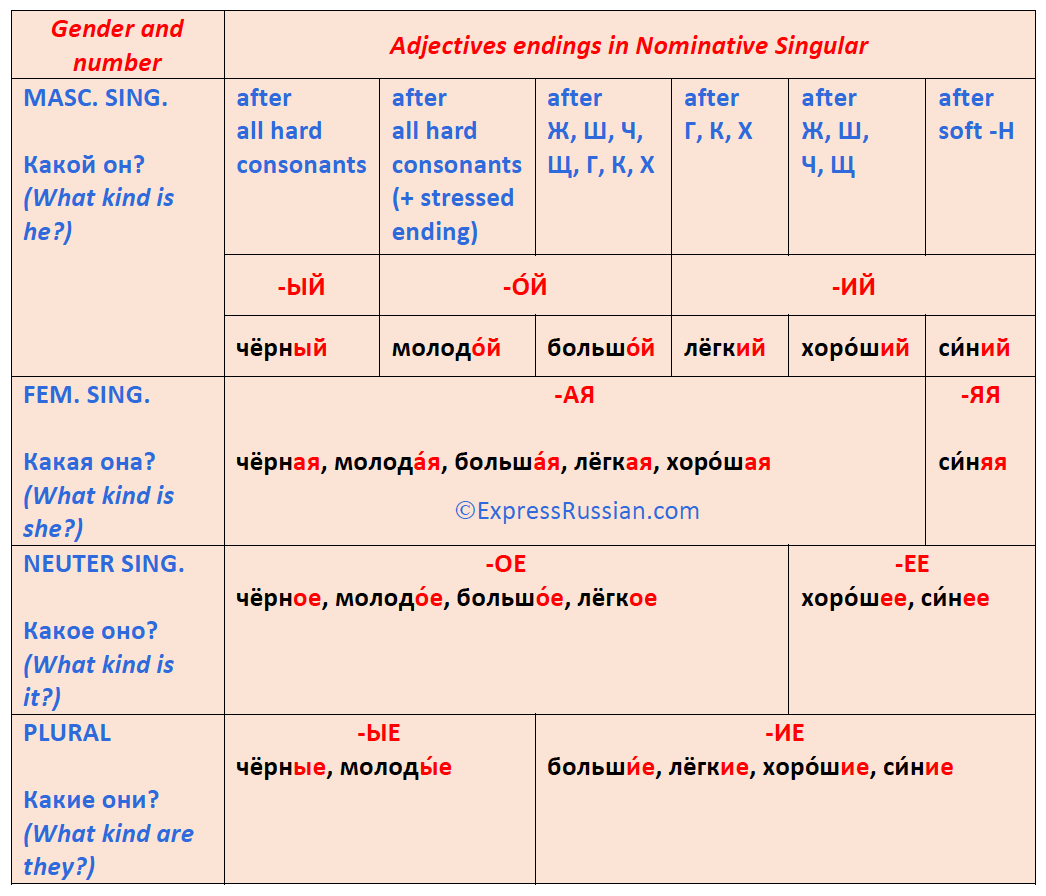
The main takeaway is the 7-letter spelling rule: After the consonants г, к, х, ж, ч, ш, щ, you cannot write the letter ы. You must write и instead. This is why we have хороший (not хорошый) and хорошие (not хорошые).
4. Practice
Let's try putting this into practice. For each pair, change the adjective in parentheses to agree with the noun.
(но́вый)+компью́тер(m.) → ?(интере́сная)+кни́га(f.) → ?(хоро́шее)+кино́(n.) → ?(но́вые)+видеои́гры(pl.) → ?(большо́й)+дом(m.) → ?(ма́ленькая)+иллюстра́ция(f.) → ?
Click to check your answers
но́вый компью́теринтере́сная кни́гахоро́шее кино́но́вые видеои́грыбольшо́й домма́ленькая иллюстра́ция
Excellent! You're now able to describe nouns using adjectives.
Conclusion
In this lesson, you've learned one of the most fundamental rules of Russian grammar.
Key Takeaways:
- Adjectives must agree with nouns in gender and number (and case).
- The basic endings in the nominative case are:
- Masculine: -ый, -ий, -ой
- Feminine: -ая, -яя
- Neuter: -ое, -ее
- Plural: -ые, -ие
- The choice between endings like
-ый/-ийdepends on spelling rules related to the adjective's stem.
Preview of the next lesson:
Now that you can make adjectives agree in the nominative case (e.g., Э́то интере́сная кни́га), the next logical step is to use them as direct objects. In the next lesson, we will learn how to match adjective endings to noun gender in the accusative case, so you can say "I am reading an interesting book" (Я чита́ю интере́сн**ую** кни́г**у**).