Здравствуйте!
In our last lesson, we finished our tour of the prepositional case by learning how to talk about topics using the preposition о. As promised, we are now moving on to a new and incredibly useful grammatical case: the Dative case, or Да́тельный паде́ж.
The Dative case is often called the "case of the indirect object" or the "case of the recipient." It answers the questions Кому́? (To whom?) and Чему́? (To what?). This case is essential for expressing who receives an action, who benefits from something, or who is experiencing a certain state or feeling.
Today's lesson focuses on the foundational mechanics. Our goal is to form the dative case of nouns and personal pronouns. We'll learn the specific endings and forms for all genders. Mastering these forms now will make the upcoming lessons—where we use the dative case to express likes, needs, and age—much smoother.
1. Dative Personal Pronouns
Let's begin with personal pronouns. They are a small, closed set of words, so it's most effective to memorize them. They are also extremely common in speech.
To get started, let's watch a very clear and focused video that introduces all the personal pronouns in their dative form.
RUSSIAN PERSONAL PRONOUNS. (Dative Case)
This short video from the 'Learn Russian Now! with Anastasia' channel presents the dative forms of all personal pronouns.
Watch the video from the beginning to 01:19, and then review the forms again from 02:16 to 03:00. Pay close attention to the pronunciation of each form.
Here are the pronouns in a table for your notes. Notice that он (he) and оно (it, neuter) share the same dative form, ему́.
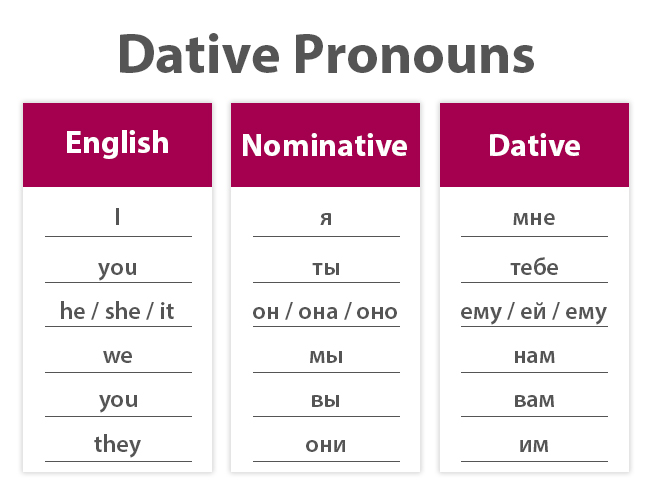
For quick reference, here is the list again:
| Nominative (Who?) | Dative (To whom?) |
|---|---|
| я (I) | мне |
| ты (you, informal) | тебе́ |
| он (he) / оно́ (it) | ему́ |
| она́ (she) | ей |
| мы (we) | нам |
| вы (you, formal/plural) | вам |
| они́ (they) | им |
Take a few minutes to say these out loud and begin committing them to memory. In our next lesson, you'll immediately start using forms like мне and тебе́.
2. Dative Noun Endings
Now, let's move on to nouns. Like with other cases, the dative ending depends on the noun's gender and its final letter in the nominative form. The rules are quite regular.
Let's start with a video that gives a quick overview of how nouns change.
The channel 'Russian with Victoria' provides a good auditory introduction to the dative endings for all noun genders.
Watch from 00:12 to 02:53. Listen for how the endings of masculine, feminine, and neuter nouns change. Don't worry about catching every detail; we will break it down in writing next.
Now, we'll use a detailed article to study the rules systematically, gender by gender.
Learn the Russian dative case (50+ simple examples)
The following article, 'Learn the Russian dative case', has excellent, clearly separated sections for forming the dative case for each noun gender. We'll go through them one by one.
Please read the following three sections from the article in this order: 'Masculine nouns': Note the simple rule for nouns ending in a consonant. 'Neuter nouns': See how the rule is very similar to masculine nouns. 'Feminine nouns': This is slightly more complex. Pay attention to how nouns ending in -а, -я, and -ь change.
Let's summarize those rules. This image provides a great visual breakdown of the singular endings.

Summary of Dative Singular Endings:
-
Masculine & Neuter Nouns: The rule is the same for both.
- If the noun ends in a consonant or -о, change the ending to -у.
- студе́нт → студе́нту
- окно́ (window) → окну́
- If the noun ends in -й, -ь (masc.), or -е, change the ending to -ю.
- музе́й (museum) → музе́ю
- учи́тель (teacher) → учи́телю
- мо́ре (sea) → мо́рю
- If the noun ends in a consonant or -о, change the ending to -у.
-
Feminine Nouns:
- If the noun ends in -а or -я, change the ending to -е.
- кни́га (book) → кни́ге
- земля́ (earth) → земле́
- If the noun ends in -ия or -ь (fem.), change the ending to -и.
- Росси́я (Russia) → Росси́и
- тетра́дь (notebook) → тетра́ди
- If the noun ends in -а or -я, change the ending to -е.
3. Irregular Nouns and Special Cases
As with most grammatical rules, there are a few important exceptions. The words for "mother" and "daughter" are irregular in the dative case. Additionally, some masculine nouns lose a vowel when the ending is added, a phenomenon sometimes called a "fleeting vowel."
This next resource clearly lays out these exceptions.
How to use the dative case in Russian? - Mango Languages
The Mango Languages article on the dative case has excellent tables for the most common irregular nouns. It's crucial to memorize these.
First, read the small section 'Changes to vowels in the dative' to see the 'fleeting vowel' example with 'отец' (father). Then, study the table under 'Russian irregular nouns in the dative case' for 'мать' (mother) and 'дочь' (daughter).
Here are the key irregulars to remember:
- мать (mother) → ма́тери
- дочь (daughter) → до́чери
- оте́ц (father) → отцу́ (vowel -е- is dropped)
4. Check Your Understanding
Let's practice forming the dative case. Change the following nouns and pronouns from their nominative form to the dative singular.
- друг (friend, masc.)
- А́нна (Anna, fem.)
- писа́тель (writer, masc.)
- зда́ние (building, neut.)
- ты (you, informal pronoun)
- мать (mother, irregular fem.)
- игра́ (game, fem.)
- они́ (they, pronoun)
Click for answers
- дру́гу (ends in consonant → -у)
- А́нне (ends in -а → -е)
- писа́телю (ends in -ь → -ю)
- зда́нию (ends in -е → -ю)
- тебе́ (pronoun)
- ма́тери (irregular)
- игре́ (ends in -а → -е)
- им (pronoun)
Conclusion
Excellent work! You have just learned the complete set of rules for forming the dative case for both nouns and personal pronouns. This is a crucial mechanical skill that underpins many conversational structures in Russian.
Key Takeaways:
- Personal pronouns have unique dative forms that must be memorized (e.g., я → мне, ты → тебе́).
- Masculine and neuter nouns generally take a -у or -ю ending in the dative singular.
- Feminine nouns generally take an -е or -и ending in the dative singular.
- A few common nouns, like мать and дочь, have irregular dative forms (ма́тери, до́чери).
Preview of the next lesson:
Now that you know how to form the dative case, you're ready to learn why and when to use it. In our next lesson, we will use these new forms to express feelings and physical states, using common phrases like Мне хо́лодно (I am cold) and Ему́ ве́село (He is having fun).