Introduction
Здравствуйте! (Hello!) In our last lesson, you successfully started blending letters to read your first Russian words. We ended with a preview of two crucial pronunciation concepts: word stress and how it affects vowel sounds. You might recall we noted that the letter 'о' often sounds like 'а'.
Today, we'll dive deep into that phenomenon. Our goal is to apply the rules of vowel reduction for unstressed vowels, focusing on the most common and important one: how the letter 'о' changes its sound. This rule, known in Russian as а́канье (ákanye - "a-ing"), is fundamental. Mastering it will be one of the biggest single improvements you can make to your pronunciation, helping you sound much more natural right from the start.
What is Vowel Reduction?
In English, we also change how we pronounce vowels depending on whether they are stressed. Think of the word "photograph". The first 'o' is stressed and clear, while the second 'o' is unstressed and reduces to a weak, neutral sound: "pho-tuh-graph".
Russian takes this principle and applies it systematically. In any Russian word with more than one syllable, only one vowel is stressed. It is pronounced clearly and with emphasis. All other vowels are "reduced"—they are pronounced more quickly and their sound often changes.
Let's begin by getting a clear overview of the main rule concerning the vowel 'о'.
Stop Saying О! Learn Akanye — Russian’s #1 Pronunciation Rule
The video 'Stop Saying О! Learn Akanye' from the Learn Russian with Denis Fedorov channel provides an excellent introduction to this concept. It explains why unstressed 'о' changes its sound and gives you a chance to hear the difference.
Watch the video from the beginning until 03:35. Pay close attention to the core rule: unstressed 'o' is pronounced like a short 'a' sound. Repeat the example words along with the speaker to start training your pronunciation.
As the video explains, the basic rule is simple:
- If 'о' is stressed, it sounds like the 'o' in "go". Example: до́м (house).
- If 'о' is unstressed, it sounds like a short 'a'. Example: вода́ (water), pronounced [va-DÁ].
The Nuances: Degrees of Reduction
Now, let's refine that rule. The sound of an unstressed 'o' isn't always identical. Its pronunciation depends on its position relative to the stressed syllable. Linguists call this "degrees of reduction."
- First-Degree Reduction: This applies to the syllable immediately before the stress. Here, the 'о' reduces to a clear, short [a] sound, similar to the 'u' in "fun".
- Second-Degree Reduction: This applies to all other unstressed syllables (e.g., two syllables before the stress, or any syllable after the stress). Here, the 'о' reduces even further to a very short, neutral vowel sound called a schwa ([ə]). This is the sound you hear at the end of the English word "sofa".
Let's see how this works in practice.
Stop Saying О! Learn Akanye — Russian’s #1 Pronunciation Rule
Let's continue with the same video, which now breaks down these degrees of reduction using excellent examples.
Watch from 03:35 to 07:53. The speaker analyzes the words 'молоко́' (milk) and 'хорошо́' (good) syllable by syllable. Notice how the pronunciation of 'o' changes based on its distance from the stress.
The word молоко́ (milk) is the classic example for this rule. Let's visualize it:
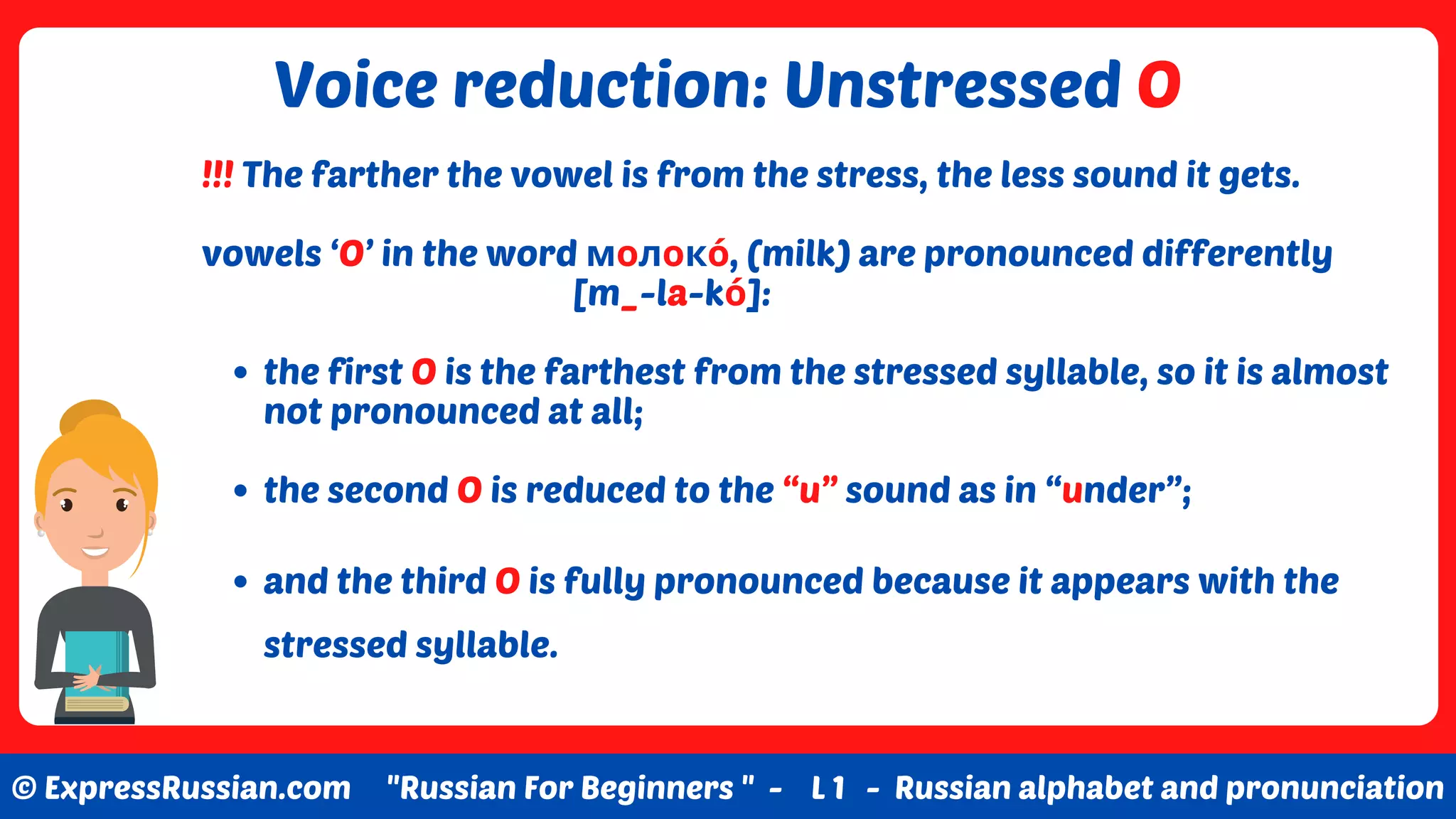
So, for молоко́:
- The last о is stressed: [KO].
- The middle о is right before the stress (1st degree): [lа].
- The first о is two syllables before the stress (2nd degree): [m(ə)].
- Putting it together: [m(ə)-la-KO].
A Simple Rule of Thumb for Beginners
Understanding the degrees of reduction is useful, but it can feel complex when you're just starting. Here is a very effective, simplified rule that will work well in most situations, especially when speaking at a normal pace.
Stop Saying О! Learn Akanye — Russian’s #1 Pronunciation Rule
The same video offers a great simplification to make this rule easier to apply in practice.
Watch from 07:53 to 09:09 to learn a practical rule of thumb for pronouncing unstressed 'o'.
Here is the simplified rule:
- Pronounce unstressed 'o' as a short 'a' sound (like in "sun") in any syllable before the stress.
- Pronounce unstressed 'o' as a schwa sound (like in "about") in any syllable after the stress.
Let's apply this:
- хорошо́ [kha-ra-SHO]: Both unstressed 'o's are before the stress, so they sound like 'a'.
- го́род [GO-r(ə)t]: The unstressed 'o' is after the stress, so it sounds like a schwa.
Practice Your Pronunciation
Now it's time to apply what you've learned. The following resource provides a list of words and, crucially, audio recordings so you can check your pronunciation.
The webpage 'LESSON 17: VOWEL REDUCTION' from GW2RU has a great set of practice exercises with audio.
Scroll down to 'Task 1'. First, try to read the six words (мя́со, Москва́, я́блоко, гора́, окно́, соба́ка) aloud yourself, paying close attention to the unstressed 'о'. Then, click the audio player to listen and compare. Repeat each word several times after the recording.
What About Other Vowels?
The learning outcome for this lesson covers unstressed vowels in general, and 'о' is the most dramatic example. However, other vowels also reduce, though often more subtly.
The vowels 'е' and 'я' also change when unstressed. They are typically pronounced like a short 'и' [i].
- Example: сестра́ (sister) is pronounced [s(i)-STRÁ].
- Example: язы́к (language) is pronounced [yi-ZYK].
You can see more examples of this in the tables on the "LESSON 17" webpage (LINK). We won't focus on this today, because the reduction of 'e' and 'я' is closely tied to the concept of "soft" consonants, which is the topic of our very next lesson!
Conclusion
Great job today! You've tackled the most important pronunciation rule in the Russian language. Internalizing this will make a massive difference in how well you're understood.
Key Takeaways:
- In Russian, only stressed vowels are pronounced fully. Unstressed vowels are reduced.
- The primary rule is 'аканье': an unstressed 'о' is pronounced like an 'а'.
- The sound changes slightly based on position: the syllable before the stress gets a short 'a' sound, while other unstressed syllables get a weaker 'schwa' sound.
- For practice, a good rule of thumb is to pronounce any 'o' before the stress as 'a', and any 'o' after the stress as a schwa.
In our next lesson, we will explore palatalization, the process of "softening" consonants. You'll learn how consonants change their sound when they come before the vowels е, ё, и, ю, and я, and we'll revisit the reduction of 'e' and 'я' in that context.