Здравствуйте! Welcome back.
In our last lesson, you learned how to start and end a conversation with essential greetings like Здравствуйте and Привет, and farewells like До свидания and Пока. You saw how the choice between them depends on the formal (вы) or informal (ты) context.
Now that you can say hello, the next logical step is to introduce yourself. Today's lesson focuses on exactly that. Our goal is to learn how to introduce yourself using 'Меня зовут...' and ask for someone's name. This is a fundamental skill for any first meeting.
1. The Core Phrases for Introductions
Let's dive right into the most common way to state your name and ask for someone else's. As you'll see, your choice of words will again depend on whether you're in a formal or informal situation.
The main phrase you'll use to introduce yourself is:
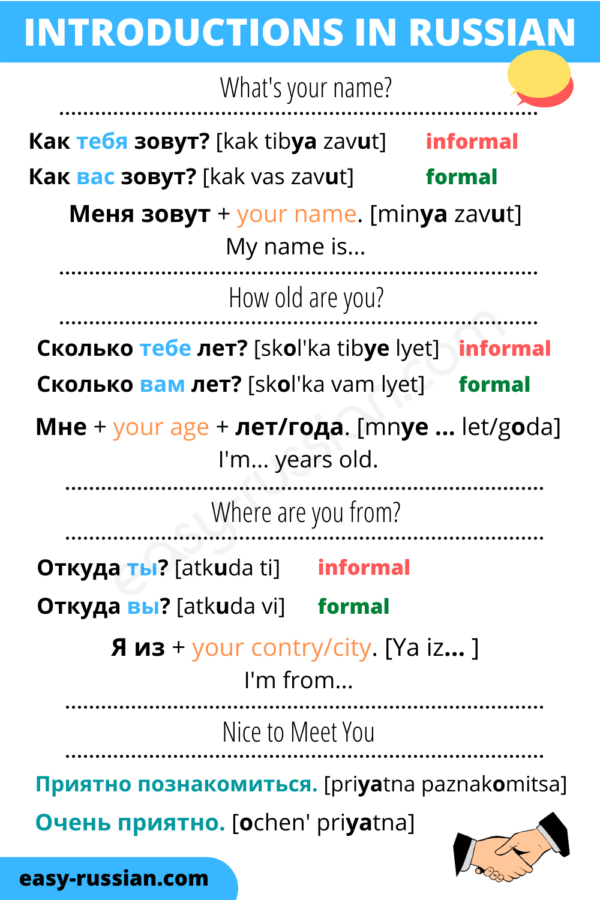
Меня́ зову́т... (Menyá zavút...) — My name is...
To ask someone for their name, you have two options:
- Informal: Как тебя́ зову́т? (Kak tebyá zavút?) — What is your name? (used with ты)
- Formal: Как вас зову́т? (Kak vas zavút?) — What is your name? (used with вы)
Notice the use of тебя́ for informal situations and вас for formal ones. This directly parallels the ты/вы distinction we've been practicing.
To hear these phrases spoken in a clear, conversational context, please watch the following short video clip.
How to properly introduce yourself in Russian
The video 'How to properly introduce yourself in Russian' from the channel Be Fluent in Russian provides a quick and clear demonstration of these essential phrases.
Watch from 01:11 to 02:16. The speaker will model how to say 'My name is...' and how to ask the question back, explaining the formal/informal difference.
This handy visual guide summarizes the key phrases for introductions.
2. Understanding the Structure
You might be wondering about the grammar behind "Меня зовут". It's not a direct one-to-one translation of "My name is". A literal translation offers a useful insight into how the language works.
- Зовут is a form of the verb звать (zvat'), which means "to call".
- Меня is a form of я (I/me).
- Тебя is a form of ты (you).
- Вас is a form of вы (you).
So, when you say "Меня зовут...", you are literally saying "They call me...". Likewise, "Как тебя/вас зовут?" literally means "How do they call you?"
This structure is very common in Russian, where feelings or states are often expressed as happening to you, rather than being something you are. You don't need to memorize the grammar details right now, but understanding the literal meaning can help the phrase stick in your memory.
The next video explains this concept clearly.
Lesson 20: INTRODUCE YOURSELF in Russian 🙋♀️ My Name 🙋♂️ Nice to Meet You | Russian Comprehensive
In 'Lesson 20: INTRODUCE YOURSELF in Russian', the instructor breaks down the phrases grammatically, which will give you a deeper understanding.
Please watch the following segments: 02:04 - 03:24: This part covers the formal 'Как Вас зовут?' and informal 'Как тебя зовут?'. 03:24 - 04:46: Here, the video explains the literal meaning 'They call me...' by looking at the verb 'звать'. 04:46 - 05:15: Participate in the interactive practice to test your recall.
3. Putting It Into a Conversation
Now, let's see how these phrases fit into a short, natural dialogue. When someone introduces themselves to you, you can respond with "And my name is..." using the conjunction а.
For example:
— Привет! Меня зовут Анна. А тебя как зовут? (Hi! My name is Anna. And what's your name?)
— Привет! А меня зовут Пётр. (Hi! And my name is Pyotr.)
A crucial follow-up to any introduction is saying "Nice to meet you." The most common way to say this is:
О́чень прия́тно. (Óchen' priyátno.) — Nice to meet you. (Literally: "Very pleasant.")
Let's examine a short dialogue that puts this all together.
Self Introductions/Basic Greetings - RussianPod101
The resource 'Self Introductions/Basic Greetings' from RussianPod101 presents a clear, formal dialogue. It will help you practice reading and see how to use 'Очень приятно'.
First, find the section 'Dialogue - Russian' at the very top and read the short formal exchange between Oksana and Erik. Then, scroll down to the 'Lesson Notes' and read the explanation for 'Меня зовут' and 'Очень приятно' (starting from 'Let's take a look at the first formal dialogue:').
4. Cursive Practice
Let's practice writing what you've learned. Mastering cursive is one of your key goals, and applying it to conversational phrases is the best way to make it useful.
Here is a snippet from a handwriting guide showing an introduction in cursive.
Russian Handwriting and Pronunciation Guide
This PDF guide contains an excellent example of a handwritten introductory dialogue.
Please open the PDF and scroll to page 6. Find 'ЗАДАНИЕ № 6 (ШЕСТЬ)'. In the box at the bottom right, you will see a handwritten dialogue that starts with 'Скажите, пожалуйста, как вас зовут?'.
The dialogue says:
— Скажите, пожалуйста, как вас зовут? (Tell me, please, what is your name?)
— Меня зовут Павел, или Паша. А вас? (My name is Pavel, or Pasha. And you?)
— А меня зовут Надежда. (And my name is Nadezhda.)
— Очень приятно! (Nice to meet you!)
Now, it's your turn. On a piece of paper, try writing out the following exchange, but replace the names with your own and mine (you can call me Алекс).
— Как тебя зовут?
— Меня зовут [Your Name]. А тебя?
— А меня зовут Алекс. Очень приятно!
This exercise combines comprehension, personalization, and cursive practice all in one.
Conclusion
Great work! You have now learned one of the most important conversational skills in any language: how to introduce yourself and ask for someone's name.
Key Takeaways:
- To state your name, use: Меня́ зову́т [Имя].
- To ask for someone's name informally, use: Как тебя́ зову́т?
- To ask for someone's name formally, use: Как вас зову́т?
- A polite and essential follow-up is: О́чень прия́тно. (Nice to meet you.)
- The literal meaning of "Меня зовут" is "They call me," which is a common grammatical pattern in Russian.
You can now greet someone and exchange names. In our next lesson, we will continue building our first conversation by learning how to ask and answer the questions "How are you?" and "Where are you from?"