Здравствуйте! Welcome back to our course.
In the last lesson, we focused on giving commands and making requests using the imperative mood, learning forms like читай! (read!) and помогите! (help!). This gave you the tools to direct action. Now, we're going to learn how to connect your ideas into more complex and meaningful sentences. Simple statements are useful, but the real power of a language comes from explaining why, contrasting ideas, and setting events in time.
Today's lesson will focus on three essential Russian conjunctions:
- но (but) - for contrast
- потому что (because) - for explaining reasons
- когда (when) - for linking events in time
Mastering these will be a major step in making your Russian sound more natural and fluent, allowing you to build richer sentences about your studies, hobbies, and opinions.
1. Expressing Contrast: Но (but)
The most common way to express contrast or an unexpected outcome is with the conjunction но (but). It connects two parts of a sentence where the second part opposes or contradicts the first.
To get a formal introduction to how conjunctions work, let's start with a short reading.
Understanding Russian Conjunctions: How to Connect Sentences ...
The article 'Understanding Russian Conjunctions' from the Polyglottist Language Academy provides a great overview of why these words are so important.
Please read the sections 'Why Conjunctions Matter in Russian' and '1. Coordinating Conjunctions (Сочинительные союзы)'. As you read, focus on the example for 'Но (but)' and its description as showing a 'stronger contrast, often unexpected'.
As the article mentions, но signals a strong contrast. For example:
- Русский язык трудный, но интересный. (The Russian language is difficult, but interesting.)
- Я хотел пойти в кино, но остался дома. (I wanted to go to the movies, but I stayed home.)
A Quick but Important Detour: Но vs. А
You will frequently encounter another conjunction, а, which can also be translated as "but" or "and." It's crucial to understand the difference to avoid common mistakes.
- Но implies opposition or an unexpected turn. The two clauses are in some kind of conflict.
- А implies a simple contrast or comparison, often joining two parallel but different facts.
This infographic provides a perfect visual summary.
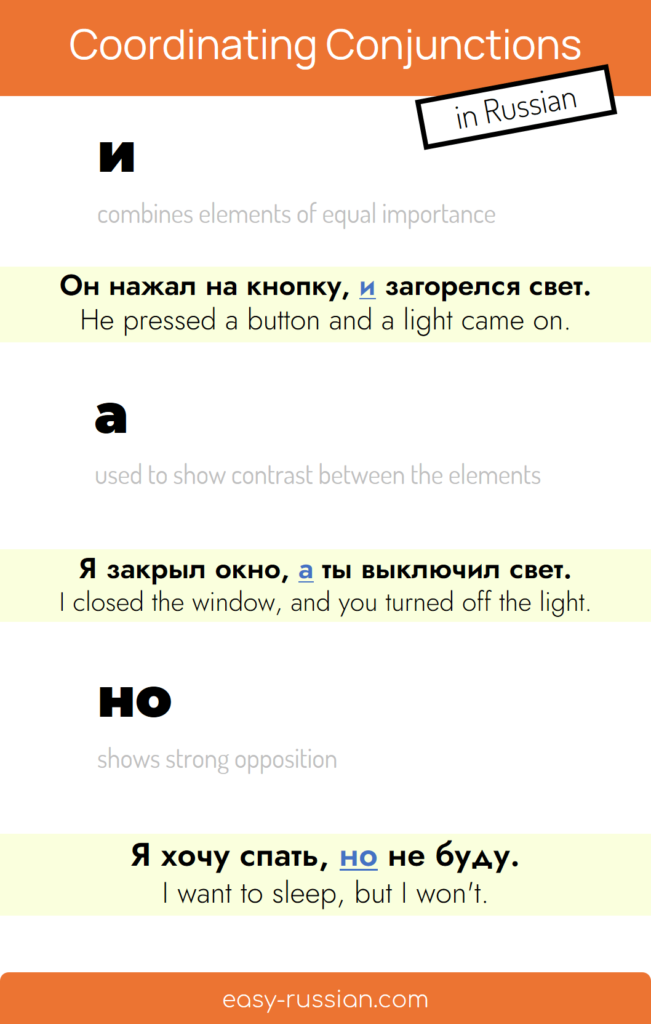
Let's use your interests as an example:
Я хочу играть в видеоигры, **но** мне нужно делать домашнее задание.(I want to play video games, but I have to do homework.) -> This shows an opposition between desire and obligation.Я люблю рисовать, **а** мой брат любит программировать.(I like to draw, and/but my brother likes to program.) -> This is a simple comparison of two different facts. There is no conflict.
2. Explaining Reasons: Потому что (because)
When you want to explain the reason or cause for something, you'll use the conjunction потому что (because). It's pronounced as one word: [patamUSHTa].
The clause with потому что explains why the first part of the sentence is true. Let's watch a video that explains this and points out a critical distinction to avoid a very common error.
How to use ПОТОМУ ЧТО in a sentence
The channel 'Be Fluent in Russian' offers an excellent explanation of потому что and contrasts it with a similar-looking word.
First, watch from the beginning to 01:13 to see the basic use of потому что. Then, jump to the crucial explanation from 03:39 to 05:20. Pay very close attention to the difference between потому что (because) and поэтому (that's why).
To summarize that key point:
-
Потому что (because) introduces the reason.
Я не пошёл в университет, **потому что** я заболел.(I didn't go to the university because I got sick.)
-
Поэтому (that's why/so) introduces the result or consequence.
Я заболел, **поэтому** я не пошёл в университет.(I got sick, that's why I didn't go to the university.)
Thinking in terms of cause and effect can help. With your background in chemical engineering, you're familiar with identifying cause-and-effect relationships in processes. The same logic applies here:
- Cause:
Я много работал.(I worked a lot.) - Effect:
Я устал.(I am tired.)
We can connect them in two ways:
- Effect + потому что + Cause:
Я устал, **потому что** я много работал. - Cause + поэтому + Effect:
Я много работал, **поэтому** я устал.
Here's an example related to your hobbies:
Я люблю эту игру, **потому что** у неё красивая графика.(I love this game because it has beautiful graphics.)
3. Linking Actions in Time: Когда (when)
Our final conjunction for today is когда (when). It's used to link two actions based on time. Interestingly, how you use когда interacts with verb aspect (imperfective vs. perfective), which you studied in Module 10.
This video demonstrates the three main temporal relationships you can express with когда.
25 Russian conjunctions: because, and, but, if, that, or, while, etc.
The video '25 Russian conjunctions' by Lina's Lessons has a great segment on когда.
Watch from 05:27 to 06:40. Notice how the verb aspects change the meaning of the sentence: Simultaneous Actions: Using two imperfective verbs. Sequential Actions: Using two perfective verbs (one action is completed, then the next begins). Interrupted Action: An imperfective (ongoing) action is interrupted by a perfective (single-moment) action.
Let's recap those patterns:
- Simultaneous Actions (at the same time):
Когда я **рисовал** (imp.), я **слушал** (imp.) музыку.(While I was drawing, I was listening to music.)
- Sequential Actions (one after the other):
Когда я **нарисовал** (perf.) картину, я **пошёл** (perf.) гулять.(When I finished drawing the picture, I went for a walk.)
- Interrupted Action:
Когда я **играл** (imp.) в игру, мне **позвонил** (perf.) друг.(While I was playing a game, my friend called me.)
This is a fantastic example of how different parts of Russian grammar—conjunctions and verb aspects—work together to create precise meaning.
4. Practice
Let's put it all together. Combine the following pairs of sentences using но, потому что, or когда. Think carefully about the relationship between the ideas.
Я хочу посмотреть фильм. У меня много работы.Я играю в Stardew Valley. Я хочу расслабиться (relax).Я приду домой. Я тебе позвоню.(Make this a sequential action: first come home, then call).Она хорошо рисует. Она не любит фотографировать.(Is this opposition or simple contrast?)
Click for answers and explanations
- Я хочу посмотреть фильм, но у меня много работы. (I want to watch a film, but I have a lot of work.) The relationship is one of opposition.
- Я играю в Stardew Valley, потому что я хочу расслабиться. (I play Stardew Valley because I want to relax.) The second sentence explains the reason for the first.
- Когда я приду домой, я тебе позвоню. (When I get home, I will call you.) This shows a sequence of events.
Придуandпозвонюare both perfective verbs, indicating completed actions. - Она хорошо рисует, а она не любит фотографировать. (She draws well, but/and she doesn't like to take photos.) Here, а is more appropriate than но. It's a simple contrast between two facts about her, not a strong opposition.
Conclusion
Great job today! You've learned how to weave simple ideas into more elaborate sentences, which is a key skill for moving beyond basic conversations.
Key Takeaways:
- Use но to express a strong contrast or an unexpected outcome. Remember to use а for simple comparisons.
- Use потому что to introduce the cause or reason for an action. Be careful not to confuse it with поэтому, which introduces the result.
- Use когда to connect actions in time. The meaning can change depending on the verb aspect you use (simultaneous, sequential, or interrupted actions).
Preview of the next lesson:
Now that you can connect your ideas, we'll expand on how you talk about your hobbies. We will learn a new, very common verb, увлекаться (to be keen on/into), which uses the instrumental case. This will allow you to say things like "Я увлекаюсь видеоиграми" (I'm into video games) or "Я увлекаюсь иллюстрацией" (I'm passionate about illustration), giving you a more sophisticated way to describe your interests.