Здравствуйте!
In our last lesson, we focused on the preposition в and learned how to use it to say someone or something is inside an enclosed space, like в магазине (in the store) or в городе (in the city). As you saw, this covers many situations, but not all.
Today, we'll explore its counterpart, the preposition на (on, at). By the end of this lesson, you will be able to use на with the prepositional case to describe being on a surface (like на столе - on the table) or at an event (на концерте - at a concert). Mastering the difference between в and на is a key step toward sounding natural in Russian.
1. The Two Core Meanings of на
While в generally implies being "inside," на has two primary uses when talking about location:
- To indicate something is on a surface.
- To indicate someone is at an event or in an open space.
Let's start with a video that introduces these concepts clearly.
Prepositions В and На | Russian Language
The speaker in this video from the 'Be Fluent in Russian' channel does an excellent job of breaking down the fundamental uses of на.
Watch from 05:41 to 08:51. Pay close attention as the speaker explains the two main uses: 1) for being on the surface of something, and 2) for being at an event. He gives the exact examples that are the focus of our lesson: 'on the table' and 'at the concert'.
This gives us a solid foundation. Let's look at each of these uses more closely.
2. Rule 1: на for Surfaces
The most literal meaning of на is "on," referring to a position on a surface. This is quite direct and similar to English.
стол(table) →Книга на стол**е**.(The book is on the table.)стена(wall) →Картина на стен**е**.(The picture is on the wall.)пол(floor) →Кошка на пол**у**.(The cat is on the floor.) - Note:полis one of those single-syllable masculine nouns that takes a-уending.
This image provides a perfect visual for this rule.

To reinforce this, let's look at a short reading that also provides audio pronunciation.
The Russian Prepositional Case, and Going Places
The article 'The Russian Prepositional Case, and Going Places' from RussianLessons.net has a useful section that contrasts в and на and includes audio examples.
Read the section 'Using prepositions and the prepositional case.' Focus on the explanation for на and the examples Что на столе? (What is on the table?) and На столе книга и карандаш (On the table is a book and a pencil). You can click the play icons on the site to hear them pronounced.
3. Rule 2: на for Events and Open Spaces
This is where на becomes more abstract. It's used for being at an event. This is a rule you'll largely need to learn through exposure and memorization, but the pattern is consistent.
концерт(concert) →Мы были на концерт**е**.(We were at a concert.)урок(lesson) →Я сейчас на урок**е**.(I am at a lesson now.)работа(work) →Папа на работ**е**.(Dad is at work.)
Given your interest in illustration and writing, you might find this useful:
выставка(exhibition) →Она на выставк**е**.(She is at the exhibition.)
This rule also extends to open, non-enclosed spaces. The classic example is:
улица(street) →Мы встретились на улиц**е**.(We met on the street.)
This contrasts with being в здании (in a building). The street is seen as an open area.
Let's watch another video that gives many more examples of на used with events.
В or НА? Which Preposition & When to use?
The 'Russian with Nastya' channel provides excellent, context-rich examples for using на with events and work/school activities.
Please watch two segments: From 09:36 to 13:12: This covers social events like parties (на вечеринке), concerts (на концерте), and exhibitions (на выставке). From 14:19 to 16:16: This covers school and work contexts, like being at an exam (на экзамене), at a lesson (на уроке), and at work (на работе).
4. A Quick Reference Guide
It can be tricky to remember which places take в and which take на. This chart is an excellent tool to help you. It organizes many common locations under the correct preposition.
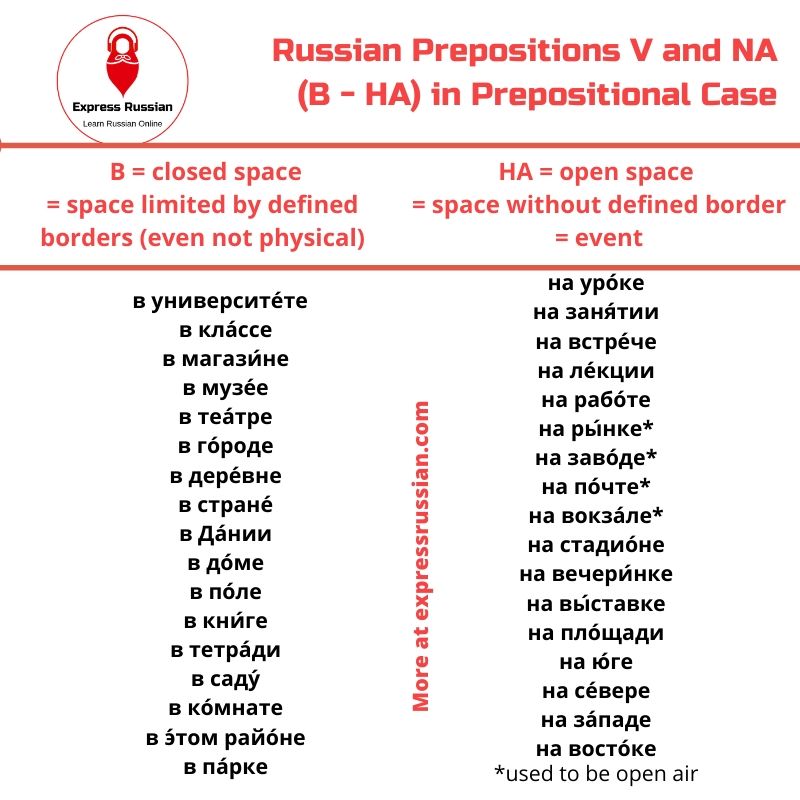
Notice how many words for events (концерт, урок, спектакль) and open spaces (улица, стадион, рынок) are in the на column.
Practice Time!
Now it's your turn. Choose the correct preposition (в or на) and put the noun in parentheses into the prepositional case.
- Моя ручка лежит ... (стол).
- Вчера я был ... (концерт).
- Мои друзья живут ... (Петербург).
- Художник ... (выставка).
- Мы сидим ... (комната).
- Ты сейчас ... (работа)?
Click for answers
- Моя ручка лежит на столе. (My pen is lying on the table.)
- Вчера я был на концерте. (Yesterday I was at a concert.)
- Мои друзья живут в Петербурге. (My friends live in St. Petersburg.)
- Художник на выставке. (The artist is at the exhibition.)
- Мы сидим в комнате. (We are sitting in the room.)
- Ты сейчас на работе? (Are you at work now?)
Conclusion
Отличная работа! (Excellent work!) You've now learned the two most common prepositions of location in Russian.
Key Takeaways:
- Use
наwhen something is on a surface (e.g.,на столе). - Use
наwhen someone is at an event or in an open space (e.g.,на концерте,на улице). - Use
вwhen something or someone is inside an enclosed space, building, city, or country (e.g.,в доме,в Москве).
Preview of the next lesson:
In our next lesson, we will put all this together. You'll practice using both в and на to build more complex sentences and describe where you live, work, and study, like a true Russian speaker.