Здравствуйте!
In our last lesson, we focused on expressing your point of view with phrases like Я думаю, что... (I think that...). This was a big step toward sharing your thoughts. Today, we open a new, essential chapter in Russian grammar that will allow you to describe the world in a new way: by specifying location and topic.
This lesson introduces the Prepositional Case (Предложный падеж). As you learned last time, to talk about something, you might say "Я думаю о...". That о (about) is a preposition, and the word that follows it must change. This is the prepositional case in action! Our goal today is to learn how to form the prepositional case for nouns and personal pronouns.
1. What is the Prepositional Case?
The prepositional case is often called "Case 6". Its name in Russian, Предложный, comes from the word предлог (preposition), because it is the only case that is always used with a preposition.
It primarily answers two questions:
- Где? (Where?) — to describe a location.
- О ком? / О чём? (About whom? / About what?) — to describe the topic of a thought or conversation.
The most common prepositions you'll use with this case are:
- в (in, at)
- на (on, at)
- о / об (about)
Let's begin with a video that explains the main uses of the prepositional case and introduces the rules for changing noun endings.
This video from the 'Lina's Lessons' channel provides a clear introduction to why and when we use the prepositional case, and then walks through the fundamental rules for changing nouns.
Watch from 00:14 to 04:51. The first part (until 01:38) explains the two key meanings: location and topic. The second part (from 01:38 to 04:51) details how to change the endings of masculine, feminine, and neuter nouns.
2. Forming the Prepositional Case for Nouns
As you saw in the video, forming the prepositional case for most singular nouns is straightforward: you change the ending to -е.
Here's a quick summary of the rules for singular nouns:
- Masculine nouns ending in a consonant: Add -е.
стол(table) →на стол**е**(on the table)парк(park) →в парк**е**(in the park)
- Feminine nouns ending in -а or -я: Change -а/-я to -е.
книга(book) →о книг**е**(about the book)Москва(Moscow) →в Москв**е**(in Moscow)
- Neuter nouns ending in -о or -е: Change -о to -е. If it already ends in -е, it doesn't change.
письмо(letter) →в письм**е**(in the letter)море(sea) →в мор**е**(in the sea)
There are also a few important spelling rules for nouns that end in -ий, -ия, -ие, or a soft sign (-ь). For these, the ending becomes -и.
Росс**ия**(Russia) →в Росс**ии**(in Russia)здан**ие**(building) →в здан**ии**(in the building)ночь(feminine, night) →о ноч**и**(about the night)
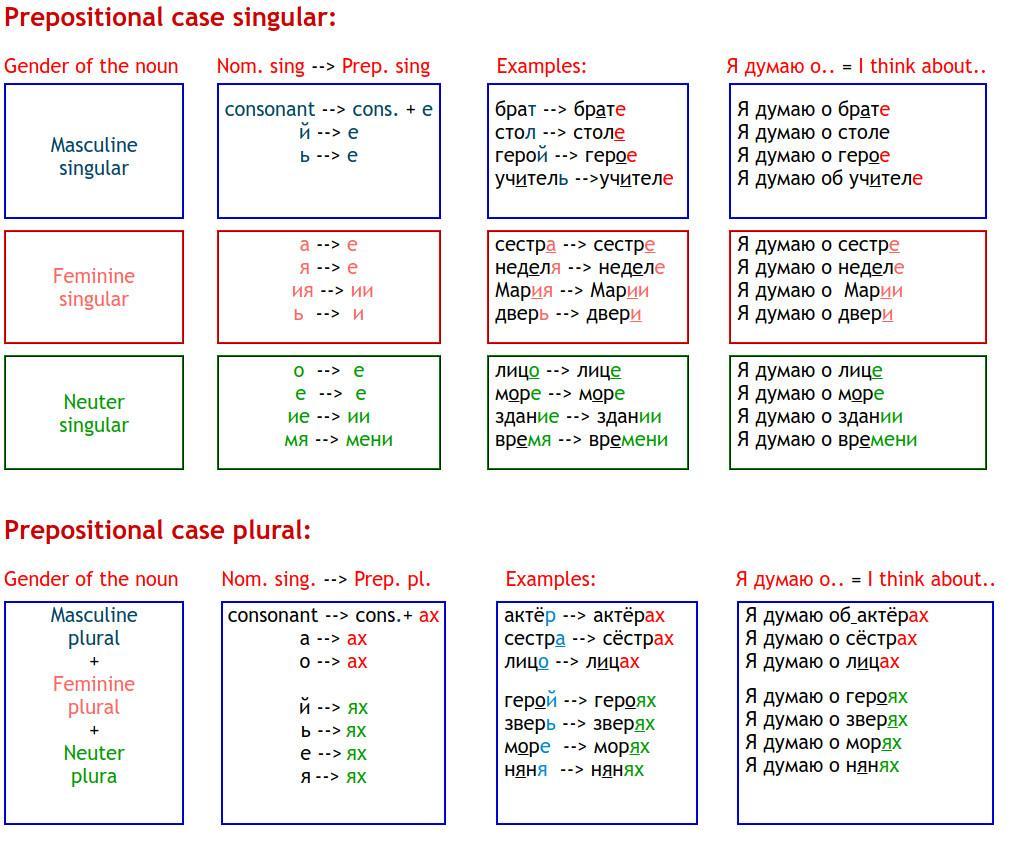
This chart is an excellent reference that summarizes these rules for both singular and plural nouns.
3. Personal Pronouns in the Prepositional Case
Just like nouns, personal pronouns (I, you, he, she, etc.) also have a special prepositional form. You'll need to memorize these, as they are very common.
Here is a clear table showing the pronoun changes.
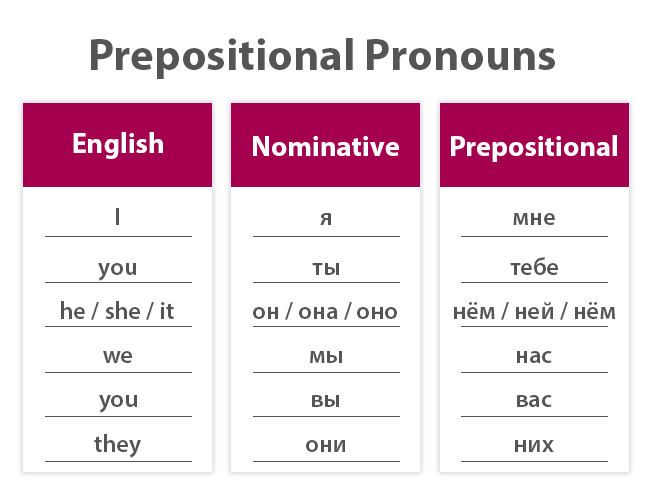
A crucial rule to remember: For pronouns он, она, оно, and они, you must add an н- prefix when they follow a preposition.
он(he) →о **н**ём(about him)она(she) →о **н**ей(about her)они(they) →о **н**их(about them)
You've already seen this in action in the previous module when expressing opinions like Мне кажется (It seems to me). The word мне is the dative case of я. The prepositional form обо мне is another example of how я changes.
4. Plurals and Common Exceptions
Finally, let's cover plural nouns and a few important exceptions you need to know.
-
Plural Nouns: The rule is simple and applies to all genders. The ending becomes -ах or -ях.
столы(tables) →о стол**ах**(about tables)книги(books) →о книг**ах**(about books)моря(seas) →в мор**ях**(in the seas)
-
Masculine Noun Exception (-у ending): A small group of common masculine nouns take an -у ending instead of -е when talking about location (but not topic).
To see these rules in action, let's return to our video resource.
The same video has two short, helpful segments on plurals and the important '-у' ending exception.
First, watch the section on plural nouns from 10:50 to 11:41. Then, watch the section on common exceptions from 13:18 to 14:28. Pay close attention to the masculine nouns that take a '-у' ending, as they are frequently used.
The words в лесу (in the forest), в аэропорту (in the airport), на полу (on the floor), and в шкафу (in the closet/cabinet) are very common, so it's a good idea to start memorizing them.
Practice
Time to practice! Put the word in parentheses into the correct prepositional form.
- Книга лежит на (стол).
- Мы говорим о (фильм).
- Я думаю о (ты).
- Студенты в (университет).
- Они живут в (Россия).
Click for answers
- Книга лежит на столе. (The book is lying on the table.)
- Мы говорим о фильме. (We are talking about the film.)
- Я думаю о тебе. (I am thinking about you.)
- Студенты в университете. (The students are at the university.)
- Они живут в России. (They live in Russia.)
Conclusion
Отлично! You've just learned the fundamental building blocks of the prepositional case.
Key Takeaways:
- The prepositional case is always used with a preposition, most commonly
в,на, orо. - It's used to talk about location (где?) or a topic (о ком/чём?).
- The standard ending for singular nouns is -е. Remember the exceptions for nouns ending in -ия, -ие, and -ь, which take -и.
- A few masculine nouns take an -у ending for location (e.g.,
в лесу). - Personal pronouns have unique forms you need to memorize (
обо мне,о тебе,о нём, etc.). - Plural nouns take the ending -ах or -ях.
Preview of the next lesson:
Now that you know how to form the prepositional case, our next lesson will focus on how to use it. We will dive deeper into the preposition в and use it to describe being inside a location. You will soon be able to form sentences like "I work in an office" or "My keys are in my bag."