Здравствуйте!
In our last lesson, we learned how to form negative sentences using the particle не. You can now confidently say things like "Я не понимаю" (I don't understand) or "Это не книга" (This is not a book).
Today, we move from making statements to asking questions. This lesson focuses on a very common and efficient feature of the Russian language: forming yes/no questions. You'll learn how a simple change in your tone of voice can turn any statement into a question, without changing a single word.
Our goal is to ask yes/no questions using rising intonation. By the end of this lesson, you'll be able to ask questions like "Are you busy?" or "Is this a video game?" just by using your voice.
1. The Simplest Way to Ask a Question
In English, to ask a question, you often have to change the word order or add auxiliary verbs. For example, "This is a house" becomes "Is this a house?" and "You play games" becomes "Do you play games?".
In Russian, it's often much simpler. You can take a statement and, just by changing your intonation, turn it into a question.
How to Ask Questions in Russian: 12 Question Words
Let's start with a quick text from FluentU that introduces this core principle with clear examples.
Please read the section under the heading 'How to Ask Questions in Russian?'. Focus on the part that explains how to ask questions without question words. Notice how the example statements 'Это дом' and 'Ты занят' become questions simply through intonation.
As you saw, the written form is identical except for the question mark.
- Statement: Это дом. (This is a house.)
- Question: Это дом? (Is this a house?)
The magic lies entirely in how you say it. But what exactly is this "question intonation"? Let's break it down.
2. The Russian Question Intonation: IK-3
The specific pattern used for yes/no questions in Russian is called Intonation Construction 3 (IK-3). It's different from the typical rising pitch at the end of a sentence that you might be used to in English.
The key is to identify the most important word in your question—the word you want to focus on. The intonation works like this:
- Start the sentence in your normal, neutral tone.
- When you get to the stressed syllable of the key word, your pitch should rise sharply.
- Immediately after that peak, your pitch should fall back to your neutral tone for the rest of the sentence.
This creates a "peak" or "hump" of intonation on the focus word.
Russian Intonation. Chapter 1 // Русская интонация. Часть 1
The channel 'Sound like a Russian' has an excellent video that explains this concept visually and audibly. It will help you hear and understand the IK-3 pattern.
Please watch from 03:04 to 07:37. The speaker will explain the 'critical point' of intonation and then demonstrate the IK-3 pattern with the example 'Взяла ключи?' (Did she take the keys?). Pay close attention to the contrast she makes with English intonation around the 05:10 mark.
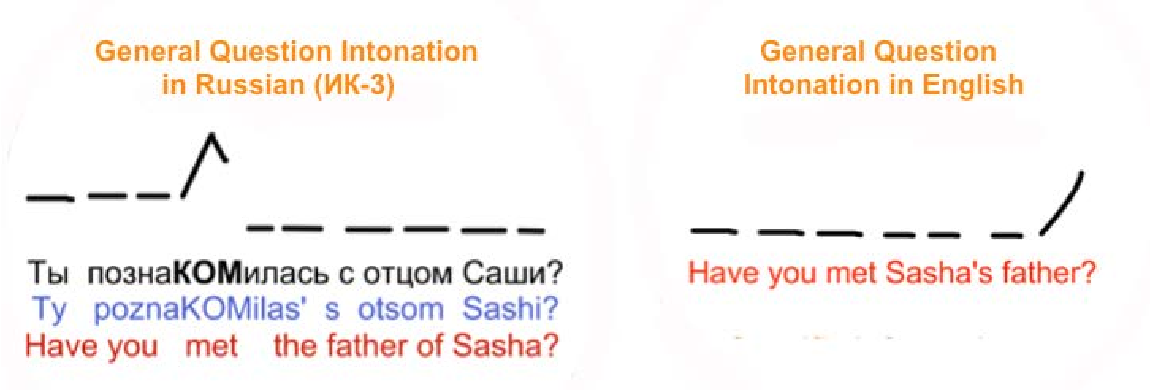
The video highlights the crucial difference:
- English: The pitch tends to rise through to the very end of the sentence.
- Russian (IK-3): The pitch rises on one specific syllable and then falls again.
This visual diagram might help clarify the difference:
3. Changing the Question by Changing the Focus
The power of the IK-3 pattern is that you, the speaker, decide which word is the focus. By placing the intonation peak on different words, you can ask entirely different questions using the exact same sentence.
Let's explore this with an example sentence: Ты вчера смотрел фильм. (You watched a movie yesterday.)
Now, let's turn it into different questions by moving the intonation peak (marked in bold).
- ТЫ вчера смотрел фильм? (Was it you who watched the movie yesterday, or someone else?)
- Ты ВЧЕРА смотрел фильм? (Was it yesterday you watched the movie, or another day?)
- Ты вчера смотрел ФИЛЬМ? (Was it a movie you watched yesterday, or something else?)
This next video demonstrates this concept perfectly.
Russian intonation / Yes/No questions
In this video from 'Live Russian', the presenter shows how changing the emphasized word alters the meaning of the question. This is a very important skill for speaking and understanding Russian.
Watch from 00:32 to 04:13. First, the presenter explains that no word order change is needed. Then, she uses the sentence 'Ты был вчера на вечеринке?' (Were you at the party yesterday?) to show how emphasizing different words changes the question being asked.
This flexibility is a key feature of Russian. Mastering it will not only make your questions clear but also help you understand the subtle focus of questions you hear from native speakers.
4. Practice Time
Let's try to produce this intonation. For each statement below, turn it into the question described. Try to say them out loud, focusing on creating that sharp pitch rise on the bolded syllable. You can even record yourself to check.
Remember the pattern: Neutral -> RISE -> Fall.
-
Statement: Это иг-ра́. (This is a game.)
- Your Task: Ask if this is a game (and not something else).
- Question: Это иг-ра́?
-
Statement: Ты ри-су́-ешь. (You are drawing.)
- Your Task: Ask if the person is drawing (as opposed to writing or something else).
- Question: Ты ри-су́-ешь?
-
Statement: О-на́ ин-же-не́р. (She is an engineer.)
- Your Task: Ask if it is she who is an engineer (not him or someone else).
- Question: О-на́ ин-же-не́р?
-
Statement: Мы смо́т-рим ки-но́. (We are watching a movie.)
- Your Task: Ask if you are watching a movie (and not a TV show).
- Question: Мы смо́т-рим ки-но́?
Listen for this intonation pattern when you watch Russian media. It's everywhere!
Conclusion
Отлично! You've just learned one of the most fundamental aspects of Russian conversation.
Key Takeaways:
- To ask a simple yes/no question in Russian, you often just use question intonation on a statement.
- This intonation, called IK-3, involves a sharp rise in pitch on the stressed syllable of the main focus word, followed by a return to a neutral tone.
- By changing which word you emphasize with this intonation, you change the specific focus of your question.
Preview of the next lesson:
Now that you can ask yes/no questions, what if you need more specific information? In our next lesson, we will learn how to use essential question words like кто (who), что (what), где (where), and когда (when) to ask for details.