Здравствуйте!
In our last lesson, we focused on the irregular but essential verbs есть (to eat) and пить (to drink), which are key to discussing meals. You learned how to say what you eat and drink for breakfast, lunch, and dinner using the На [meal] я ем/пью... construction.
Today, we'll expand on that foundation. Our goal is to describe your daily routine using present tense verbs. We'll learn new verbs for common daily actions, see how they fit together in a sequence, and practice building a narrative of your own day, from waking up to going to bed.
1. The Building Blocks: Verbs for Your Day
To talk about a daily routine, we need a set of core verbs. Many of these describe actions you do to yourself, like washing or waking up. In Russian, these are often reflexive verbs, which you can spot by their -ся or -сь ending. This ending is a bit like adding "-self" in English (e.g., I wash myself).
Here are some of the most common verbs for a daily routine. Notice the ones ending in -ся.
| Russian Verb | English Meaning | Example Sentence (from you) |
|---|---|---|
| просыпа́ться | to wake up | Я просыпа́юсь (I wake up) |
| встава́ть | to get up | Я встаю́ (I get up) |
| умыва́ться | to wash one's face | Я умыва́юсь (I wash my face) |
| чи́стить зу́бы | to brush one's teeth | Я чи́щу зу́бы (I brush my teeth) |
| за́втракать | to have breakfast | Я за́втракаю (I have breakfast) |
| рабо́тать | to work | Я рабо́таю (I work) |
| учи́ться | to study | Я учу́сь (I study) |
| обе́дать | to have lunch | Я обе́даю (I have lunch) |
| у́жинать | to have dinner | Я у́жинаю (I have dinner) |
| ложи́ться спать | to go to bed | Я ложу́сь спать (I go to bed) |
You'll notice that the я form of вставать and учиться looks a bit different from the infinitive. We'll look at these irregularities shortly. First, let's see these verbs in a natural context.
2. A Day in the Life: Watching a Routine
Watching someone go through their day is one of the best ways to learn this vocabulary. We'll watch a video from the Easy Russian channel where the host describes her daily routine.
How to Describe Your Day In Russian | Super Easy Russian 18
In this video, 'How to Describe Your Day In Russian', the host walks you through her day from morning to evening. As you watch, listen for the verbs from our table and try to understand the sequence of her actions.
Watch the first part of the video, from the beginning to 05:25. Pay attention to how she describes her morning, breakfast, and work-from-home activities. Don't worry about understanding every single word; focus on recognizing the key routine verbs.
Did you notice how she strings the actions together?
- Я просыпа́юсь в 8 утра. (I wake up at 8 a.m.)
- ...и иду́ в ва́нную. (...and go to the bathroom.)
- Я умыва́юсь и чи́щу зу́бы. (I wash my face and brush my teeth.)
- Я пью ко́фе и ем бутербро́д. (I drink coffee and eat a sandwich.)
- Я рабо́таю за компью́тером. (I work at the computer.)
This is the basic structure you will use to describe your own day.
3. Understanding the Grammar of Routine
Now that you've seen the verbs in action, let's clarify a few grammatical points. Some of these verbs have slight irregularities that are important to master.
The article 'Daily routine' from Private Russian Class highlights the conjugation patterns for some of the tricky verbs we've just seen. It's a great reference for understanding the 'why' behind their forms.
Please read the following parts of the article: Start with the introduction and the first table with verbs like принимать, завтракать, etc. Note that these are regular 1st conjugation verbs. Find the section on the verb “вставать”. This explains the key change that happens in its present tense conjugation. Finally, read the section 'Now the trickiest ones', which covers reflexive verbs like просыпаться and ложиться спать.
Let's summarize the key points from the reading:
- Regular Verbs: Verbs like за́втракать, обе́дать, and у́жинать are regular first-conjugation verbs, which you already know how to form.
- The verb
вставать(to get up): As the article explains, in the present tense, the suffix -ва- is dropped. So, вста-ва-ть becomes я вста-ю́, ты вста-ёшь, etc. - Reflexive Verbs (-ся): The ending -ся is used after consonants (e.g., он умыва́ется), and -сь is used after vowels (e.g., я умыва́юсь). The rest of the conjugation is usually regular. For example,
учиться: я учу́сь, ты у́чишься, он/она у́чится.
4. Practice Your Routine
Now it's time to apply what you've learned to your own life.
Writing Practice
Since improving your writing is one of your goals, let's start there. The phrase "I wake up at..." is a perfect first step.

Take a moment to practice writing this sentence, perhaps changing the time to match your own schedule. For example: "Я просыпа́юсь в во́семь утра́." (I wake up at eight in the morning.)
Self-Check
Here is a quick matching exercise. Try to connect the times on the left with a logical activity on the right. This will help you reinforce the vocabulary.
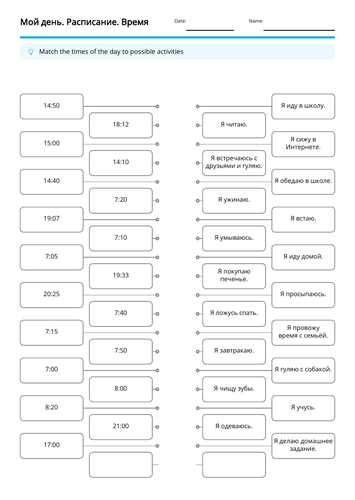
Click for suggested matches
- 8:00 - Я завтракаю (I have breakfast)
- 9:00 - Я иду в школу (I go to school)
- 14:00 - Я обедаю (I have lunch)
- 16:00 - Я читаю (I read)
- 19:00 - Я ужинаю (I have dinner)
- 23:00 - Я ложусь спать (I go to sleep)
Describe Your Day
Now, try to write 3-5 sentences describing your own morning routine. Use the verbs from today's lesson and feel free to incorporate your interests.
Here is a template you can use:
- Обы́чно я просыпа́юсь в ____ утра́. (Usually I wake up at ____ a.m.)
- Пото́м я умыва́юсь и чи́щу зу́бы. (Then I wash my face and brush my teeth.)
- На за́втрак я ем ____ и пью ____. (For breakfast I eat ____ and drink ____.)
- Пото́м я учу́сь / рабо́таю. (Then I study / work.)
- Ве́чером я игра́ю в видеои́гры. (In the evening, I play video games.)
This exercise is the most important part of the lesson, as it brings everything together in a practical, personalized way.
Conclusion
Отлично! You've learned the essential vocabulary and grammatical structures to describe your daily routine in Russian.
Key Takeaways:
- A set of core verbs like просыпаться, вставать, завтракать, работать, ужинать, and ложиться спать form the backbone of a daily routine narrative.
- Many routine verbs are reflexive, ending in -ся or -сь to show the action is performed on oneself.
- Some key verbs have slight irregularities, like вставать, which drops its -ва- suffix in the present tense.
- You can sequence actions using words like пото́м (then) to build a simple story of your day.
Preview of the next lesson:
So far, we've focused on actions (I read, I study). But what about the objects of those actions? In our next module, "Hobbies and Interests," we'll dive into the Accusative Case. You'll learn how to say "I read a book," "I watch a movie," or "I understand chemical engineering." This will be a huge step in allowing you to talk more deeply about your interests, including video games and art.