Здравствуйте!
In our last lesson, you learned how to express absence using the construction У меня нет... followed by a noun in the genitive singular. This is a vital skill, but what happens when you're talking about the absence of multiple things? For example, "I have no books," or "There are many video games."
Today, we will build directly on that knowledge by learning how to form the genitive plural of common nouns. This is a notoriously tricky part of Russian grammar, but we'll approach it step-by-step. Mastering the genitive plural is essential not only for expressing absence but also for counting and talking about quantities.
1. The Foundation: Standard Endings for Genitive Plural
Let's start by learning the most common, or "standard," endings for masculine, feminine, and neuter nouns. The video below provides a very clear introduction.
GENITIVE PLURAL - Russian cases
In this video, 'GENITIVE PLURAL - Russian cases' by Learn Russian with Alfia, the instructor breaks down the formation of genitive plural endings, starting with the most common patterns.
Watch the section from 00:05 to 06:28. Pay close attention to the standard ending for each gender: '-ов' for masculine, and the 'zero ending' (removing the last vowel) for feminine and neuter nouns.
To summarize what you just saw:
- Masculine nouns ending in a consonant usually add -ов.
студент(student) →студентовстол(table) →столов
- Feminine nouns ending in -а or -я typically have a zero ending (the vowel is simply dropped).
книга(book) →книгмашина(car) →машин
- Neuter nouns ending in -о also typically have a zero ending.
слово(word) →словписьмо(letter) →писем(Note the vowel 'е' that appears! We'll discuss this soon.)
2. Handling the Exceptions and Special Rules
As the video mentioned, the complexity of the genitive plural comes from its exceptions. These are not random; they follow specific spelling and pronunciation rules.
Let's continue with the video to see how these exceptions work.
GENITIVE PLURAL - Russian cases
Now, let's look at the special endings and pronunciation adjustments that make the genitive plural so interesting.
Watch from 06:28 to 12:10. This part covers: Special endings for masculine nouns (like '-ей' and '-ев'). The crucial concept of 'vowel insertion' for feminine and neuter nouns to avoid difficult consonant clusters (e.g., 'девушка' → 'девушек'). Endings for nouns ending in '-е', '-ь', and '-ие'.
This was a lot of information, so let's organize it. The image below is an excellent summary chart of the rules we've just covered. I recommend saving it for future reference.
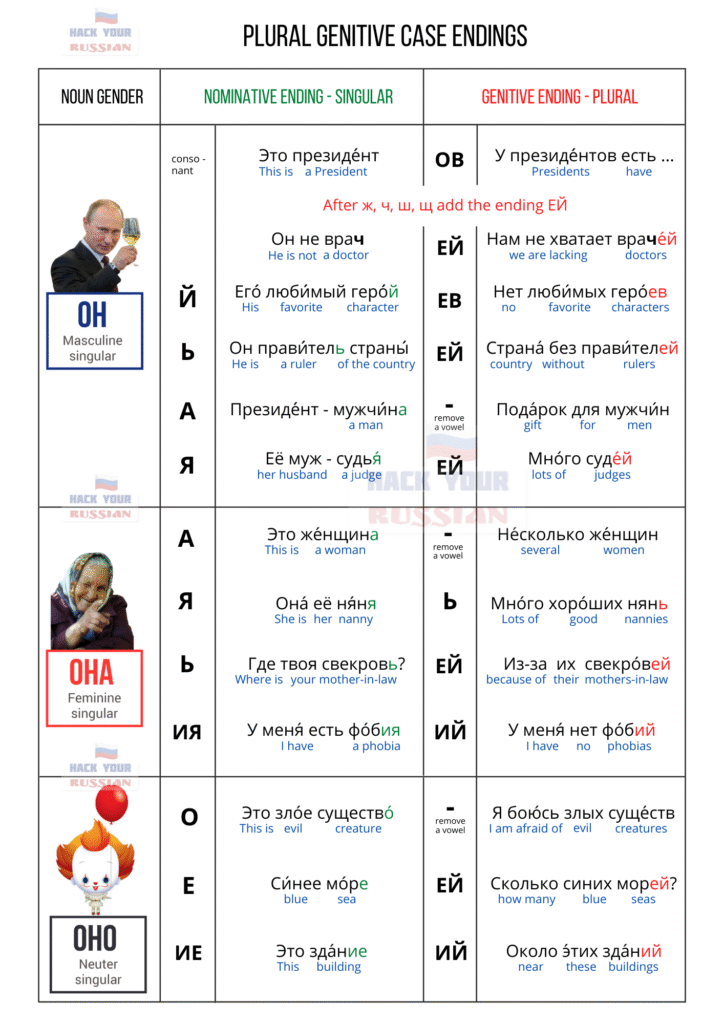
The most important new concepts from that segment are:
- Masculine endings -ев / -ей: Nouns ending in -й, -ь, or a "hushing" consonant (ж, ч, ш, щ) often take different endings.
музей(museum) →музеевкарандаш(pencil) →карандашей
- Vowel Insertion: This is a key principle. When dropping a vowel for a zero ending creates a consonant cluster that's hard to pronounce, a vowel (-о- or -е-) is inserted. This is common in both feminine and neuter nouns.
- Feminine:
девушка(girl) →девушек(instead ofдевушк) - Neuter:
окно(window) →окон(instead ofокн)
- Feminine:
- Neuter -ие ending: Nouns ending in -ие change to -ий.
здание(building) →зданий
3. Seeing Genitive Plural in Context
Now that you know the rules, let's see how these forms are used in natural conversation. The genitive plural appears after нет (absence) and also after words of quantity, like много (many/a lot of) and мало (few/a little).
Russian cases - Lesson 4: The Genitive
This resource provides dialogues that use the genitive case naturally. We will focus on one that uses words of quantity.
Please read 'Dialogue 3' on the page. Notice how nouns change to the genitive plural after the word 'много' (many/a lot of). For example: 'много людей' (many people), 'много машин и домов' (many cars and houses).
This context is key. You'll use the genitive plural constantly when you talk about quantities: five books, many games, a few minutes, etc.
4. Practice Time
Let's test your understanding. Try to form the genitive plural for the following nouns. Think about the gender and the final letter of each word to choose the correct ending.
фильм(film, masc.)игра(game, fem.)слово(word, neut.)друг(friend, masc.)неделя(week, fem.)музей(museum, masc.)девушка(girl, fem.)
Click for answers
фильмов(standard masculine ending-ов)игр(feminine ending in-аgets a zero ending)слов(neuter ending in-оgets a zero ending)друзей(this is a common irregular noun, an important one to memorize!)недель(feminine ending in-яgets a zero ending)музеев(masculine ending in-йtakes-ев)девушек(feminine noun requiring vowel insertion-е-)
Now, complete these sentences using the genitive plural of the noun in parentheses.
- В Москве много _________. (
театр) - У меня нет __________. (
карандаш)
Click for answers
- В Москве много театров. (In Moscow, there are many theaters.)
- У меня нет карандашей. (I don't have any pencils.)
Conclusion
Excellent work today! You have tackled one of the most challenging aspects of Russian noun grammar. Don't worry if it doesn't all stick at once; forming the genitive plural becomes more automatic with practice and exposure.
Key Takeaways:
- The genitive plural is used to express the absence of multiple items (
нет книг- no books) and with words of quantity (много студентов- many students). - The most common masculine ending is -ов.
- Feminine and neuter nouns often have a zero ending, where the final vowel is dropped.
- Be mindful of vowel insertion (
окон,девушек) to make words easier to pronounce. - Special endings like -ей, -ев, and -ий apply to nouns ending in soft signs, vowels, or certain consonants.
Preview of the next lesson:
Now that you know how to form the genitive plural, you have the key to unlock counting in Russian! In our next lesson, we will learn to count from 21 to 100 and beyond. You'll see exactly how the genitive plural you learned today is used with numbers.