Здравствуйте!
In our last lesson, we started talking about time by learning the words вчера́ (yesterday), сего́дня (today), and за́втра (tomorrow). We focused on using them with the verb "to be" (быть), and you learned its past tense forms: был, была́, бы́ло, and бы́ли.
Today, we'll build directly on that foundation. You'll learn how to form the past tense for most other Russian verbs. This will let you move beyond saying what was and start describing what you did, played, read, or watched. The good news is that the Russian past tense is refreshingly straightforward compared to the present tense conjugations you've learned.
1. The Basic Rule: From Infinitive to Past Tense
Forming the past tense in Russian follows a simple and consistent pattern. You start with the verb's infinitive form (the one you'd find in a dictionary, usually ending in -ть) and then modify the ending based on the subject.
Unlike the present tense, where the verb changes for every person (я, ты, он, etc.), the past tense only cares about two things:
- Gender (masculine, feminine, or neuter)
- Number (singular or plural)
Let's watch a video that breaks down this core rule.
Forming the Past Tense in Russian
The video 'Forming the Past Tense in Russian' provides a clear, step-by-step guide to this rule. We'll start with the first part, which covers the essential endings.
Watch from 00:07 to 01:42. Focus on how the infinitive ending '-ть' is replaced by '-л', '-ла', '-ло', or '-ли'.
As the video explained, the rule for most verbs is:
Remove -ть from the infinitive and add the appropriate suffix.
Here’s a summary table:
| Subject | Suffix | Example: чита́ть (to read) |
|---|---|---|
| Masculine singular (он, я, ты) | -л | он чита́л (he read) |
| Feminine singular (она́, я, ты) | -ла | она́ чита́ла (she read) |
| Neuter singular (оно́) | -ло | оно́ чита́ло (it read) |
| Plural (они́, мы, вы) | -ли | они́ чита́ли (they read) |
This visual provides another clear example with the verb де́лать (to do/make).
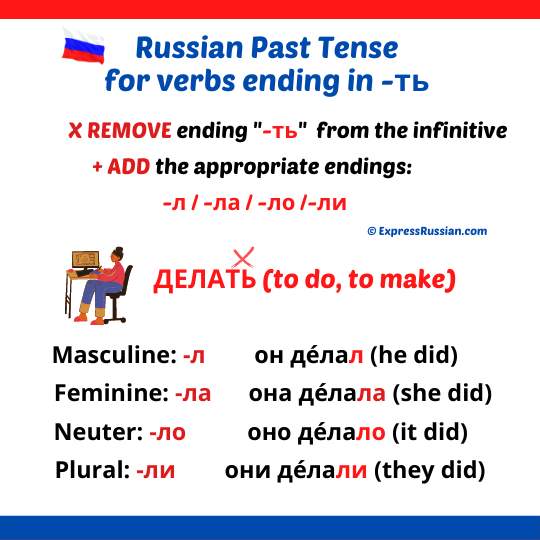
2. Gender Agreement: Я, Ты, Он, Она
A crucial point is that the past tense verb must agree with the gender of the subject, even for the pronouns "I" (я) and "you" (ты).
Let's quickly watch the next segment of the video that emphasizes this.
Forming the Past Tense in Russian
This part of the video clarifies how gender agreement works, which is different from the present tense.
Watch from 02:25 to 03:00. The key takeaway is that the verb ending depends on the speaker's gender, not just the pronoun.
So, as a male speaker, you will always use the masculine ending -л when talking about yourself in the past.
- Я чита́л кни́гу. (I read a book.)
- Я игра́л в ко́мпьютерные и́гры. (I played computer games.)
- If you were speaking to a male friend, you'd ask: Ты чита́л э́ту кни́гу? (Did you read this book?)
A female speaker would use -ла: Я чита́ла, я игра́ла.
3. Past Tense of Reflexive Verbs (-ся/-сь)
You may have encountered reflexive verbs, which end in -ся or -сь (like учи́ться - to study). Forming their past tense is just as easy. You follow the same rule as above and simply keep the reflexive particle at the end.
- Remember the rule for the particle: use -сь after a vowel and -ся after a consonant.
Since the masculine past tense ending is -л (a consonant), the full ending will be -лся. The other endings are vowels, so they take -сь.
- Он учи́л + ся → Он учи́лся (He studied)
- Она́ учи́ла + сь → Она́ учи́лась (She studied)
- Они́ учи́ли + сь → Они́ учи́лись (They studied)
4. Reading and Practice
Now, let's consolidate this with a comprehensive reading resource. The following article summarizes all the rules we've discussed and provides many useful examples, including for the verb быть that you learned last time.
Russian Past Tense | ExpressRussian.com
The article 'Russian Past Tense' from ExpressRussian.com is a great reference. It covers the core rules, reflexive verbs, and the verb 'быть' in one place.
Please read the sections 'Past Tense for Russian verbs ending in -ть', 'Reflexive Verbs & Russian Past Tense', and 'Verb “Быть” (to be) in the Past Tense in Russian'. This will reinforce the rules for regular verbs, reflexive verbs, and give you a good review of 'быть'.
Time to Practice
Let's apply these rules. Using the time word вчера́ (yesterday), translate the following sentences into Russian. Remember to use the masculine -л ending for "I".
- Yesterday I played a game. (игра́ть в игру́)
- Yesterday I drew a picture. (рисова́ть карти́ну)
- Yesterday she watched a movie. (смотре́ть фильм)
- Yesterday they were at home. (быть до́ма)
Click for answers
- Вчера́ я игра́л в игру́.
- Вчера́ я рисова́л карти́ну.
- Вчера́ она́ смотре́ла фильм.
- Вчера́ они́ бы́ли до́ма.
Conclusion
Отли́чно! (Excellent!) You've now unlocked the ability to talk about past actions in Russian. The system is logical and much less complex than present tense conjugation.
Key Takeaways:
- To form the past tense, remove -ть from the infinitive verb.
- Add the ending that matches the subject's gender and number:
- Masculine singular: -л (я, ты, он)
- Feminine singular: -ла (я, ты, она́)
- Neuter singular: -ло (оно́)
- Plural: -ли (мы, вы, они́)
- Reflexive verbs keep their -ся/-сь particle after the past tense ending.
Preview of the next lesson:
Now that you can form the past tense, a new question arises. How do you say "I was reading a book" versus "I read the book (and finished it)"? In English, we use different tenses (Past Continuous vs. Past Simple). In Russian, this distinction is handled by something called verb aspect. In our next lesson, we will explore the difference between imperfective verbs (for processes) and perfective verbs (for results), which is a core concept in Russian grammar.