Здравствуйте! Welcome back to our course.
In our last lesson, we discovered the function of the accusative case: it marks the direct object of a sentence, the thing that receives the action. You learned to identify it by asking что? (what?) after the verb. For example, in "Я читаю..." (I read...), the thing you are reading is the direct object.
Today, we'll learn how to form the accusative case for inanimate nouns. This is the mechanical part—changing the word endings. By the end of this lesson, you will be able to take a masculine, feminine, or neuter noun and correctly change its ending to use it as a direct object, a crucial step for talking about your interests in video games, books, and movies.
1. The Rules of Formation: A Quick Guide
The rules for forming the accusative case of inanimate nouns depend on the noun's gender. The good news is, for two of the three genders, the rule is incredibly simple!
- Masculine Inanimate Nouns: No change.
- Neuter Inanimate Nouns: No change.
- Feminine Inanimate Nouns: These are the ones that change.
Let's watch a short, clear video that explains these rules with a helpful mnemonic.
Russian Cases - Nouns in the Accusative
The video 'Russian Cases - Nouns in the Accusative' from the Russian grammar channel explains the rules for all three genders in under four minutes. Pay close attention to the rhyme it introduces for feminine nouns.
Please watch the entire video (00:00 - 04:12). Focus on how each gender is treated. Note that the video covers exactly what we need for today's lesson: inanimate nouns in the singular and plural.
2. Breaking Down the Rules by Gender
As the video showed, the rules are quite straightforward. Let's review them with some examples.
Masculine and Neuter: The Easy Part
For any inanimate masculine or neuter noun, the accusative form is identical to the nominative (dictionary) form. You don't have to do anything!
Masculine Examples:
- Nominative: Это журнал. (This is a magazine.)
- Accusative: Я читаю журнал. (I read a magazine.)
- Nominative: Это интересный фильм. (This is an interesting film.)
- Accusative: Я смотрю интересный фильм. (I am watching an interesting film.)
Neuter Examples:
- Nominative: Это письмо. (This is a letter.)
- Accusative: Я пишу письмо. (I am writing a letter.)
- Nominative: Это новое здание. (This is a new building.)
- Accusative: Я вижу новое здание. (I see a new building.)
Feminine: The Main Change
This is where you'll apply the rhyme from the video: "а goes to у, я goes to ю, soft sign stays the same."
-
Nouns ending in -а change to -у:
- Nominative:
книга(book) → Accusative:книгу - Example: Я читаю книгу. (I am reading a book.)
- Nominative:
музыка(music) → Accusative:музыку - Example: Я слушаю музыку. (I am listening to music.)
- Nominative:
-
Nouns ending in -я change to -ю:
- Nominative:
статья(article) → Accusative:статью - Example: Он пишет статью. (He is writing an article.)
- Nominative:
химия(chemistry) → Accusative:химию - Example: Ты понимаешь химию? (Do you understand chemistry?)
- Nominative:
-
Nouns ending in -ь (soft sign) do not change:
- Nominative:
тетрадь(notebook) → Accusative:тетрадь - Example: Студентка покупает тетрадь. (The student buys a notebook.)
- Nominative:
3. Summary and Reference
To consolidate these rules, let's look at a clear text-based resource. The summary table is particularly useful as a quick reference.
The Accusative case of singular nouns
The article 'The Accusative case of singular nouns' provides a concise written summary of the rules we've just learned. The table at the end is a perfect tool for review.
Read the sections titled 'Masculine nouns', 'Feminine nouns', and 'Neuter nouns'. Pay special attention to the 'Accusative case memo chart' at the end. For masculine nouns, focus only on the rule for inanimate nouns for now.
Here is a visual summary of the rules for inanimate nouns, which you might find helpful for memorization.
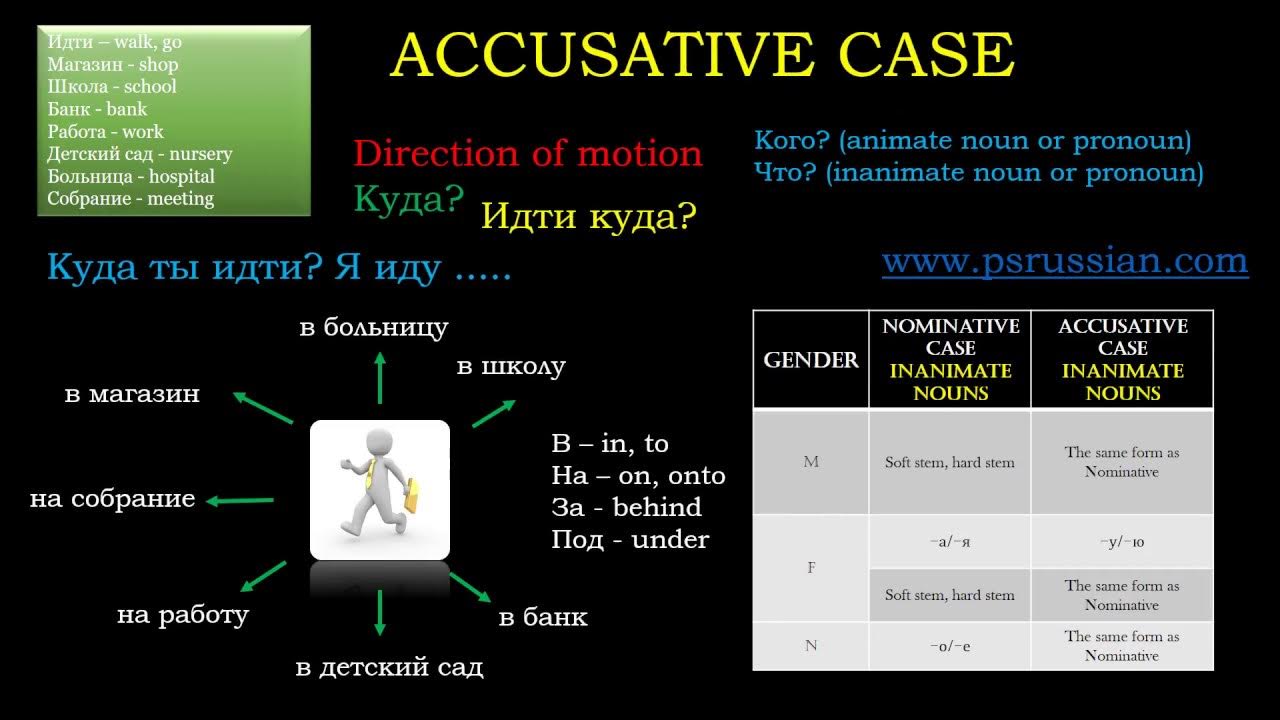
4. Practice
Now it's your turn to apply the rules. For each sentence, change the noun in parentheses from its nominative form to the correct accusative form.
- Я люблю (пицца).
- Ты читаешь (журнал)?
- Она смотрит (комедия).
- Мы видим (море).
- Я не понимаю (задача - task/problem).
- Он покупает (хлеб - bread).
- Они изучают (история - history).
Click to check your answers
- Я люблю пиццу. (Feminine: -а → -у)
- Ты читаешь журнал? (Masculine inanimate: no change)
- Она смотрит комедию. (Feminine: -я → -ю)
- Мы видим море. (Neuter: no change)
- Я не понимаю задачу. (Feminine: -а → -у)
- Он покупает хлеб. (Masculine inanimate: no change)
- Они изучают историю. (Feminine: -я → -ю)
Conclusion
Excellent work! You've now mastered the essential mechanics of forming the accusative case for inanimate nouns. This is a significant step that unlocks a huge range of expression.
Key Takeaways:
- Masculine and Neuter inanimate nouns do not change in the accusative case.
- Feminine inanimate nouns change their endings:
- -а becomes -у.
- -я becomes -ю.
- -ь (soft sign) does not change.
Preview of the next lesson:
Now that you know how to form the accusative case, we will put it into practice. In the next lesson, you'll learn to use common verbs like читать (to read), смотреть (to watch), and понимать (to understand) with direct objects to build sentences about your own hobbies and interests.