In our last lesson, we delved into Ashby's Black Box method, a powerful protocol for investigating a system whose internal workings are unknown. We saw how an observer can systematically build a functional model by manipulating inputs and observing outputs. This approach allows us to understand what a system does. Now, we shift our focus from observing adaptation to understanding how a system can achieve adaptation on its own.
This lesson explores one of W. Ross Ashby's most profound contributions: the concept of ultrastability and its physical embodiment, the Homeostat. If the Black Box method is about how to study an adaptive system from the outside, ultrastability is the theory of how such a system works from the inside. You will learn how a system can automatically maintain its own stability, even when faced with disturbances its designer never anticipated. This principle is a cornerstone of cybernetics and provides a mechanism for learning and adaptation that is foundational to designing truly robust systems.
1. Beyond Simple Homeostasis: The Need for Adaptation
We have previously discussed homeostasis as a core cybernetic concept: the maintenance of critical variables within viable limits. A classic example is a thermostat maintaining room temperature. This is a form of simple stability. The system has a single, fixed goal and a mechanism to correct deviations from that goal.
But what happens when the environment changes in a fundamental way? What if a window is left open in winter, making the furnace's job impossible with its current settings? What if the system's own internal structure is damaged? A simple homeostatic system will fail; it will run continuously without ever reaching its target. It can regulate against disturbances, but it cannot adapt to changes in the conditions of regulation.
This is where Ashby introduces a more powerful idea. For a system to survive in a changing world, it must not only regulate its essential variables but also be able to change its own internal organization when the old organization is no longer working. This ability to find a new, stable mode of operation is called ultrastability.
[PDF] Adaptive Systems W. Ross Ashby The problem and method
These lecture slides by Ezequiel Di Paolo provide a concise, formal introduction to Ashby's view on adaptation and ultrastability. They lay the groundwork for understanding stability as the primary goal of an adaptive organism.
Please read through the first few slides to grasp the key definitions. Start from the slide titled Essential variables to understand what a system must protect. Then, on the slide Adaptation as stability, note the definition of adaptive behavior. Finally, focus on the slides under the heading Ultrastability. This section introduces the core idea: when essential variables go out of bounds, they trigger changes in the system's parameters, S, leading to a new state of equilibrium.
An ultrastable system, therefore, possesses a second layer of feedback. It doesn't just adapt its behavior; it adapts its structure.
2. The Mechanism of Ultrastability: A Double Feedback Loop
To achieve ultrastability, Ashby proposed a brilliant two-level structure. This is a crucial concept to understand.
-
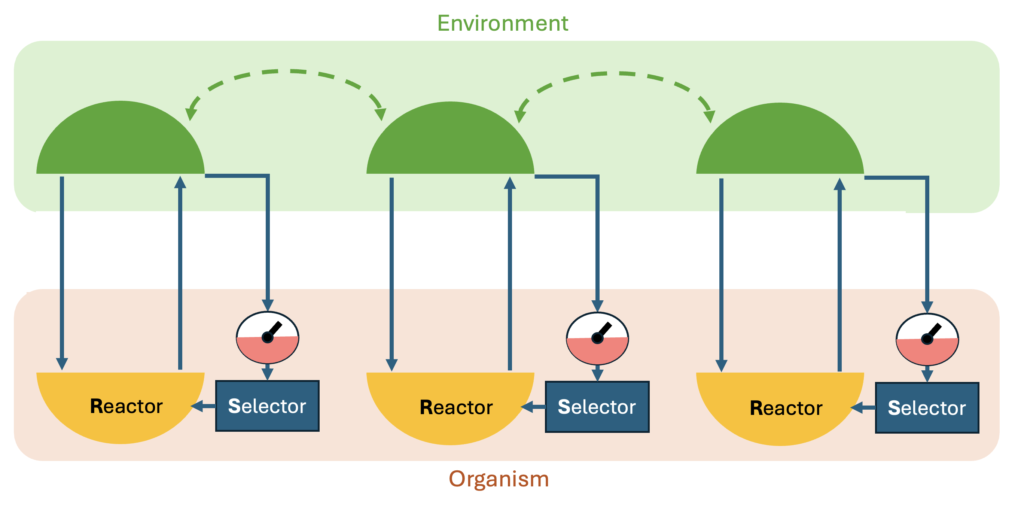
The Inner Loop (Behavior): This is the primary system that interacts directly with the environment. Ashby called the mechanism responsible for this the Reactor. It senses the environment and acts upon it, producing the system's moment-to-moment behavior. This loop handles small, expected disturbances. For an animal, this might be the neural circuits for walking. For a company, it's the operational processes for producing a product.
-
The Outer Loop (Adaptation): This loop monitors the essential variables of the system (e.g., body temperature, blood sugar; for a company, profitability). If a disturbance is so great that the Reactor's current behavior can't keep an essential variable within its viable limits, this second loop activates. Ashby called this the Selector. The Selector's job is to change the parameters or structure of the Reactor itself. It makes a change, then waits to see if the essential variable returns to a stable range. If it doesn't, it tries another change.
This "double feedback" is the engine of adaptation.
You want AGI? You need to read Ross Ashby
This article provides an excellent, non-mathematical explanation of Ashby's framework, which is perfect for building a strong conceptual foundation.
Read the section Ashby's Framework. Pay close attention to the diagram and the explanation of the Reactor, the Selector, and the two feedback loops. The author's clear distinction between the continuous inner loop and the intermittent outer loop is key to understanding the model.
Crucially, the Selector does not need to be "intelligent." Ashby demonstrated that the selection of a new configuration for the Reactor can be entirely random. The system simply tries new configurations until, by chance, it finds one that restores stability. This provides a powerful, mechanistic explanation for goal-directed, adaptive behavior without needing to invoke any mysterious "life force" or homunculus—a "ghost in the machine" who makes the smart choices.
3. The Homeostat: An Idea Made Manifest
Being an experimentalist as well as a theorist, Ashby built a machine to demonstrate the principle of ultrastability. This device, the Homeostat, became one of the most famous and debated icons of early cybernetics.
The Homeostat was an electromechanical device consisting of four identical units, each representing a part of a larger system. Each unit's goal was to keep its own essential variable—represented by a pivoting magnet and needle—centered in a trough of water.

Here’s how it worked:
- Interconnection: The output from each unit was fed as an input to all other units (including itself), creating a complex, coupled system. You can see this in the top-right block diagram of the image above.
- Disturbance: An experimenter could disturb the system by manually moving one of the needles. This would disrupt the equilibrium, causing all the other needles to move as the effect cascaded through the system.
- Adaptation: If a needle was pushed so far that it went outside its viable limits (the "null value" in the diagram), it would trigger a 25-step rotary switch called a "uniselector" (the 'X' in the diagram). This uniselector would randomly change the circuitry of its unit, effectively altering the rules by which that unit responded to its inputs.
- Finding Stability: The uniselectors across the four units would continue to click and step through random configurations. The machine would thrash about until, purely by chance, the system of connections settled into a configuration that could absorb the disturbance and allow all four needles to return to their central, stable positions. At that point, the uniselectors would stop, and the system would remain in its new stable state.
The Homeostat demonstrated that a machine, with no prior programming for the specific task, could find its own solution to a problem. It was "learning" to adapt.
You want AGI? You need to read Ross Ashby
Let's return to the same article to see how the Homeostat is described as the culmination of these ideas.
Read the section titled The Homeostat. This gives a concise summary of what the machine was and what it did. Also, read the final paragraphs in the section to understand the criticisms leveled against it, which will appeal to your philosophical interests. Critics like Grey Walter saw it as a "sleeping machine," which raises important questions about the nature of proactive versus reactive intelligence.
4. Implications of Ultrastability
The Homeostat was more than a clever gadget; it was a proof of concept with far-reaching implications.
Scaling and Compartmentalization
A key question is whether this random search is feasible in a complex system. If a brain has billions of neurons, would it take eons to find a stable configuration? Ashby showed mathematically that it would, if the system were fully and randomly connected.
However, he also demonstrated that if the system is compartmentalized—composed of subsystems that are richly connected internally but only sparsely connected to each other—then adaptation can occur much more quickly. The subsystems can adapt semi-independently. This insight prefigured modern findings in neuroscience about the modular structure of the brain and, in your field of computer science, the efficiency of sparse neural networks.
Adaptation to the Unknown
Perhaps the most powerful demonstration was the Homeostat's ability to adapt to conditions unforeseen by Ashby himself. In one famous experiment, an observer crossed the input wires to one of the units, effectively reversing its "perception." The machine became wildly unstable, but after a period of random searching, it found a new internal configuration that was stable even with the crossed wires. It had adapted to a fundamental change in its own structure, a feat impossible for a system with only simple homeostatic feedback.
Conclusion
In this lesson, we have moved from the "what" of adaptation to the "how." You have learned about Ashby's principle of ultrastability as a mechanism for a system to maintain viability in a changing world.
Here are the key takeaways:
- Ultrastability vs. Homeostasis: Simple homeostasis regulates variables within a fixed system structure. Ultrastability achieves regulation by changing that very structure.
- Double Feedback Mechanism: Ultrastability relies on an inner "Reactor" loop for behavior and an outer "Selector" loop for adaptation. The outer loop activates when essential variables are threatened and changes the parameters of the inner loop.
- The Homeostat: Ashby's electromechanical machine that provided a physical demonstration of ultrastability, showing how a system could use random search to find a new stable configuration in response to unforeseen disturbances.
- The Power of Randomness: Ultrastability offers a non-teleological mechanism for learning and adaptation. The system does not "know" the solution; it discovers it by trying possibilities until one works.
We have seen that an ultrastable system can adapt by changing its internal parameters. But what determines if its range of possible configurations is sufficient to handle the range of possible disturbances? This brings us to a crucial link between Ashby's work and the information theory we studied earlier. In our next lesson, we will explore this connection by relating the Law of Requisite Variety to Shannon's information-theoretic concepts.