Welcome to the first lesson of our module on management cybernetics. In the previous module, you forged a deep connection between the physical concept of variety and the mathematical language of information theory. We saw how regulation can be understood as an act of communication—a battle of information where a regulator must possess enough "channel capacity" (variety) to counteract the "noise" from disturbances. We also touched upon the limits of this analogy when faced with the circular causality of real-world systems, and the mind-boggling scale of complexity identified by Ashby.
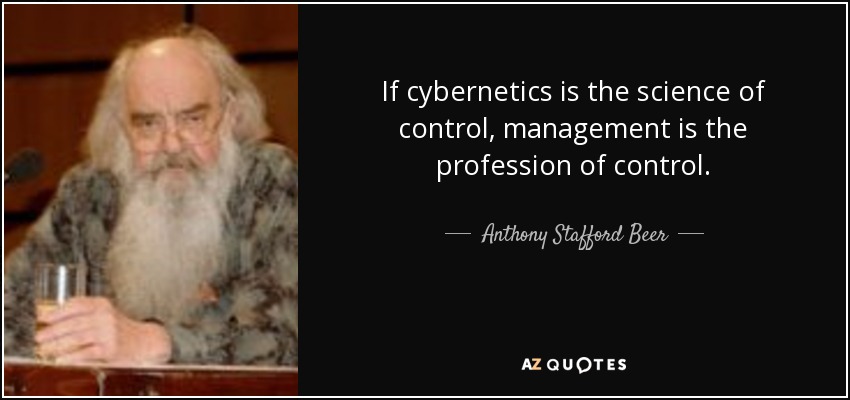
This lesson marks a pivotal shift from these foundational, and at times abstract, principles to their application in a domain that is both intensely practical and deeply philosophical: the management of complex organizations. Our guide in this journey is the remarkable British theorist and consultant, Stafford Beer. We will explore his core motivations for applying the nascent science of cybernetics to the world of management, setting the stage for his most influential work, the Viable System Model (VSM), which was central to the Project CyberSyn that inspired you.
1. The View from the Shop Floor
Stafford Beer was not a detached academic who happened upon management as a field of study. His insights were forged in the heat, noise, and complexity of post-war British industry. His early career in operations research (OR) for a large steel company provided him with a direct, unvarnished view of how organizations actually worked, as opposed to how they were depicted on an organization chart.
[PDF] Stafford Beer - Origins of Team Sentegrity - Das Cwarel Isaf Institute
In this paper, Beer himself recounts his formative experiences and his growing dissatisfaction with traditional organizational theory. It provides a firsthand account of his motivations.
Start at the beginning of the article with the section titled The Start. Notice his respect for the tacit, unquantified knowledge of the shop-floor workers and the clear disconnect between their expertise and the formal management structure. Then, read the introduction that begins right after the table of contents, starting from Master and slave. Pay close attention to his critique of the hierarchical "family tree" as merely "an instrument for discovering who is to blame" and his early search for non-hierarchic solutions.
As you read, it becomes clear that Beer's first motivation was empirical. He saw that the official, hierarchical models of management were not just incomplete; they were fundamentally wrong. They failed to account for the true sources of control and expertise within the system. The managers, who held formal authority, lacked the requisite variety to control the complex steel-making process; the workers, who had the requisite variety, lacked formal authority. The neatly-drawn lines of the organization chart were a fiction that ignored the messy, vital reality of the system's functioning. This dissonance between theory and reality spurred his search for a new science of organization.
2. The Crisis of Complexity: Disobeying Unknown Laws
Beer generalized this observation from the factory floor to all of society's institutions. He argued that we are surrounded by systems—corporations, government departments, national economies—that are failing, not because of ill will or incompetence, but because they are managed in defiance of fundamental laws of complexity.
He felt that we, as a culture, readily accept the existence of universal laws in the physical sciences but remain stubbornly blind to their equivalents in the social and organizational spheres. To understand his argument directly, let's turn to Beer himself in his 1973 Massey Lectures.
Designing Freedom: The Disregarded Tools of Modern Man | Stafford Beer
In this clip from his lectures, Beer uses a brilliant analogy to make his case and then states his core diagnosis of the problem facing modern society.
First, watch his discussion of gravity from the apple tree to "govern institutional behavior". He argues that just as it took centuries for our culture to internalize Newtonian physics, we have not yet internalized the "laws of institutional behavior." Then, watch the following segment from "be burnt at the stake" to "techniques of cybernetics". Here, he delivers his central thesis: our institutions are failing because they disobey the laws of effective organization, laws which their administrators do not even know exist.
This is Beer’s second, and perhaps most profound, motivation: the conviction that there exists a science of effective organization—cybernetics—and that our failure to recognize and apply it is leading to systemic collapse. He saw a catastrophic mismatch between the immense complexity of the modern world and the primitive tools we use to manage it.
This connects directly to the concepts from our last lesson. The "hyper-astronomical" number of states that Ashby warned about far exceeds the cognitive capacity of any individual manager or committee.

Beer argued that our inherited institutions, particularly rigid hierarchies, are woefully inadequate for this task. They attempt to manage complexity by destroying the variety of the system, forcing conformity and stifling adaptation, rather than by intelligently attenuating and amplifying it as cybernetic principles would suggest.
3. The Humanist Vision: Designing Freedom
Beer’s motivation was not purely critical. He had a powerful, positive vision for what could be achieved if we applied cybernetic principles correctly. This vision is captured in the title of his lectures: Designing Freedom.
This may seem paradoxical. How can a science of control be used to design freedom?
The Tragedy of Stafford Beer - by Kevin Munger
This article by Kevin Munger provides an excellent overview of Beer's broader philosophy and political drive. It connects his work to the humanist tradition and explains the urgency behind his message.
First, read the section that starts with the heading Can you recognize an Angel?. This section explains Beer's concept of designing freedom and links him to Norbert Wiener's humanist concerns. Focus on the idea that liberty is an output of a well-designed viable system. Next, read the following section, which begins with the quote There is a branch. This part explains the urgent, almost prophetic, nature of Beer's motivation. He feared that technology, if not used for humanistic ends, would inevitably be used to create an "electronic mafia."
Beer's argument is subtle and profound. He reframes the debate away from the simplistic dichotomy of "government control" versus "individual liberty." In his view, a system that cannot effectively regulate itself—that cannot maintain stability in the face of disturbances—cannot provide freedom to its members. A failing economy, a collapsing ecosystem, or a dysfunctional organization does not make people free; it subjects them to chaos, want, and crisis.
Therefore, for Beer, effective regulation is the mechanism that creates freedom. His life's work was dedicated to designing systems that could provide "the most effective society...able to make full use of each human’s capacities rather than forcing the overwhelming majority of humans to contribute only tightly controlled and alienated labor."
This humanist drive was coupled with a deep sense of urgency. He saw that the very tools he championed—computers, telecommunications, and cybernetics—could be used to build systems of Orwellian control just as easily as they could be used to design freedom. His motivation was to seize the initiative and build intentional, humanity-enhancing systems before less scrupulous powers used the same technology to erode liberty.
4. The Ultimate Test: Chile
Beer's ideas were radical, and he was not content for them to remain theoretical. This brings us to his most famous undertaking and the inspiration for your own interest in this course: Project CyberSyn.
Why would a successful British consultant, accustomed to working with capitalist enterprises, agree to work with Salvador Allende's Marxist government in Chile? Because it was the opportunity of a lifetime: a chance to apply his cybernetic principles not just to a single firm, but to an entire national economy. It was the ultimate test of his theories.
This video provides a concise summary of the context and purpose of Beer's work in Chile.
First, watch the introduction from the beginning to get a sense of the collaboration between Beer and the Chilean government. Next, watch the segment from "the viable system model stands in contrast", which reiterates Beer's critique of traditional hierarchies as an obstacle to both productivity and freedom. Finally, watch the concluding section from "less exploitative social relations" which summarizes why Allende's government found Beer's ideas so attractive: they offered a path to a more efficient, decentralized, and liberated society, avoiding the pitfalls of both capitalist markets and authoritarian bureaucracy.
In Chile, Beer's cybernetic philosophy was brought into sharp political focus. He began to reformulate political concepts in informational terms. For example, in an unpublished text from that time, he redefined Marxist "exploitation" not simply as the extraction of surplus value, but as the deprivation of information. This is a powerful idea that resonates with everything we have studied. A system that denies its components the information they need to self-regulate is an exploitative system. A truly liberated system is one where information flows freely, enabling autonomy and effective action at all levels. This was the vision he tried to build in Chile.
Conclusion
In this lesson, we have uncovered the core motivations that drove Stafford Beer to dedicate his life to creating the field of management cybernetics. These were not the impulses of a typical business consultant, but those of a scientist, a philosopher, and a revolutionary.
Here are the key takeaways:
- Empirical Discontent: Beer's firsthand experience in industry revealed the inadequacy of traditional hierarchical management models, which failed to reflect the true distribution of knowledge and control.
- A Crisis of Complexity: He believed that modern institutions were failing because they were managed in violation of the scientific laws of effective organization, which cybernetics could reveal.
- The Inadequacy of Hierarchy: He saw rigid hierarchies as fundamentally incapable of handling the variety of the real world, serving more as blame-allocation systems than effective regulators.
- A Humanist Vision: Beer was driven by a desire to use cybernetic tools to "design freedom"—creating adaptive, responsive systems that would enhance human potential and liberty, rather than constrain it.
- A Sense of Urgency: He feared that if humanistic cyberneticians did not act, the same technologies would be co-opted by an "electronic mafia" to create new forms of technological control.
You now understand why Beer embarked on his project. In the next lesson, we will begin to explore how he did it. We will take our first step into his framework by learning to see organizations not as pyramids of boxes, but as complex, probabilistic systems, and we will apply the concept of variety to analyze their fundamental challenge: managing complexity.