Introduction
Welcome to the next step in our exploration of management cybernetics. In our last lesson, we defined variety engineering as the deliberate practice of managing complexity through attenuation and amplification. You learned that these aren't just passive phenomena but strategic levers for designing effective organizations. We also touched upon Stafford Beer's profound insight that the choice of which lever to pull is a deeply ethical and political act.
This lesson builds directly on that foundation. If variety engineering provides the tools for managing complexity, feedback loops are the engine that drives the process. Today, we will describe the crucial role of feedback in two fundamental organizational processes: regulation and learning. You will learn to distinguish between maintaining the status quo and fundamentally challenging it, a distinction that is at the heart of creating truly adaptive and viable systems. This understanding will be essential as we prepare to analyze the full architecture of the Viable System Model (VSM).
A Tale of Two Loops: Single vs. Double
At its core, a feedback loop is a process where the output or consequence of an action is "fed back" as input, influencing the next action. In organizations, this happens constantly, but not always in the same way. There are two primary modes of learning that occur through feedback, first conceptualized by the theorist Chris Argyris and philosopher Donald Schön.
To get an immediate, practical feel for this distinction, please watch the following short video. It uses a simple, relatable example of seeking feedback at work to illustrate the concepts of single-loop, double-loop, and even triple-loop learning. For now, focus just on the first two.
Explaining Single, Double and Triple Loop learning
This video from UNSW eLearning provides a clear, concise explanation of the different learning loops.
Watch the video from the beginning until the end of the double-loop section. Pay close attention to the key question associated with each loop: Single-Loop: Am I doing things right? Double-Loop: Am I doing the right things?
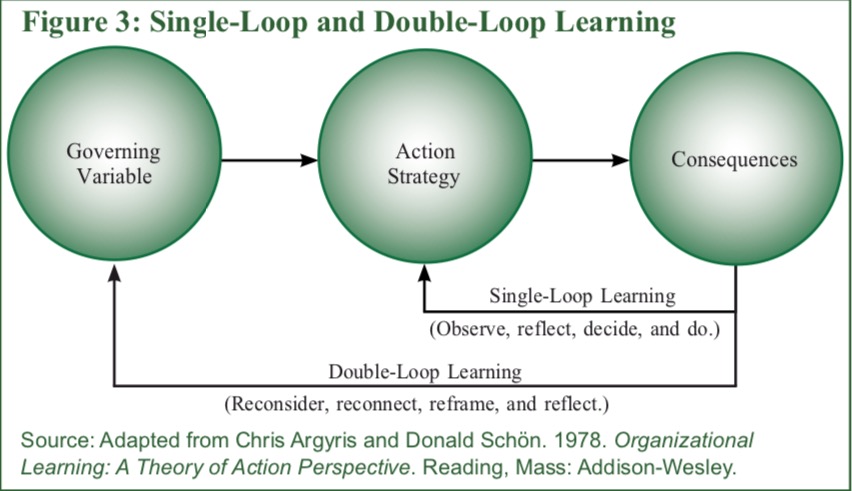
As the video illustrates, the first response to a problem is often to try a different tactic to achieve the same goal. This is single-loop learning. When that fails or reveals a deeper issue, we are forced to step back, reflect on our assumptions, and perhaps even change the goal itself. This is double-loop learning.
The diagram below, adapted from the original work of Argyris and Schön, provides the canonical model for this idea.
Formalizing Regulation and Learning
Let's now deepen our understanding of these concepts. The text "Learning and Self-Organization" by Gareth Morgan provides an excellent overview of how these cybernetic ideas apply to organizations.
Learning and Self-Organization
This chapter excerpt explains the cybernetic principles of feedback and applies them to organizational learning, formally defining single-loop and double-loop learning and discussing the barriers that prevent organizations from achieving the latter.
Please read the first two major sections of the chapter: Start with CYBERNETICS, LEARNING, AND LEARNING TO LEARN. Read from the beginning of this section down to the end of the part that defines the two loops. This will ground the concepts in the history of cybernetics and the principle of negative feedback. Next, read the section titled CAN ORGANIZATIONS LEARN TO LEARN? from its beginning up to the start of the "Guidelines" subsection. Focus on the examples of each type of learning and, critically, the discussion of why double-loop learning is so difficult for many organizations to achieve.
As you've just read, we can associate these two learning loops with two distinct organizational functions:
-
Regulation (Single-Loop Learning): This is the process of maintaining stability and achieving pre-defined goals. It's about error correction. Think of a thermostat maintaining room temperature, or a project manager adjusting resources to stay on budget. The "governing variables"—the desired temperature, the budget—are not questioned. This process is about ensuring the organization "does things right." It's a form of homeostasis, a concept we've seen before, ensuring the system's key variables remain within stable limits.
-
Adaptation (Double-Loop Learning): This is the process of questioning and changing the goals, norms, and underlying assumptions. It is essential for long-term survival in a changing environment. This is where an organization might decide the budget itself is based on a flawed strategy, or that the product it's building no longer meets market needs. This process is about ensuring the organization is "doing the right things." It is fundamentally about reframing.
Your background in computer science provides a useful analogy. Single-loop learning is like debugging a program to eliminate errors and ensure it conforms to its specification. Double-loop learning is like a code refactoring or architectural review where you question the specification itself: Does this algorithm actually solve the user's real problem, or do we need a fundamentally new approach?
The reading highlighted that organizations often excel at single-loop learning but struggle with double-loop learning due to "defensive routines," bureaucracy, and a culture that discourages questioning the status quo. This is a central problem that management cybernetics, and specifically the VSM, seeks to solve.
Feedback Loops within the Viable System Model
The Viable System Model is, in essence, a sophisticated architecture of feedback loops designed to enable both regulation and learning, allowing an organization to be both stable and adaptable. Let's map what we've learned onto the VSM's structure.
Regulation: The "Inside and Now" Axis (Systems 1, 2, 3)
The primary function of the VSM's operational systems is single-loop learning.
- System 1 (Operations) contains its own local management, which constantly regulates its activities to meet operational goals.
- System 3 (Control) monitors the performance of all System 1 units and intervenes when they deviate from agreed-upon parameters (e.g., resource usage, output levels). This is a classic negative feedback loop. The VSM Guide you've consulted before refers to this as a balancing loop, which "underpins homeostasis and is fundamental to understanding the stability of any system."
- System 2 (Coordination) serves as another regulatory feedback mechanism, but its purpose is to dampen oscillations between System 1 units, preventing their actions from destabilizing each other.
This entire vertical axis from System 3 down to System 1 is a powerful engine for single-loop learning, ensuring the day-to-day work of the organization runs smoothly and efficiently—that it "does things right."
Learning: The Metasystem and its Loops (Systems 4, 5)
If the organization only had Systems 1, 2, and 3, it would be efficient but brittle, unable to adapt to fundamental changes in its environment. Double-loop learning is the responsibility of the metasystem.
- System 4 (Intelligence) is the primary engine of double-loop learning. Its entire function is to look outward and forward ("outside and then"), building models of the changing environment and the organization's possible futures. It constantly questions the current operating assumptions of System 3, proposing new strategies, products, and ways of working. It is in a permanent, creative tension with System 3.
- System 5 (Policy) provides the ultimate closure for double-loop learning. It receives the strategic debates between Systems 3 and 4 and makes the final decisions on identity, values, and purpose—the "governing variables." When System 5 changes a core policy, it adjusts the very framework within which single-loop learning occurs.
The Algedonic Channel: A Loop for Emergencies
Beer's model includes a brilliant feature for rapid, unscheduled learning: the algedonic channel (from the Greek algos, pain, and hedone, pleasure). This is a feedback loop that bypasses the normal hierarchical reporting lines, allowing a critical alert from deep within System 1 to shoot directly up to the highest levels of management (Systems 3, 4, and 5).
The following short clip explains this powerful concept.
This clip from the "The Viable System Model" video gives a concise explanation of the algedonic signal.
Please watch the section from "importantly beer also designed" that explains this crucial feedback mechanism.
The algedonic channel ensures that when a truly novel or dangerous situation arises, the system doesn't get bogged down in single-loop bureaucracy. It forces the metasystem to engage in double-loop learning immediately, assessing whether the current rules are equipped to handle the new reality. It is a feedback loop designed to break the rules when necessary.
Conclusion
In this lesson, you have explored the vital role of feedback loops as the drivers of organizational behavior. You've learned to distinguish between two fundamental modes of operation: regulation via single-loop learning and adaptation via double-loop learning.
Here are the key takeaways:
- Feedback loops are the core mechanism for both stability and change in an organization.
- Single-loop learning answers the question, "Are we doing things right?" It involves correcting errors to better achieve existing goals and is the primary mode of regulation and homeostasis. In the VSM, this is the main function of the Systems 1-2-3 axis.
- Double-loop learning answers the question, "Are we doing the right things?" It involves questioning and changing the underlying goals, rules, and assumptions. This is the mechanism for adaptation. In the VSM, this is driven by the interaction between Systems 3, 4, and 5.
- The Viable System Model is an elegant architecture that institutionalizes both types of feedback, creating a balance between the stability needed for current operations and the adaptability needed for future survival.
You now understand the dynamic processes that animate a cybernetic organization. With this knowledge, we are ready to look at how these processes map onto the traditional structure of a company. In our next lesson, we will distinguish between the operational, tactical, and strategic management levels in cybernetic terms, providing a direct bridge between VSM theory and conventional organizational design.