Introduction
In our previous lesson, we surveyed the entire landscape of the Viable System Model, understanding its purpose as a blueprint for any system aiming for survival. We saw how it tackles the challenge of complexity through an elegant, recursive architecture that balances the autonomy of its parts with the cohesion of the whole. You now have the high-level map, showing the five key systems and their relationship to the environment.
Today, we begin our detailed exploration of this map by zooming in on its very foundation: System 1. This is where the action happens—the part of the system that fulfills the organization's primary purpose. It is the collection of operational units that, in Stafford Beer's words, do the thing the system exists to do. By the end of this lesson, you will be able to explain the core function of System 1, its relationship with its environment, and why its design is a direct consequence of cybernetic law.
The Purposeful Work: Defining System 1
At its heart, System 1 is the reason the organization exists. If the viable system is a manufacturing company, its System 1 units are the factories. If it's a university, they are the teaching departments. If it's a living organism, they are the organs. System 1 is the collection of all the primary activities that produce the value or output for which the system is known.
To formalize this, let's turn to a couple of key descriptions. The first text, from a chapter by Espinosa, clearly defines System 1's role in implementing the organization's purpose.
[PDF] Chapter 5: The Viable System Model - ScienceOpen
This document provides a concise, academic definition of System 1.
Read the two short paragraphs under the heading "The Viable System Model" which introduce the three main components (Operational units, Environment, Metasystem). Then, read the first paragraph under the heading "The Five Systems", which gives a direct definition of System 1's function.
As you can see, System 1 is composed of multiple operational units, each interacting with its own specific part of the outside world, or its "operational niche."
Another excellent guide frames this slightly differently, describing System 1 as the organization's very raison d'être (reason for being). It also usefully packages System 1 as a triad of its own: Operation, Management, and Environment.
[PDF] The VSM Guide - SCiO - Systems and Complexity in Organisation
This guide offers a practical definition of System 1.
Read the section titled "System 1 – Operation". Note the three integral elements it lists and the emphasis on System 1 encapsulating the "primary activities."
This idea of each operational unit having its own management and environment is the seed of the recursion principle we discussed. Before we explore that further, this short animation provides a helpful analogy for System 1's role.
This segment of "The Viable System Model" explains System 1 using the human body as an example.
Watch the clip from "first there is system one". It clearly illustrates how the primary, outward-facing, and semi-autonomous functions (like limbs and organs) constitute System 1.
The Front Lines of Complexity
The most crucial cybernetic insight about System 1 is its relationship with the environment. Each operational unit is on the front lines, directly confronting the complexity and uncertainty of its specific niche. A sales team deals with the variety of customer demands; a software development team deals with the variety of technical challenges and user requests; a factory deals with the variety of its suppliers and machinery.
As we established in our last lesson with Beer's powerful explanation of Ashby's Law, only variety can absorb variety. For an operational unit to be effective—indeed, for it to be viable—it must possess enough internal variety to match the variety of the environment it faces.
This is the fundamental reason why the VSM insists on autonomy for System 1 units. A central authority, no matter how intelligent, simply cannot have the requisite variety to micromanage the real-time challenges faced by all the operational units simultaneously. Decision-making power must be decentralized and placed where the complexity is encountered.
The document "The VSM Guide" frames this as a "variety balance" and poses a set of critical diagnostic questions that an analyst would ask when examining System 1.
[PDF] The VSM Guide - SCiO - Systems and Complexity in Organisation
This section frames the relationship between System 1 and its environment as a practical challenge of balancing workload and variety.
Find the heading "Workload - Variety balance 1" on page 16. Read the bulleted questions in this subsection. Think about how these questions directly test whether a System 1 unit has requisite variety and autonomy.
These questions transform the abstract principle of requisite variety into a practical tool for analysis. When diagnosing an organization, a cybernetician looks at the operational units and asks: Are they empowered? Do they have the resources and authority to handle their own problems? If not, Ashby's Law guarantees that the unabsorbed environmental variety will manifest as problems—delays, errors, customer complaints, or system failure.
A Recursive Universe: System 1 as a Viable System
We now arrive at a point that ties everything together. The previous lesson ended with the dramatic reveal that the VSM is recursive. Let's make that concrete. The VSM states that for the whole system to be viable, its operational units (System 1) must also be viable systems.
This means that each circle in a VSM diagram is not just a "department" but a complete, self-contained VSM in its own right, nested within the larger one.
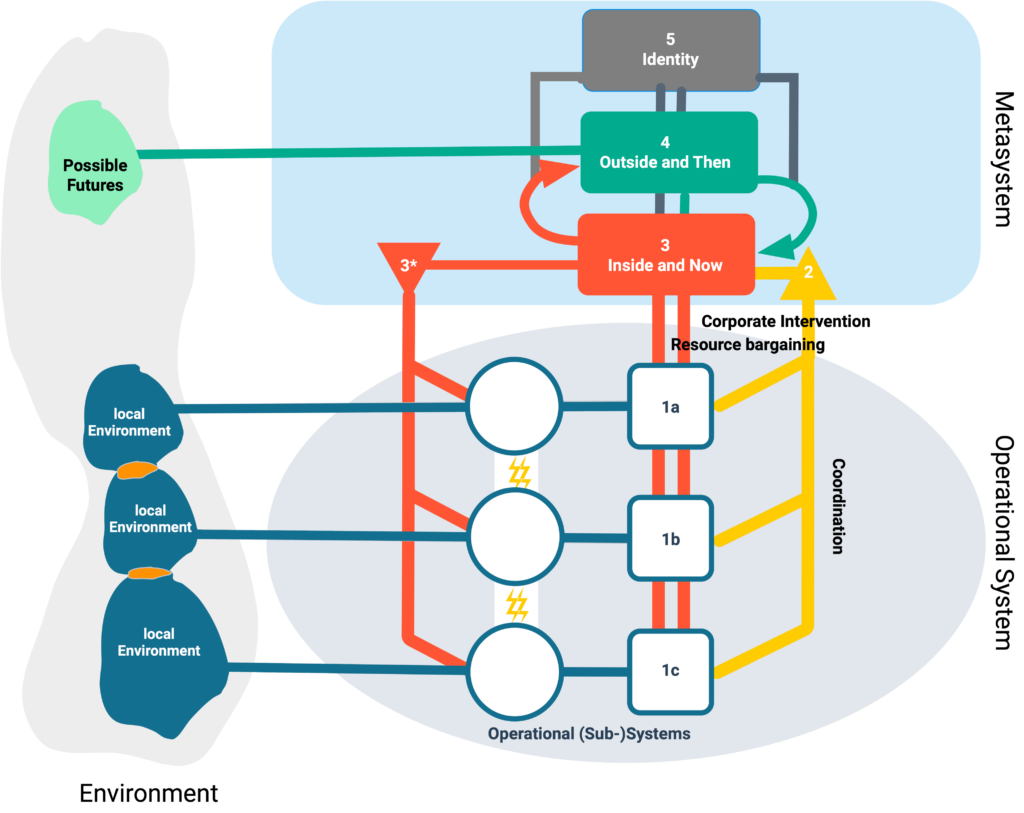
Each operational unit (e.g., 1a) has:
- Its own purpose (its specific value-producing activity).
- Its own local environment (its "niche").
- Its own operational management (the small square attached to it), which is effectively the metasystem for that unit.
This is the VSM's profound solution to managing complexity. It doesn't try to eliminate it; it delegates it. It pushes the responsibility for absorbing variety down to the lowest possible level, giving those units the autonomy to do so effectively. As we saw in Beer's lecture from the previous lesson, this is what so excited Salvador Allende: the model inherently empowers the operational level—"¡el pueblo!"
System 1 in Practice: A Software Organization
Given your computer science background, let's map these concepts onto a more familiar domain. The following image shows a VSM analysis of a software development organization. It's complex, but it provides a rich, real-world illustration of System 1 at work.

Take a moment to study the blue "Value Production" area at the bottom. This is System 1. Notice the components:
- Operational Units: These are the teams doing the primary work: "IT Devs," "IT Ops," "Support," "Sales," "UI design," etc. Each of these is a System 1 unit.
- Local Environments: Look at the clouds outside the main blue area that these units interact with. "Users" interact with "Front" (front-end developers) and provide "User feedback." The "IT Ops" team deals with "Google Cloud" and "docker images." The development teams as a whole deal with "npm packages" and other dependencies. Each unit faces a different set of environmental complexities.
- Autonomy in Action: For this organization to be viable, the "IT Devs" team must have the autonomy to decide how to "write code," "fix security issues," and "solve problems" without seeking permission from the "High Brain" (System 5) for every line of code. They have the local knowledge and therefore the requisite variety to manage the technical environment. Similarly, the "Support" team needs the autonomy to handle "user feedback" directly.
This example brings the theory to life. System 1 isn't an abstract concept; it's the collection of real teams and people creating value and wrestling with the complexity of their immediate worlds. The VSM provides the language and structure to understand how they must function to ensure the entire organization thrives.
Conclusion
This lesson has taken you into the engine room of the Viable System Model. We've defined System 1 not just as a department on an org chart, but as the collection of autonomous, value-creating, viable systems that form the foundation of any organization.
Here are the essential takeaways:
- System 1's function is to perform the primary activities that realize the system's purpose—its raison d'être.
- Each System 1 unit operates in a local environment, and its success depends on having requisite variety to absorb that environment's complexity. This is the cybernetic justification for autonomy.
- The principle of recursion is key: every operational unit within System 1 must itself be a viable system, with its own management and ability to adapt.
Of course, granting autonomy to multiple powerful operational units creates a new problem: how do you ensure they work together harmoniously instead of pulling in different directions? Complete autonomy leads to disintegration. In our next lesson, we will address this by examining System 2 (Coordination), the VSM function designed to damp oscillations and foster harmony among the operational units of System 1.