Introduction
In our previous lesson, we inventoried the four primary technological components of Project CyberSyn: the Cybernet communications grid, the Cyberstride data-filtering software, the CHECO economic simulator, and the iconic Operations Room. Having familiarized ourselves with these individual parts, we can now assemble them conceptually to understand the project's overarching architecture.
This lesson directly addresses your core interest: seeing how the theoretical principles of cybernetics, specifically Stafford Beer's Viable System Model (VSM), were translated into a concrete design for national governance. We will analyze how CyberSyn was a deliberate, ambitious attempt to build a VSM for the entire Chilean social economy. This is not just a historical exercise; it's our first application of the VSM as a powerful analytical tool to deconstruct and understand a complex system, a skill we will continue to hone throughout this course.
The VSM: A Blueprint for a Nation
Before mapping CyberSyn's parts onto the Viable System Model, it's helpful to refresh our understanding of the VSM's fundamental structure and philosophy. Remember, Beer's goal was not to create a rigid, top-down hierarchy but a system that could balance autonomy with cohesion, allowing operational units the freedom to manage their own affairs while ensuring the whole system remained stable and directed towards a common purpose.
The video "The Viable System Model" by Auxiliary Statements offers a concise and visually clear review of the model's core concepts.
Please watch the segments from the introduction to the VSM, which contrasts it with typical hierarchical structures, and from the detailed breakdown of Systems 1 through 5, the algedonic signal, and the crucial concept of recursion. Pay close attention to the human body analogy and how each system contributes to the whole.
As the video emphasizes, two concepts are paramount for our analysis: the five interacting subsystems and the principle of recursion. Your computer science background provides a strong intuition for recursion: a function that calls itself, or a data structure defined in terms of itself. In the VSM, recursion means that every viable system is composed of other viable systems, each of which contains further viable systems, and so on.

This recursive structure was central to Beer's design. The national economy was the "system in focus," but it was composed of operational units like the industrial sector, which itself was composed of individual firms, then workshops, and crews. Each of these levels was to be structured as a VSM, granting it the autonomy to manage its own affairs while being cohesively integrated into the next level up.
Mapping CyberSyn to the VSM
With the VSM's structure refreshed, we can now see how CyberSyn's components were designed to serve its various functions. This was not a loose analogy; Beer and his team explicitly designed the technology to instantiate the VSM's information channels and regulatory loops.
System 1: The Operations
This is the part of the system that does things—the fundamental activities that justify the system's existence.
- In CyberSyn: The System 1 units were the nationalized factories, mines, and other state-run enterprises. These were the productive engines of the economy, each one considered a viable system in its own right, responsible for its day-to-day operations.
System 2: Coordination
System 2's role is to dampen harmful oscillations between the System 1 units. It's an anti-oscillation mechanism that ensures the autonomous operational units don't work at cross-purposes.
- In CyberSyn: This function was primarily enabled by Cybernet. By creating a near real-time communication network, factory managers could coordinate directly with each other to solve shared problems (e.g., one factory has a surplus of a raw material that another needs) without having to go "up the chain of command." This "horizontal coordination" was a key design feature meant to increase efficiency and autonomy at the operational level.
System 3: Control and the "Inside-and-Now"
System 3 is responsible for the internal regulation of the system as a whole, focusing on optimizing current operations. It represents the classic management function of "command and control," but in a cybernetic, not autocratic, sense. It receives filtered information from the System 1s to maintain a big-picture view.
- In CyberSyn: The software Cyberstride was the technological heart of System 3. Its purpose was to perform variety attenuation: taking the torrent of raw data from the factories and using statistical analysis to filter it, presenting managers with only the critical information. The government body CORFO acted as the human component of System 3, using the information from Cyberstride to manage the overall industrial sector.
System 3*: The Audit Channel
System 3* (Three-Star) is a special, high-priority audit channel that bypasses System 2. It provides System 3 with an intermittent, direct look into the operations of System 1, ensuring that the filtered information System 3 normally receives is accurate and that problems aren't being hidden.
- In CyberSyn: This was the function of the algedonic signal (the "pain/pleasure" signal). When Cyberstride detected a significant statistical deviation in a factory's performance—a potential crisis or a remarkable success—it triggered an algedonic alert. This signal went straight from the operational unit (System 1) to the relevant management body (System 3), providing an immediate, unmediated warning. The escalation protocol we discussed in the last lesson is a perfect example of this channel in action.
[PDF] Working Paper No. 67, Insights into Project Cybersyn - PDXScholar
The paper from Portland State University provides a clear summary of how the VSM was embedded in the project's logic.
Please read the section that describes how the VSM's structure was programmed into Cyberstride. Find the paragraph that begins "Though Cybernet was the tool". This passage explicitly details how the system was designed to notify workers first and only escalate problems to higher levels (CORFO, the state) if they couldn't be resolved locally, thus embedding the principles of autonomy and management-by-exception directly into the software.
System 4: Intelligence and the "Outside-and-Then"
System 4 is the strategic function. It looks outward to the system's environment and forward into the future, modeling, simulating, and planning for adaptation and long-term viability.
- In CyberSyn: This was the intended role of CHECO, the Chilean Economic Simulator. By using the real-time data from Cyberstride, CHECO would allow policymakers to "test" the potential consequences of economic decisions before implementing them. It was the government's laboratory for exploring the future and formulating strategy.
System 5: Policy and Identity
System 5 is responsible for ultimate closure and identity. It balances the "inside-and-now" pressures from System 3 with the "outside-and-then" strategic imperatives from System 4. It makes the final policy decisions and defines the overall purpose, values, and direction of the system.
- In CyberSyn: System 5 was embodied by President Allende's cabinet and the highest levels of government. The Operations Room was designed as the physical environment for System 5's deliberations. It was here that the leaders would absorb the information from Cyberstride (System 3) and the simulations from CHECO (System 4) to make final, binding policy decisions that would define the identity of the Chilean socialist project.
The Complete Cybernetic Scheme
When we put all these pieces together, we get the comprehensive cybernetic architecture that Beer designed.
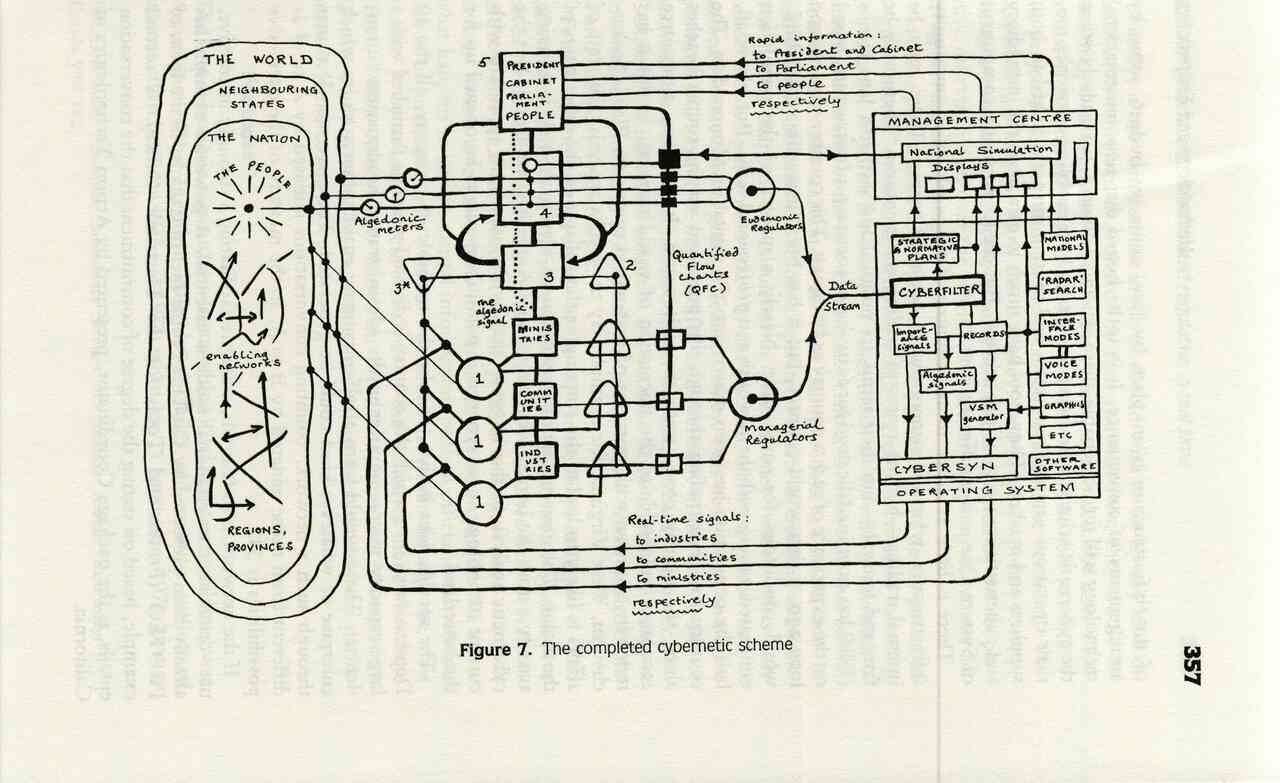
This diagram, though complex, synthesizes our entire analysis. On the far left, you see "The People, Regions, Provinces" organized into recursive levels—these are the System 1s. Information flows from them into the central operating system, where it is processed by Cyberfilter (System 3) and the Strategic & Normative Planner (System 4), before being presented in the Management Centre (the Opsroom) for deliberation by the President and Cabinet (System 5). The feedback loops—both for internal regulation and external communication—are all explicitly drawn.
More Than Just a Dashboard
It's tempting, especially from a modern perspective, to view CyberSyn as just an early "Executive Information System" (EIS)—a fancy dashboard for the president. However, one of the project's key Chilean directors, Raul Espejo, argues this view misses the point entirely. The true innovation was the attempt to restructure the entire organization of the state according to the VSM.
Cybersyn, big data, variety engineering and governance - PMC
In this reflective article, Raul Espejo explains the practical and conceptual challenges of applying the VSM in Chile.
First, read the subsection "My methodological beginnings with the viable system model VSM." Notice the difficulty the team had in moving from the VSM as a brain analogy to a practical tool for modeling the economy. This highlights the non-trivial effort of applying theory to practice. Next, skip down to the section "Real-time management and variety engineering" and read the long paragraph where Espejo quotes a letter he wrote, starting with "I am left with the impression". Here, he contrasts the holistic, power-balancing aims of the VSM (which he calls "variety engineering") with the more limited scope of an EIS, arguing that the latter may increase efficiency but fails to achieve the deeper cybernetic goal of organizational transformation.
Espejo's point is crucial. CyberSyn wasn't just about giving managers better data. It was about designing freedom and autonomy into the system, balancing power between workers and the state, and creating a new, more participatory form of governance. The technology was merely the instrument for achieving this deeper structural and philosophical goal.
Conclusion
In this lesson, we have moved from a simple inventory of CyberSyn's parts to a systemic analysis of its architecture. By using the Viable System Model as our map, we have seen how the project was a coherent and deliberate attempt to implement cybernetic principles at a national scale.
Key takeaways from our analysis include:
- Explicit Mapping: Each of CyberSyn's components had a specific role corresponding to one of the VSM's five systems or its communication channels (Cyberstride as System 3, CHECO as System 4, etc.).
- Recursion as a Core Principle: The design was fundamentally recursive, intending for every level of the economy—from the nation down to the factory floor—to be organized as an autonomous, viable system.
- More than Technology: The project's ultimate goal was not just to build a sophisticated information system, but to fundamentally restructure the organization of the Chilean economy to be more democratic, adaptive, and effective, embodying the VSM's principles of balancing autonomy and cohesion.
We have now used the VSM to understand the intended design of CyberSyn. In our next lesson, we will take this a step further. We will use the VSM as a formal diagnostic tool to evaluate the project in practice, identifying its cybernetic strengths and the weaknesses that may have contributed to its limitations and ultimate fate.