Hello. This course begins with the vocabulary needed for every later settlement check. You will go on to examine routes, qualifying residence, evidence, rights and proposed reforms. First, it helps to separate permission to be in the UK, British nationality, and the document or digital record used to prove either. This lesson establishes those distinctions without assuming that everyone follows the same route to settlement.
Permission can have a time limit—or no set end date
A visa is often the word people use for permission to come to or stay in the UK. In everyday speech, “I’m on a work visa” usually means the person has immigration permission under a work route. More precisely, a visa may be an entry document, while the underlying permission determines how long someone can stay and what they may do. A physical visa sticker is evidence of a grant, not the grant itself.
Limited leave is permission subject to a time limit. Its conditions depend on the route: permission to study, for example, is not interchangeable with permission to work. A person can hold successive grants of limited leave without yet being settled. Nor does every form of limited leave lead to settlement.
Indefinite leave to remain (ILR) and indefinite leave to enter (ILE) are different: they impose no set time limit on staying in the UK. “Remain” and “enter” describe the form in which indefinite permission was granted; neither term means British citizenship. GOV.UK describes someone with ILR or ILE whose home is in the UK as settled. “Indefinite” does not mean impossible to lose—the circumstances in which status can lapse or be taken away come later in the course.
Indefinite leave to remain in the UK: your rights and status - GOV.UK
Read this UK Visas and Immigration guidance for its precise definition of indefinite leave and its distinction between status and proof of status.
In “If you have indefinite leave to remain or enter (ILR or ILE),” read the definition. In “If you do not have a document to prove your ILR or ILE,” read from the paragraph beginning “If you believe that you have ILR or ILE” through the eVisa definition. Finally, in “If you have ‘settled status’ under the EU Settlement Scheme,” read the opening paragraph through the sentence ending “view and prove your status”; notice how proof works for that status. You can stop before “Your biometric residence permit (BRP).”
The wording matters when reading an immigration history. “Has ILR” identifies permission without a set end date. “Has a visa” is less precise: it does not, by itself, tell you the route, the conditions, or whether the person has become settled.
The EU Settlement Scheme uses two similar-sounding labels
Under the EU Settlement Scheme (EUSS), settled status is a grant of indefinite leave under that scheme. The word settled therefore describes genuine indefinite immigration status, not citizenship. The EUSS has its own eligibility and residence rules; its familiar name is not a reason to apply another settlement route’s rules to it.
Pre-settled status is different. It is generally limited leave under the EUSS, even though it can be extended. It does not become a grant of settled status merely because five years have passed. A person may become eligible for settled status, but the applicable EUSS requirements and their individual position must be checked. The GOV.UK guidance also describes circumstances in which a person with pre-settled status may have a permanent right to live in the UK without yet having a grant of settled status. That nuance is another reason not to treat the label alone as a complete account of someone’s rights.
Apply to the EU Settlement Scheme (settled and pre-settled status): What you’ll get - GOV.UK
Read this GOV.UK guide to compare the two EUSS outcomes and see why a right, a grant of status, and eligibility for citizenship are not identical.
In “What you’ll get,” read the opening list and the paragraphs immediately below it, from the two outcomes through the explanation that applicants do not choose which status they receive. Continue through the short paragraph beginning “You may be eligible for settled status before you have 5 years’ continuous residence”; it qualifies the usual pattern. Then, in “Your rights with settled or pre-settled status,” read the rights and distinctions from the rights list to the final sentence about possible eligibility for settled status. Focus on the conditions attached to public funds and citizenship, not just the list of activities both groups may undertake.
Both EUSS statuses can allow work, study and travel. That overlap does not make them the same kind of leave. Nor does settlement automatically grant benefits: access to public funds remains subject to the relevant benefit’s eligibility rules.
British citizenship is a separate status of nationality, not a more permanent version of a visa sticker or an eVisa. A person with ILR or EUSS settled status does not automatically become a British citizen. Some people are British citizens from birth; others acquire citizenship through a separate process if they qualify. Settlement can be relevant to a later citizenship application, but the two decisions answer different questions. Holding ILR also does not, by itself, change a person’s nationality or give them a British passport.
A record proves status; it does not create it
The sample biometric residence permit (BRP) below shows how a physical document could display a person’s permission. It is a historical sample showing student leave to remain, a “valid until” date and a work condition—not a specimen of ILR. Those printed details describe permission at the time the card was issued. An old card alone cannot establish what permission its holder has now.
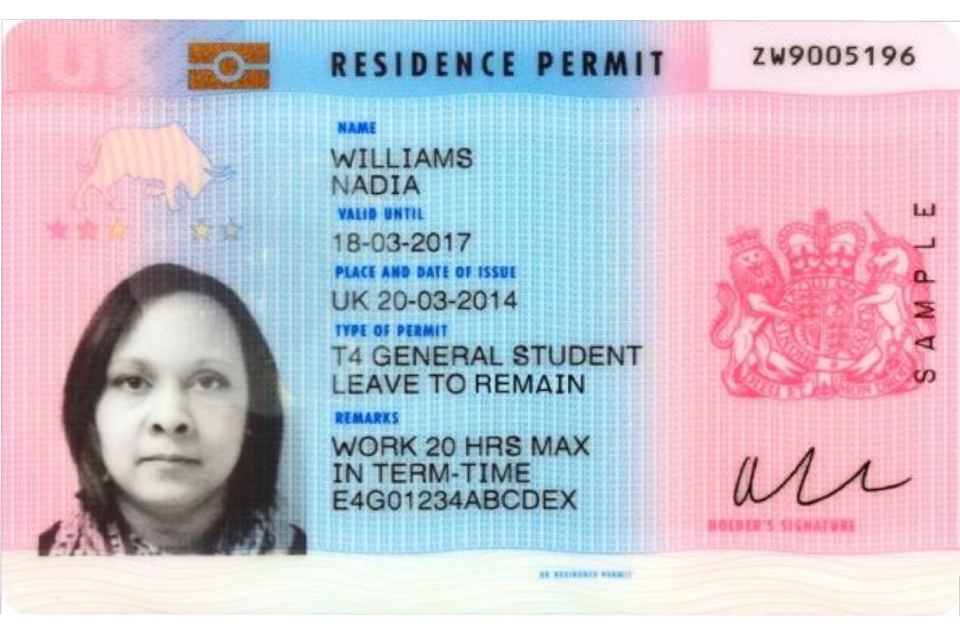
An eVisa serves a different format of proof: it is a digital record of identity and immigration status. It can record time-limited permission or indefinite permission. Having access to an eVisa is therefore not a separate settlement route and does not mean the person has ILR. Similarly, a UKVI account provides a way to access a record, while a share code lets someone check specified information from it; neither is a new grant of immigration permission.
2024: How to prove your immigration status with an eVisa
Watch the Home Office’s “2024: How to prove your immigration status with an eVisa” for a practical view of the difference between digital proof and the permission it displays.
Watch the introduction on replacing physical evidence with a digital record, then view and prove on inspecting status online. Skip ahead to share codes, noting that a code is generated for a particular purpose, such as proving a right to work. Keep the distinction in mind throughout: the service shows or shares information about permission already held.
A useful way to read any claim about immigration status is to identify what is being claimed and what is being shown as evidence. “Settled status” names a grant under the EUSS. “An eVisa showing settled status” names a digital record of that grant. “A share code” is a means of showing selected information from the record to someone else.
Keep the labels in their proper places
| Term | What it identifies |
|---|---|
| Visa | An often-used term for immigration permission or its entry document; check the actual route and grant. |
| Limited leave | Immigration permission with a time limit and route-specific conditions. |
| ILR / ILE | Indefinite immigration permission, not British citizenship. |
| EUSS settled status | Indefinite leave granted under the EU Settlement Scheme. |
| EUSS pre-settled status | Generally limited leave under the EU Settlement Scheme, not itself a grant of settled status. |
| British citizenship | Nationality, distinct from immigration permission. |
| eVisa | A digital record used to view and prove immigration status, not a type of leave in its own right. |
These distinctions are the foundation for the rest of the course. When you next encounter a case described only as “a visa holder” or “settled,” you will need the specific route and grant before drawing conclusions about eligibility. The next lesson uses the official settlement route finder to locate that route’s guidance rather than assuming one set of rules applies to everyone.