Hello! Welcome to the final lesson of your engineering economics course.
Over the last twelve modules, you have built a robust analytical toolkit, moving from fundamental concepts like time value of money to sophisticated methods for handling risk, taxes, and inflation. In our last session, you learned how to translate your analysis into a persuasive recommendation for business stakeholders.
In this capstone lesson, we will step back and look at the big picture. Our goal is to review and synthesize the core principles of engineering economics for software and technology projects. This isn't about learning new material, but about connecting all the pieces into a coherent framework that you can carry forward and apply directly in your work as a software leader and manager.
1. The Guiding Philosophy: Core Principles
Before we review the specific techniques, let's revisit the fundamental mindset of engineering economics. Any sound analysis is built upon a set of core principles. These principles guide your thinking and ensure your conclusions are logical and defensible.
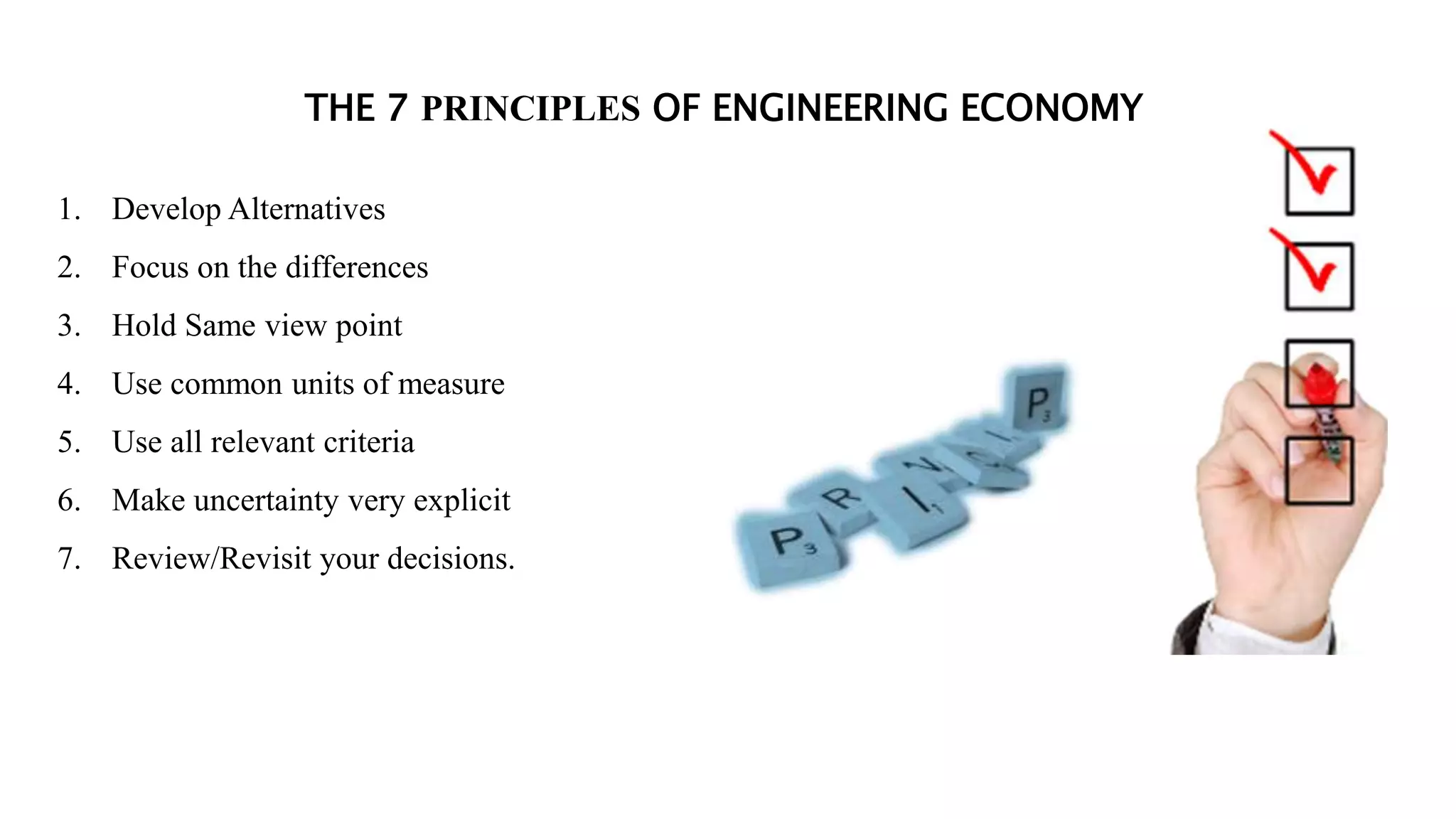
While all seven are important, let's highlight three that are especially critical in the context of technology decisions:
- Develop Alternatives: This is the cornerstone of engineering economics. A decision only exists if there are choices. For you, this means always framing a problem as a choice between well-defined options: build vs. buy, refactor vs. replace, AWS vs. Azure.
- Focus on the Differences: Once you have alternatives, your analysis should focus only on the costs and benefits that differ between them. If two cloud-provider options use the same number of developers, that labor cost is irrelevant for the choice. This is the logic behind the incremental analysis we performed when comparing projects.
- Make Uncertainty Explicit: No forecast is perfect. Acknowledging and quantifying uncertainty is what separates a naive analysis from a professional one. Our work on sensitivity analysis (Module 9) and probabilistic methods (Module 10) was all about addressing this principle head-on.
2. A Unified Framework for Analysis
With these principles as our guide, how do we systematically approach a problem? The many techniques we've covered—PW, AW, IRR, B/C, depreciation, sensitivity analysis—can be organized into a logical workflow.
First, let's anchor our toolkit with a concise summary of the primary evaluation methods.
1.011 Project Evaluation Review
As we synthesize the course, this review sheet from an MIT Project Evaluation course provides a succinct summary of the core evaluation criteria. This directly aligns with your goal of learning in accordance with MIT's approach.
Quickly read section 1.2, 'Monetary Criteria for Accepting a Project'. This list—Net Present Value, Future Value, Annual Worth, IRR, and Benefit/Cost Analysis—is the heart of our analytical toolkit. Note how each provides a clear rule for project acceptance (e.g., NPV > 0, IRR > MARR).
Now, how do you decide which of these tools to use? The following flowchart provides a "master key" for navigating your decision-making process.

Let's trace the most common path through this map, which reflects the structure of our course:
- Frame the Problem: Identify alternatives (e.g., build a new feature vs. integrate a 3rd party service).
- Model Cash Flows: For each alternative, construct a cash flow model over a defined study period, estimating all costs and benefits (Module 2).
- Follow the Flowchart:
- "Are all Decision Criteria (DCs) convertible to present dollars?" For most business decisions, the answer is YES. This takes us down the main branch of our analysis.
- This leads to our core evaluation methods: Present Worth (PW/NPW), Annual Worth (AW), and Internal Rate of Return (IRR). As we've learned, PW is the most reliable method for comparing mutually exclusive projects, while AW is ideal for alternatives with unequal lives.
- Notice the loops for uncertainty and sensitivity analysis. After getting a baseline result, you must test your assumptions, as we did in Module 9.
- If some criteria are NOT convertible to dollars (e.g., team morale, brand image), the flowchart directs you to methods like multiple-attribute evaluation, which we discussed as qualitative or scoring models (Module 7).
This framework integrates everything: you start with principles, model the specifics, select the right tool using a logical flow, test for uncertainty, and account for both tangible and intangible factors.
3. Bringing it Home: Software Engineering Economics
To conclude our review, let's explicitly connect this framework to your domain. The principles and techniques of engineering economics are not just for civil or mechanical engineers building bridges and power plants; they are powerful tools for making strategic software development and technology investment decisions.
SWE 402: Software Engineering Economics
To bring all these concepts directly into your world of software development, this document on Software Engineering Economics provides an excellent summary of why these principles and techniques are so relevant.
Please read the sections 'What is Software Engineering Economics (SWEE)?' and 'Examples of economic principles that can be applied in software engineering'. Focus on the list of questions SWEE addresses (cost estimation, ROI, lifecycle costing) and the examples of applying Opportunity Cost, Marginal Analysis, and Time Value of Money to software projects.
As the reading highlights, every major decision you face has an economic dimension:
- The opportunity cost of choosing Python/Django over another tech stack.
- The marginal analysis of deciding whether one more week of performance optimization is worth the effort.
- The time value of money when evaluating whether to invest in a large-scale platform refactor now for benefits that will accrue over many years.
By applying the frameworks from this course, you can move from making these decisions based on technical intuition alone to making them with a clear, data-driven, and financially sound rationale that aligns with business objectives.
Conclusion and Final Thoughts
Congratulations on completing the course! You have successfully journeyed from the foundational concepts of economics to a comprehensive, practical framework for evaluating complex technology projects.
Our synthesis today leaves you with two key takeaways:
- A Guiding Philosophy: The seven principles of engineering economics provide a robust mindset for approaching any decision that involves allocating scarce resources—be it time, money, or engineering talent.
- A Systematic Framework: You now have a structured process to move from a problem statement to a defensible recommendation, equipped with a versatile toolkit (PW, AW, IRR, etc.) and a clear map for when to use each tool.
The ultimate goal of engineering economics is to bridge the gap between what is technically possible and what is economically valuable. Your ability to build this bridge is what will distinguish you as a strategic leader. I encourage you to actively apply these models and ways of thinking in your work. Start small, perhaps by modeling a simple make-vs-buy decision, and build from there.
It has been a pleasure guiding you through this subject. Best of luck in your future projects