Hello! Welcome back to our module on Present Worth Analysis.
In our last lesson, you learned how to use Present Worth (PW) analysis to make a "go/no-go" decision for a single project. The rule was clear: if the PW of a project at the MARR is greater than or equal to zero, it's financially viable.
Today, we address a more common and practical business scenario: choosing between several viable options. Often, you can't pursue every good idea. You must select the best one from a set of competing alternatives. This is especially true in software and technology, where you might have to decide between different architectures, platforms, or vendors for the same goal.
Our learning outcome is to compare mutually exclusive alternatives using the present worth method. By the end of this lesson, you'll be able to confidently recommend one project over another using a clear, data-driven framework.
Mutually Exclusive vs. Independent Projects
First, let's clarify a critical distinction.
- Mutually Exclusive Projects: These are "either/or" choices. Selecting one alternative automatically excludes all others. For example, if you're choosing a cloud provider for a new application, you can build it on AWS or Google Cloud or Azure, but not all three simultaneously for the same deployment.
- Independent Projects: The decision to accept or reject one project does not affect the decision on another. For instance, a project to upgrade your company's CRM system can be evaluated independently of a project to redesign the corporate website. You could do both, one, or neither, depending on their individual merits and your budget.
When projects are mutually exclusive, simply finding all options with a PW > 0 isn't enough. We need a rule to select the single best option.

The decision rule for mutually exclusive alternatives is straightforward:
Of the available alternatives, select the one with the numerically largest (most positive) Present Worth (PW).
Of course, the selected alternative must still have a PW greater than or equal to zero to be better than doing nothing.
Comparing Alternatives with Present Worth
Let's apply this rule. The key is to ensure you are making an "apples-to-apples" comparison. For today, we will assume all alternatives have the same useful life. We will tackle the challenge of unequal lives in our next lesson.
Scenario 1: Revenue Alternatives
These are projects that generate different costs and different revenues. Your goal is to maximize the net value.
Example: Your firm is deciding which of two mobile app features to develop. Both are mutually exclusive due to resource constraints. Both have a projected life of 4 years, and the company's MARR is 12%.
- Feature A (Enhanced User Profiles):
- Initial Cost: $60,000
- Annual Net Revenue: $25,000
- Feature B (Gamification Module):
- Initial Cost: $90,000
- Annual Net Revenue: $35,000
Let's calculate the PW for each. We'll use the Present Worth of an Annuity factor (P/A, 12%, 4).
Recall the formula: .
For i=12% and n=4, the (P/A) factor is 3.0373.
PW for Feature A:
PW for Feature B:
Decision:
Both projects are acceptable (PW > 0). However, since they are mutually exclusive, we apply our rule: select the one with the higher PW.
.
Therefore, we should choose to develop Feature B. It is expected to create slightly more value for the firm in today's dollars.
Scenario 2: Cost Alternatives
These are projects that provide the same service or accomplish the same task, so there are no differential revenues to consider. The goal is to select the option that accomplishes the task at the minimum cost.
Example: You need to choose a server for a 5-year project. Both options meet the technical requirements. MARR is 10%.
- Server Option 1 (On-Premise):
- Initial Cost: $20,000
- Annual Maintenance: $3,000
- Server Option 2 (Cloud Lease):
- Initial Cost: $0
- Annual Lease Cost: $7,500
For i=10% and n=5, the (P/A) factor is 3.7908.
PW of Costs for Option 1:
PW of Costs for Option 2:
Decision:
Here we are comparing two negative values. Our rule is to select the numerically largest PW.
.
Therefore, we should choose Server Option 2 (Cloud Lease). Its total life-cycle cost, expressed in today's dollars, is lower.
Test your understanding!
Your company needs a new automated deployment system. You are comparing two mutually exclusive software packages, "DeployBot" and "ShipIt". The analysis period is 6 years and the MARR is 15%.
- DeployBot: Initial license cost of $40,000 and an annual support fee of $10,000.
- ShipIt: Initial license cost of $75,000 and an annual support fee of $5,000.
Which system is the more economical choice based on PW analysis? The (P/A, 15%, 6) factor is 3.7845.
Show answer
-
Calculate PW of Costs for DeployBot:
-
Calculate PW of Costs for ShipIt:
-
Compare and Decide:
We compare the two present worth values:-$77,845(DeployBot) and-$93,922.50(ShipIt).
Since-$77,845is numerically larger (less negative) than-$93,922.50, DeployBot is the more economical choice.
Why PW Analysis is Robust: The Incremental Investment
You might be tempted to use other metrics, like the Internal Rate of Return (IRR), to rank projects. However, for mutually exclusive alternatives, this can lead to the wrong choice. The PW method is more reliable because it correctly accounts for the value of incremental investments.
Consider our first example. Feature B required an extra investment of $30,000 ($90k - $60k) to get an extra annual revenue of $10,000 ($35k - $25k). The PW analysis implicitly confirmed that this incremental investment was worthwhile—it generated a return greater than the 12% MARR, adding to the total value. Choosing the project with the highest PW ensures you are maximizing the total value created, not just the percentage return on the initial investment.
To deepen your understanding of this crucial point, the following reading provides an excellent example.
Vol. II, Essay 4: Financial Assessment
This essay from an MIT course collection explains exactly why relying on IRR can be misleading when choosing between mutually exclusive projects. It uses a clear step-by-step analysis of an incremental investment to show why maximizing Net Present Value is the correct financial objective.
Please read the section titled 'Choosing Among Mutually Exclusive Projects' (it begins on page 59 and continues to page 61). Pay close attention to the example comparing a parking lot with buildings of different sizes. The key is to understand how they evaluate the incremental investment required to go from a smaller option to a larger one. This will solidify why selecting the alternative with the highest PW is the right strategy.
A Preview: The Problem of Unequal Lives
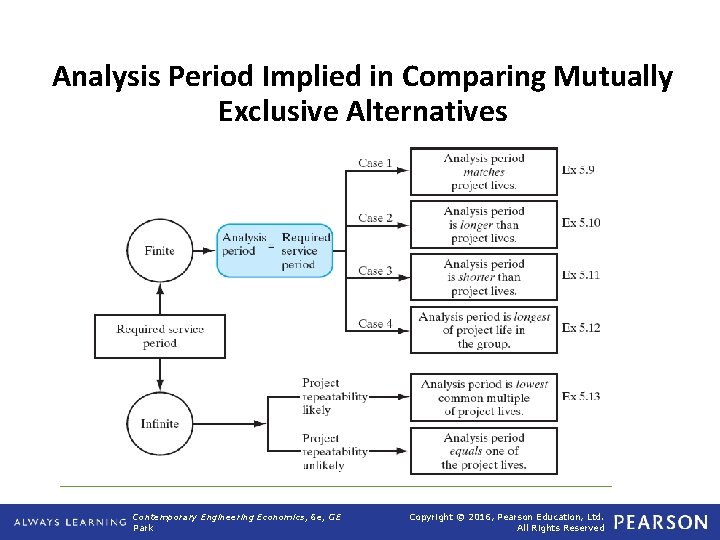
A key assumption we've made today is that all alternatives have the same lifespan. But what if you are comparing a server with a 3-year life to one with a 5-year life? A direct PW comparison would be misleading because it doesn't account for the full service period required.
Conclusion
You now have a robust method for choosing between competing, mutually exclusive projects. This is a powerful tool for making investment decisions related to technology and software development.
- Key Takeaways:
- For mutually exclusive alternatives with equal lives, you should select the one with the highest Present Worth (PW), as long as that PW is positive.
- For revenue alternatives, this means choosing the project that creates the most net value.
- For cost alternatives, this means choosing the project with the lowest PW of costs (the least negative PW).
- The PW method is superior to simple IRR ranking for these decisions because it correctly values the return on incremental investments.
Preview of the Next Lesson
The issue of unequal lives is a common and important one. In our next lesson, we will dive into this challenge, learning how to handle alternatives with unequal useful lives using the least common multiple of lives or a defined study period, ensuring our comparisons are always on a level playing field.