Hello! Welcome to the fourth lesson in our module on Financial Mathematics.
In our last lesson, we explored simple and compound interest, using the core formula . A key assumption we made was that interest was compounded annually. However, in the real world of finance—from business loans to SaaS subscriptions—interest is often calculated and added to the principal more frequently: semi-annually, quarterly, or even monthly. This has a significant impact on the total amount of interest paid or earned over a year.
Today's lesson addresses this directly. Our goal is to convert between nominal and effective annual interest rates to account for compounding frequency. Understanding this distinction is essential for making accurate financial comparisons, a skill you'll need constantly when evaluating technology projects or investment opportunities.
Nominal vs. Effective Interest Rates
When you see an advertised interest rate, you're usually looking at the nominal interest rate. However, the actual rate you earn or pay depends on how often the interest is compounded.
To formalize this, let's look at the definitions provided by the MIT course materials.
Engineering Risk Benefit Analysis
This short excerpt from 'Engineering Risk Benefit Analysis' defines the two key terms for today's lesson: nominal and effective interest rates.
Please read the section titled 'Nominal and Effective Interest Rates (1)' on page 17. Focus on the definitions and the credit card example.
Here’s a summary of those crucial concepts:
- Nominal Interest Rate (r): This is the stated annual interest rate before considering the effects of compounding. It's often quoted as "X% per year, compounded Y-ly". For example, "12% per year, compounded monthly".
- Effective Interest Rate (i_eff): This is the actual annual rate of interest you earn or pay. It reflects the real impact of compounding over the course of a year. Because you start earning interest on your interest sooner and more often, the effective rate is almost always higher than the nominal rate (unless compounding is only annual).
Think of it this way: the nominal rate is the advertised specification, like a server's clock speed. The effective rate is the actual performance you get, which is influenced by other factors like the system bus speed and cache (the compounding frequency).
The Conversion Formula
To convert a nominal rate to an effective annual rate, we use a straightforward formula that builds directly on what we learned last lesson.
Let:
r= the nominal annual interest ratem= the number of compounding periods per year
The interest rate per period is simply . We then compound this for all m periods in the year. The formula for the effective annual interest rate, , is:
Let's break this down:
- : This calculates the interest rate for a single compounding period (e.g., for a monthly rate, you divide the annual rate by 12).
- : This is the growth factor for one period.
- : This compounds the growth over all
mperiods within a single year. - : This subtracts the original principal to isolate the total interest earned over the year, giving us the effective rate.
Example: The Credit Card
Let's use the example from the reading: a nominal rate of 18% compounded monthly.
r= 0.18m= 12 (since it's compounded monthly)
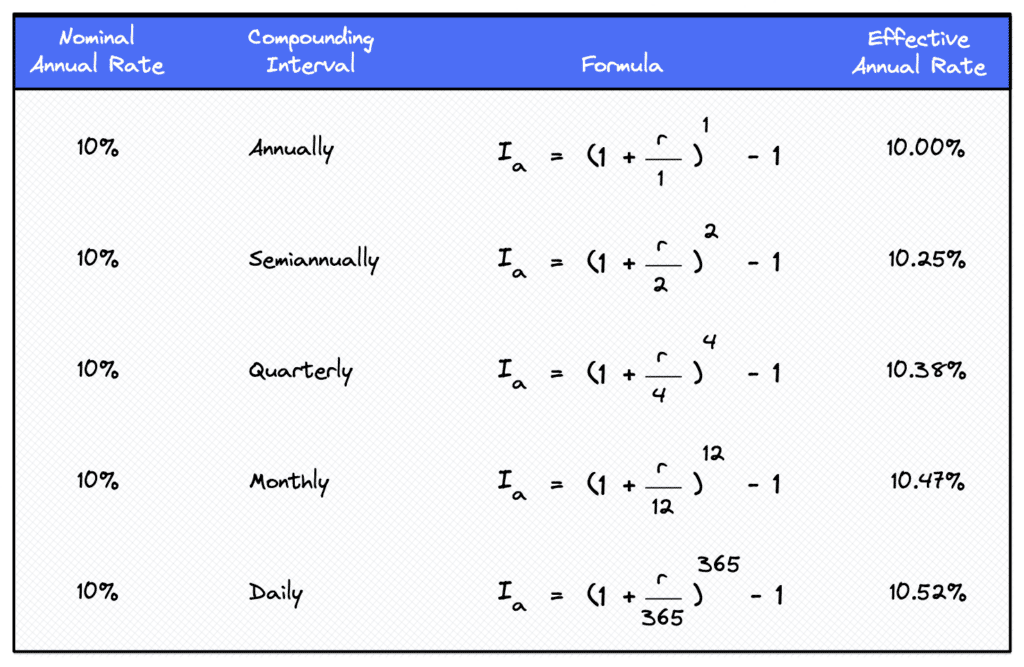
So, a nominal rate of 18% compounded monthly is actually an effective annual rate of 19.56%. This is the rate you would use to find the future value after one full year: .
The more frequently you compound, the higher the effective rate becomes.
Why This Matters: Comparing Alternatives
The real power of this concept comes when you need to compare different financial options. As a manager, you'll often face choices between loans, investments, or vendor contracts with different interest rates and compounding periods. You can't simply compare the nominal rates; you must convert them to a common basis, and the effective annual rate is the perfect tool for that.
Let's analyze a practical scenario.
1.7 Effective and Equivalent Interest Rates – Financial Math
The following reading presents a common problem: choosing between two loans with slightly different nominal rates and compounding frequencies. It demonstrates how to use the effective interest rate to make the correct decision.
Read the 'Introduction' and the section on 'Effective Interest Rates', up to (but not including) the calculator instructions. Focus on the example comparing the two loans: 6.6% compounded semi-annually vs. 6.57% compounded quarterly.
Let's work through that example together. You need to choose the cheaper loan:
- Loan A: 6.6% nominal, compounded semi-annually (
m=2) - Loan B: 6.57% nominal, compounded quarterly (
m=4)
At first glance, Loan B looks cheaper because 6.57% is less than 6.6%. But is it? Let's calculate the effective annual rate for both.
Loan A:
Loan B:
After converting both to their effective annual rates, we see that Loan A is actually the better option, despite having a higher nominal rate. The less frequent compounding works in your favor as a borrower. This is a critical insight for making sound financial decisions.
Test your understanding!
Your company is evaluating two financing options for new server hardware.
- Option 1: A loan with a 10% nominal annual rate, compounded quarterly.
- Option 2: A loan with a 9.8% nominal annual rate, compounded monthly.
Which option has the lower effective annual rate and is therefore the cheaper choice?
Show answer
Option 1 (Compounded Quarterly):
r= 0.10,m= 4- or 10.38%
Option 2 (Compounded Monthly):
r= 0.098,m= 12- or 10.25%
Option 2 has the lower effective annual rate (10.25% vs 10.38%), making it the cheaper financing choice. This again shows that the lowest nominal rate isn't always the best deal.
Conclusion
Today we've added a crucial layer of realism to our understanding of interest. What you see (the nominal rate) isn't always what you get (the effective rate).
- Key Takeaways:
- The Nominal Rate (r) is the stated annual rate.
- The Effective Rate (i_eff) is the true annual rate once compounding is included.
- The formula allows you to convert from nominal to effective.
- Always compare financial options based on their effective interest rates, not their nominal rates, to ensure a true "apples-to-apples" comparison.
Preview of the Next Lesson
Now that we can calculate a true, comparable annual interest rate for any opportunity, we need a way to decide if that rate is "good enough" for our business. In the next lesson, we will define the Minimum Acceptable Rate of Return (MARR). The MARR is your company's unique hurdle rate—the minimum return it must expect from a project to even consider investing. It's the benchmark against which all investment opportunities are judged.