Hello! Welcome back.
In our last lesson, we explored intangible benefits and externalities—the crucial project impacts that don't show up on a balance sheet. We discussed how factors like brand reputation or team morale are vital, but we ended with a key question: if you can't assign a dollar value to these things, how do you compare them when choosing between projects?
Today, we will answer that question directly. Our learning outcome is to apply non-monetary scoring models to compare projects with significant intangible factors. We will build a structured, practical framework that allows you to systematically evaluate and rank alternatives based on multiple, often subjective, criteria. This method is a cornerstone of strategic project selection and is especially powerful for technology decisions where intangible value is paramount.
1. From Intuition to Structure: Weighted Scoring Models
When you're faced with choosing between, say, refactoring a legacy system versus building a speculative new feature, your decision involves trading off different kinds of value. This is a classic Multi-Criteria Decision Analysis (MCDA) problem. While the theory can be complex, the most common and practical approach is the weighted scoring model.
Let's begin by reading a short overview of MCDA to understand its core components.
Multi-Criteria Decision Analysis (MCDA/MCDM)
The article 'Multi-Criteria Decision Analysis (MCDA/MCDM)' provides an excellent, non-technical introduction to this field. It will help us define the essential building blocks of our scoring model.
Please read the section 'How does Multi-Criteria Decision Analysis work?'. Focus on the four key components it identifies: Alternatives, Criteria, Weights, and Decision-makers.
As the article explains, the goal is to move beyond "gut feel" to a more transparent process. A weighted scoring model does this by breaking the decision down:
- Criteria: The factors that matter for the decision (e.g., Strategic Fit, Cost, Risk).
- Weights: The relative importance of each criterion.
- Scores: A rating of how well each alternative performs on each criterion.
By combining these, we can calculate a single, overall score for each alternative. Here is a clear example of what a completed model looks like.
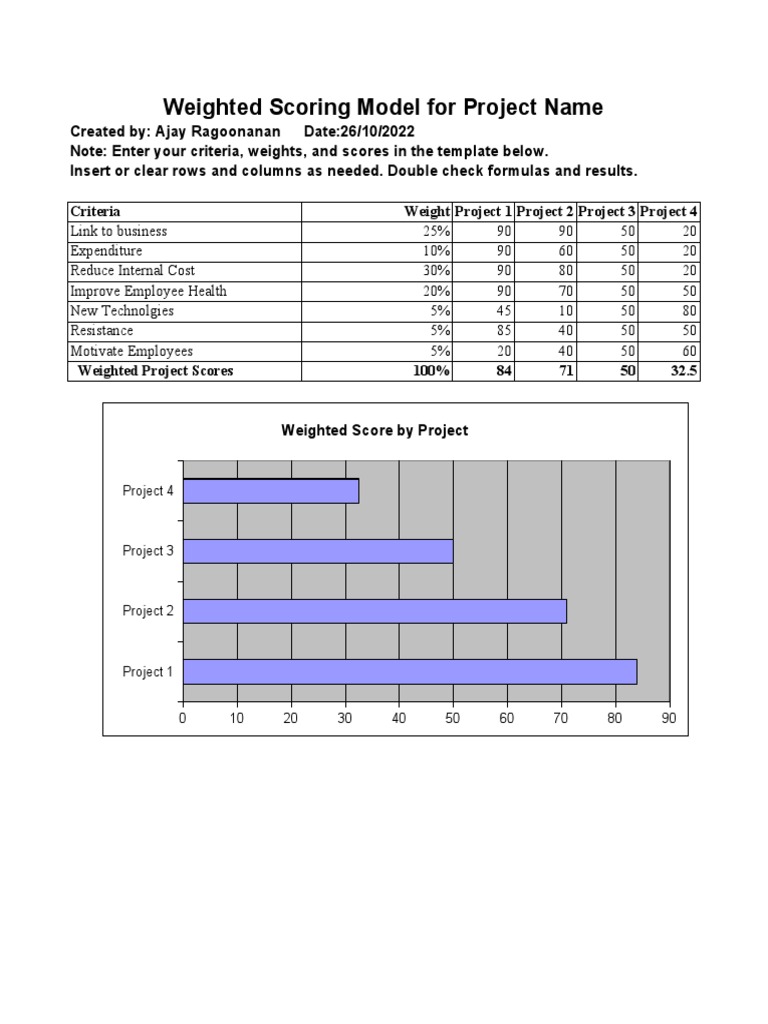
This is the tool we are going to learn how to build and apply.
2. The 6-Step Process for Applying a Scoring Model
The article from 1000minds.com also outlines a clear, six-step process for performing MCDA. This provides a systematic workflow, which you'll recognize as essential from your experience in software development and project management. Let's walk through it.
Step 1 & 2: Structure the Problem and Specify Criteria
First, you define your alternatives (the projects you're choosing between) and your criteria. The criteria are the heart of the model and should reflect the project's strategic goals, including the intangible benefits we discussed last time.
But what makes a good criterion? They should be relevant, comprehensive, and avoid overlap.
Unusual Non-Financial Criteria for Project Selection with Ricardo Vargas
To see what good, non-financial criteria look like in practice, let's watch this short video from project management expert Ricardo Vargas. He suggests several criteria that are highly relevant for technology and business projects.
Watch the segments on 'Stakeholders' (02:04 - 03:06), 'Risks' (03:06 - 04:40), 'Internal Expertise' (07:13 - 09:03), and 'Third part dependence' (09:03 - 09:44). Notice how he defines each criterion and, importantly, how he suggests grading them.
The video gives us excellent examples of criteria you might use to evaluate a software project:
- Stakeholder Commitment: How much support does this project have from key executives?
- Internal Expertise: Do we have the skills in-house to complete this project successfully?
- Risk: What is the level of technical or market risk involved? (Note that he scores this inversely: low risk = high score).
- Third-Party Dependence: How much do we have to rely on external suppliers or partners?
These criteria are far more telling than a simple financial forecast and directly address project feasibility and strategic alignment.
Step 3 & 4: Measure Performance, Score Alternatives, and Weight Criteria
This is where we translate qualitative assessments into numbers.
Scoring: For each criterion, you need a consistent scale. Ricardo Vargas used 0-1000, but 0-100 or 1-5 are also common. The key is to clearly define what each point on the scale means.
- For Stakeholder Commitment, you might define it as: 0 = Actively hostile, 50 = Neutral, 100 = Fully supportive champion.
- For Internal Expertise, it could be: 0 = No experience, 50 = Some experience, but requires training, 100 = World-class experts on the team.
Weighting: This is the most subjective step. Here, you decide the relative importance of each criterion. If reducing risk is twice as important as strategic alignment, its weight should be twice as high. A simple method is direct rating: give each criterion an importance score (e.g., out of 100), and then normalize the scores so they sum to 1.0 (or 100%). This is a team exercise to reflect shared priorities.
Step 5: Calculate the Total Score
Once you have weights and scores, the calculation is straightforward. For each alternative, you multiply the score for each criterion by its weight and sum the results.
The formula is:
Where represents each criterion from 1 to .
The Excel video below demonstrates exactly how this is done using the SUMPRODUCT function, which is purpose-built for this calculation. You don't need to be an Excel expert; the logic is the main takeaway.
How to Create a Weighted Scoring Model
This video from ExcelDemy shows the mechanics of calculating a weighted average. It's a practical demonstration of the formula we just discussed.
Watch from 01:08 to 02:45. Focus on how the SUMPRODUCT function is used to multiply the criteria scores for a location by their corresponding weights, and then the SUM function normalizes it. This is the core calculation for our model.
Step 6: Support Decision-Making
The final scores—for example, Project A gets 78 and Project B gets 65—are not absolute truths. They are tools to facilitate a more informed discussion. A project with a lower score might still be chosen for strategic reasons not captured in the model. The model's primary value is making the trade-offs explicit and the decision process defensible.
Test your understanding!
Imagine you are comparing two projects using a weighted scoring model.
- Project A (Refactor): Scores 90/100 on "Risk Reduction" but only 30/100 on "New Revenue Generation."
- Project B (New Feature): Scores 20/100 on "Risk Reduction" but 80/100 on "New Revenue Generation."
If both criteria have an equal weight (0.5), which project scores higher? What if the weight for "Risk Reduction" is 0.7 and "New Revenue Generation" is 0.3?
Show answer
Scenario 1 (Equal Weights):
- Project A: (0.5 * 90) + (0.5 * 30) = 45 + 15 = 60
- Project B: (0.5 * 20) + (0.5 * 80) = 10 + 40 = 50
- Project A scores higher.
Scenario 2 (Risk is more important):
- Project A: (0.7 * 90) + (0.3 * 30) = 63 + 9 = 72
- Project B: (0.7 * 20) + (0.3 * 80) = 14 + 24 = 38
- Project A scores much higher. This shows how changing weights to reflect priorities dramatically impacts the outcome.
3. The Theory Behind the Practice: A Nod to MIT
Your goal is to learn this material in accordance with MIT's standards. It's important to know that these practical scoring models are a simplified application of a rigorous field called Applied Utility Theory.
PI27s Lecture 5: Basics of Applied Utility Theory
These slides from an MIT course, 'Basics of Applied Utility Theory,' introduce the formal theory behind our scoring model. We won't dive into the math, but it's useful to see the origin of these ideas.
Skim through the first 13 slides (pages 3-13). Focus on the key terms: 'Value' as stakeholder satisfaction, an 'Attribute' as a metric for an objective, and 'Multi-Attribute Utility Theory (MAUT)' as a method to aggregate attributes into a single score. This is the formal language for what we've been doing.
In essence, MAUT provides the theoretical foundation for creating a "utility function" — a formula that converts a set of attributes (our criteria) into a single number representing value or preference. Our weighted scoring model is a simple, linear utility function. Knowing this connects the practical tool we've built to the robust academic principles taught at institutions like MIT.
Conclusion
Today you learned a powerful, structured method for making complex project decisions. By moving beyond financials to include critical intangible factors, you can make choices that are more strategically sound and easier to justify to stakeholders.
- Key Takeaways:
- Weighted scoring models are a practical form of Multi-Criteria Decision Analysis (MCDA).
- The process involves defining alternatives, criteria, and weights, then scoring each alternative against the criteria.
- The final score is calculated as the sum of
Weight * Scorefor all criteria, often using aSUMPRODUCTfunction. - The model's output is a tool to support decision-making, not dictate it, by making trade-offs explicit and transparent.
- This practical method is a simplified application of the more formal Multi-Attribute Utility Theory (MAUT).
Preview of the Next Lesson
We've now spent several lessons on the "front-end" of project evaluation—cash flows, benefit-cost ratios, and non-monetary factors. Next, we will pivot to a crucial "back-end" topic that affects a project's real-world financial reporting and profitability. We will define depreciation and explain its role in after-tax economic analysis, a fundamental concept for any manager dealing with capital assets.