Hello! Welcome back to your course on Engineering Economics.
In our last lesson, we applied Present Worth (PW) analysis to the classic "build-vs-lease" decision for IT infrastructure, comparing an on-premise solution to a cloud service. We saw how PW analysis allows us to compare alternatives with different cash flow patterns by bringing all costs to a single point in time—the present.
Today, we're going to learn a new but closely related technique that answers a different, often more intuitive question: "What is the equivalent value of this project on a per-year basis?"
Your learning outcome for this lesson is to convert project cash flows to an equivalent uniform annual worth (AW). This method is a cornerstone of project evaluation, and as a manager, you'll likely find its results—a simple annual figure—very practical for planning and communication.
What is Annual Worth (AW)?
Imagine you're evaluating a complex software project. It has a large upfront development cost, varying annual revenues over its five-year life, and a final decommissioning cost. Reporting the total Present Worth is useful, but stakeholders might also ask, "What does that boil down to per year?"
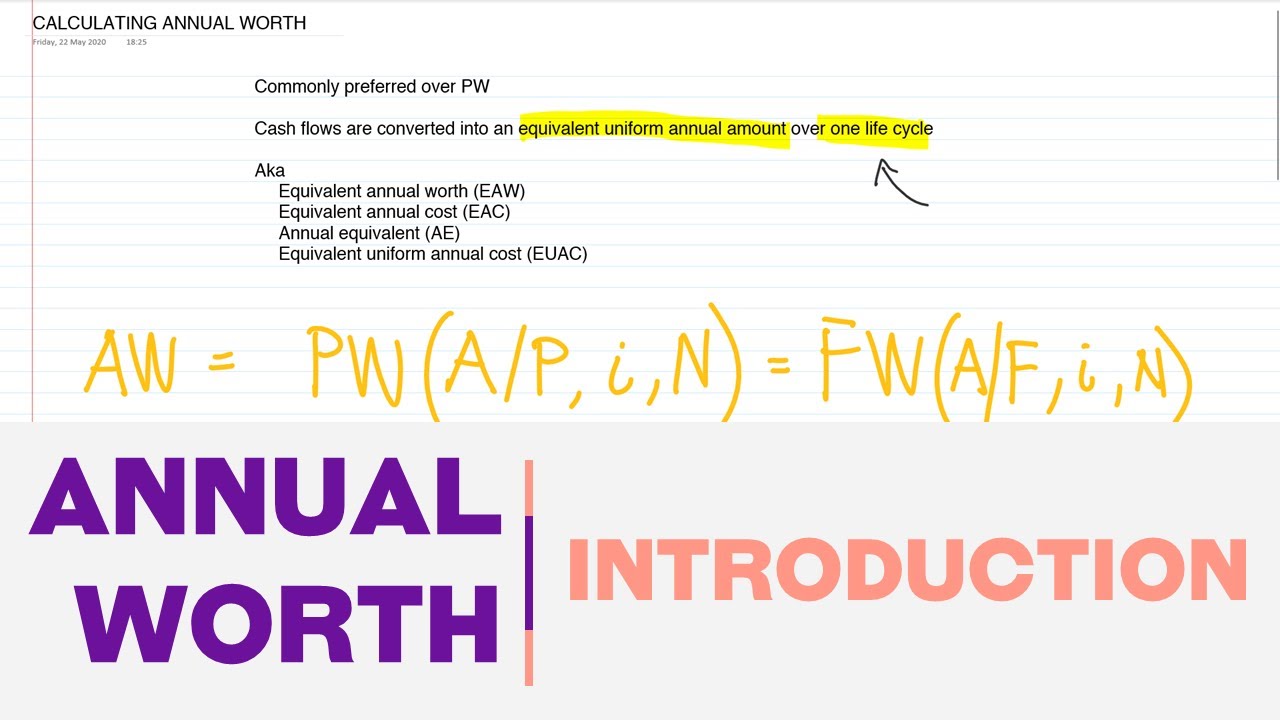
Annual Worth (AW) analysis answers exactly that. It converts any pattern of cash flows—initial investments, recurring payments, one-time future amounts—into a single, equivalent uniform annual series over the project's life.
Think of it as the financial equivalent of amortization. Just as a large loan is converted into equal monthly payments, a project's entire financial picture can be converted into an equal annual amount. This makes it incredibly easy to conceptualize the project's value in terms of an annual budget or profit.
A project's Annual Worth is typically composed of two parts:
- Capital Recovery (CR): The equivalent annual cost of the initial investment, offset by the equivalent annual benefit of its future salvage value.
- Annual Amounts (A): Any cash flows that are already a uniform annual series, such as maintenance contracts, software subscriptions, or fixed annual revenues.
The total Annual Worth is simply the sum of these components:
The Mechanics of Conversion
To convert lump-sum cash flows (P and F) into an annual series (A), we use two key factors that you've seen before in a different context. Let's briefly review them specifically for this purpose.
To calculate Annual Worth, we need factors that convert present and future values into uniform annual series. The 'Applied Engineering Economy' guide clearly explains the Capital Recovery Factor (A/P) and the Sinking Fund Factor (A/F), which are the tools for this job.
Please review section 3.2, focusing on the Capital Recovery Factor (A/P), which converts a present value P to an annual series A. Then review section 3.3, focusing on the Sinking Fund Factor (A/F), which converts a future value F to an annual series A. The cash flow diagrams in Figures 9 and 10 are particularly helpful for visualizing these transformations.
As you've just read, we can formulate the Capital Recovery (CR) component precisely:
- The initial investment
Pis a present cost, so we "spread it out" overnyears using the(A/P, i, n)factor. Its annual equivalent isP(A/P, i, n). - The salvage value
Sis a future revenue, so we "spread it out" overnyears using the(A/F, i, n)factor. Its annual equivalent isS(A/F, i, n).
Therefore, the full equation for Annual Worth is:
Where A represents any pre-existing uniform annual costs or revenues.
From Present Worth to Annual Worth
Let's use the on-premise server example from our last lesson to see AW in action and demonstrate its connection to PW.
Scenario Recap:
- Alternative: Build (On-Premise)
- Initial Cost (P): $25,000
- Annual Maintenance (A): $2,000
- Salvage Value (S): $6,000 at the end of year 3
- Study Period (n): 3 years
- MARR (i): 10%
Calculation Steps:
First, we need the factor values for i=10% and n=3:
- (A/P, 10%, 3) = 0.40211
- (A/F, 10%, 3) = 0.30211
Now, we calculate the Annual Worth of the "Build" alternative:
- Annualize the Initial Cost:
-$25,000 * (A/P, 10%, 3) = -$25,000 * 0.40211 = -$10,052.75 - Annualize the Salvage Value:
+$6,000 * (A/F, 10%, 3) = +$6,000 * 0.30211 = +$1,812.66 - Include the existing Annual Cost:
-$2,000
Total Annual Worth (AW):
This means that owning and operating this server for three years is financially equivalent to paying $10,240.09 every year. This single number is often much easier to communicate and budget for than the complex set of initial, annual, and salvage cash flows.
The PW-AW Connection:
In the last lesson, we calculated the Present Worth of this alternative to be PW = -$25,466. Let's see what happens when we convert this PW value into an AW:
They are the same! This confirms that PW and AW are just two different ways of expressing the same underlying value. PW gives the value as a lump sum today, while AW gives it as an equivalent annual series.
A Comprehensive Example
Let's look at another example that consolidates various costs into a single annual figure.
Lecture 9 (S'04) Methods for Evaluating Individual Projects
This example from an MIT lecture note shows how to apply the AW method to a real estate investment. It's a clear demonstration of how to handle an initial investment, a salvage value (the land), and various recurring costs to find the total equivalent annual cost.
Please read the example under '2. Annual Worth (AW) Method' on pages 2-3. Pay close attention to how the 'Annual worth of capital costs' is calculated by annualizing the building cost and the recovered land cost, and then how this is combined with the other yearly expenses (taxes, upkeep) to find the total equivalent annual cost.
The approach in the MIT example is identical to ours: annualize the capital costs and add the recurring annual expenses. This method is universally applicable, from real estate to software platforms.
Test your understanding!
Your company is considering purchasing a new automated testing server.
- The server costs $60,000 today.
- Annual software licenses and maintenance cost $8,000.
- It has a useful life of 4 years, after which it can be sold for an estimated $12,000.
- The company's MARR is 12%.
What is the Equivalent Uniform Annual Cost (EUAC) of this server?
(Factors for i=12%, n=4: (A/P, 12%, 4) = 0.32923, (A/F, 12%, 4) = 0.20923)
Show answer
We use the AW formula, framing it as a cost (EUAC).
- Annualize Initial Cost:
$60,000 * (A/P, 12%, 4) = $60,000 * 0.32923 = $19,753.80 - Add Annual Maintenance:
+$8,000 - Subtract Annualized Salvage Value:
-$12,000 * (A/F, 12%, 4) = -$12,000 * 0.20923 = -$2,510.76
Total EUAC:
The equivalent annual cost of owning and operating this server is $25,243.04.
Conclusion
Today, you have learned how to transform any series of project cash flows into an Equivalent Uniform Annual Worth (AW). This is a powerful skill that complements Present Worth analysis by providing an intuitive, year-over-year measure of a project's financial impact.
- Key Takeaways:
- Annual Worth (AW) expresses a project's total value as a uniform series of annual payments.
- It is calculated by annualizing all lump-sum costs and revenues (like initial investments and salvage values) and summing them with any existing annual cash flows.
- The core formula is
AW = -P(A/P, i, n) + S(A/F, i, n) + A. - AW and PW are directly convertible:
AW = PW(A/P, i, n). They represent the same economic value, just expressed in different terms.
Preview of the Next Lesson
So why learn AW if it's just another way to express PW? In our next lesson, we will uncover the unique power of the Annual Worth method. Your learning goal will be to compare alternatives with unequal lives using the annual worth method. You will discover that for this common and tricky problem, AW analysis is significantly more straightforward than PW analysis.