Introduction
Welcome back! In our last lesson, we explored the critical concepts of lengthened and shortened muscle positions, establishing that training with high tension in the stretched state—stretch-mediated hypertrophy—is a potent driver of muscle growth. We differentiated between exercises that challenge the pecs at the bottom of the rep (like a dumbbell press) and those that maintain tension at peak contraction (like a cable fly).
Today, we will synthesize everything we've covered in this module. Our goal is to answer the definitive question for any aspiring coach or trainee: "Which exercises build which part of the chest, and why?" This lesson directly addresses the learning outcome: Map specific exercises (e.g., incline press, flat fly, dip) to the anatomical function of each pectoral division.
We will move beyond simply knowing the pec has divisions. By combining our understanding of fiber direction with the principles of biomechanics, we will create a clear, actionable map that connects specific movements to their primary muscular targets. Mastering this is the key to building a complete, well-proportioned chest and designing truly intelligent hypertrophy programs.
1. The Guiding Principle: Aligning Resistance with Fiber Direction
To selectively target a muscle division, the line of resistance in an exercise must directly oppose the direction of that division's muscle fibers. Think of it as a tug-of-war: to put maximum stress on a specific rope (muscle fiber), you must pull directly against it.
Let's revisit the anatomy of the pectoralis major and its distinct fiber orientations.
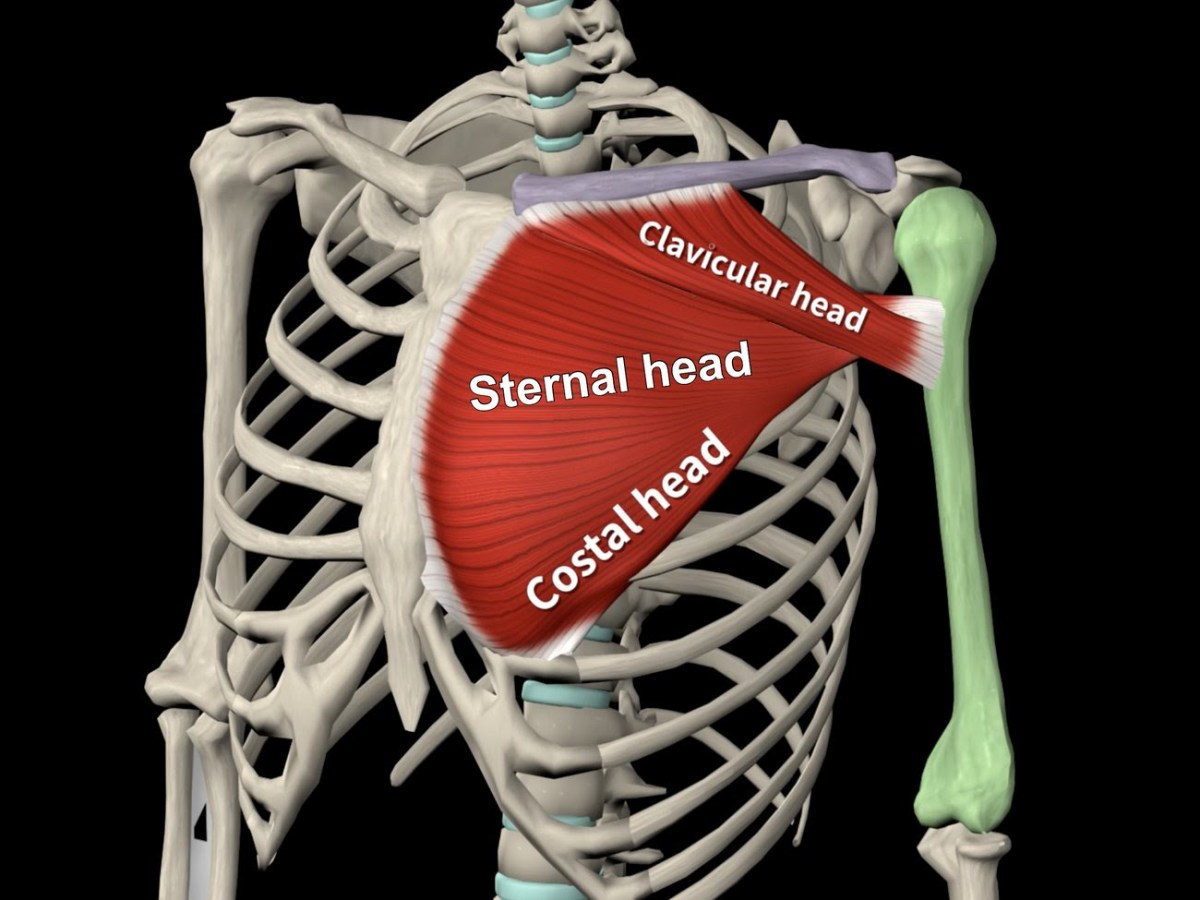
This fan-like arrangement is the entire reason we can bias different regions. To make this concept crystal clear, let's hear from Dr. Mike Israetel of Renaissance Periodization.
What Is The King Chest Building Exercise?
In this short clip from the video 'What Is The King Chest Building Exercise?', Dr. Israetel explains the core principle of matching the line of pull to the fiber direction.
Watch from 01:53 to 02:35. Pay close attention to how he describes the different fiber paths and how the line of pull must align with them to develop a specific region of the pecs.
This gives us our fundamental rules for exercise selection:
- Clavicular (Upper) Division: Fibers run from the clavicle down and out to the arm. To target them, we need an exercise that pushes the arm up and in, against a force pulling it down and out. This implies an incline angle.
- Sternal (Middle) Division: Fibers run horizontally from the sternum straight across to the arm. To target them, we need an exercise that pushes the arm straight across the body, against a force pulling it out to the side. This implies a flat or horizontal angle.
- Costal (Lower) Division: Fibers run from the lower ribs up and out to the arm. To target them, we need an exercise that pushes the arm down and in, against a force pulling it up and out. This implies a decline angle.
Let's now apply these rules to select the best exercises for each division.
2. Targeting the Clavicular (Upper) Division
As our principle dictates, incline movements are the key to targeting the clavicular head. By setting your torso on an incline, the path your arms take during a press or fly directly opposes the line of pull of those upper fibers.
The following video provides a superb visual demonstration using an anatomical model.
The Science of Building Your Pecs: Best Exercises & Anatomy
Let's watch a segment from the Institute of Human Anatomy video, 'The Science of Building Your Pecs,' which clearly demonstrates how changing the joint angle biases different pectoral fibers.
Watch from 09:04 to 11:30. Focus on the explanation for the incline press (starting around 10:48) and how that arm path specifically aligns with the downward-angled clavicular fibers.
The angle of the incline is a crucial variable. Too low, and it becomes a flat press. Too high, and the anterior deltoid (front shoulder) takes over.
Advanced Chest Training: Angle Matters When Training the Chest
The article 'Advanced Chest Training' from TSG Fitness provides specifics on the optimal training angle for the upper chest.
Read the two paragraphs under the heading 'Angle Matters When Training the Chest'. Note the specific degree range recommended for targeting the clavicular head and what happens when the angle becomes too steep.
An incline of 15 to 30 degrees is generally considered the sweet spot for maximizing clavicular head activation while minimizing unwanted assistance from the deltoids.
For a data-driven perspective, this chart shows the upper chest activation across various exercises, measured via electromyography (EMG) as a percentage of Maximum Voluntary Contraction (%MVC).

Mapped Exercises for the Upper Chest:
- Primary Press: Incline Dumbbell or Barbell Press (at 15-30 degrees).
- Primary Fly/Isolation: Incline Cable Fly or Low-to-High Cable Crossover.
3. Targeting the Sternal (Middle) Division
The sternal division, being the largest and having horizontally-oriented fibers, is the primary target of all flat pressing and fly movements. The action of horizontal adduction—bringing the arm across the body in the transverse plane—perfectly opposes the line of pull of these fibers.
The flat bench press is the quintessential exercise for this division.
How to Train Your Chest Muscles: The Bench Press
The article 'How to Train Your Chest Muscles' from StrengthLog breaks down the role of four key chest exercises. Let's look at its description of the bench press.
Read the section titled '1. The Bench Press'. Focus on the statement that it 'almost perfectly embodies the pecs’ primary function, which is to bring the arm forward' and that a wide grip 'involves almost all of the pectoralis major’s muscle fibers'.
While the flat bench press is an excellent overall chest builder, its primary stress falls on the large, middle portion of the muscle. Other exercises that follow this horizontal adduction pattern are equally effective.
Mapped Exercises for the Middle Chest:
- Primary Press: Flat Barbell or Dumbbell Press, Machine Chest Press.
- Primary Fly/Isolation: Pec-Deck Machine, Flat Dumbbell Fly, Cable Crossover (with cables set at chest height).
4. Targeting the Costal (Lower) Division
To align with the upward-and-out orientation of the lower (costal) fibers, we need exercises that involve pushing the arm down and in. This is achieved through decline presses and, most effectively, dips.
Dips are particularly effective because they place a significant stretch on the lower pec fibers at the bottom of the movement, which, as we learned in the last lesson, is a powerful stimulus for hypertrophy.
How to Train Your Chest Muscles: Bar Dips
Let's return to the StrengthLog article to see its take on bar dips.
Read the section '3. Bar Dips'. Note the explicit statement that dips emphasize your 'lower chest' and that peak resistance occurs in a stretched position.
To emphasize the chest during a dip, a slight forward lean of the torso is crucial. A more upright posture shifts the emphasis to the triceps.
Decline presses accomplish a similar arm path, making them a great alternative, especially if an individual lacks the strength for controlled dips. The TSG Fitness article also highlights these movements.
Mapped Exercises for the Lower Chest:
- Primary Press/Compound: Dips (with a forward lean), Decline Barbell or Dumbbell Press.
- Primary Fly/Isolation: High-to-Low Cable Crossover.
Conclusion
By understanding that exercise selection is a problem of aligning force vectors with fiber directions, you can now program with anatomical precision.
Key Takeaways:
Here is a summary table mapping each pectoral division to its optimal movement pattern and example exercises:
| Pectoral Division | Fiber Direction | Optimal Movement Pattern | Primary Exercises |
|---|---|---|---|
| Clavicular (Upper) | Down and outward | Incline (Low-to-High) | Incline Press (15-30°), Low-to-High Cable Fly |
| Sternal (Middle) | Horizontally outward | Flat/Horizontal | Flat Press, Pec-Deck, Horizontal Cable Crossover |
| Costal (Lower) | Up and outward | Decline (High-to-Low) | Dips (forward lean), Decline Press, High-to-Low Cable Fly |
Coach's Corner: From Mapping to Programming
A common mistake is to see this map and think you need to do nine different exercises every week. The real art of coaching is using this knowledge efficiently. A well-rounded chest program will typically include one exercise from each of the three categories, distributed throughout the training week, to ensure balanced development.
For example, a complete chest workout could look like this:
- Incline Dumbbell Press: 3 sets of 6-10 (Targets Upper Pecs)
- Flat Barbell Bench Press: 3 sets of 5-8 (Targets Middle Pecs)
- Weighted Dips: 3 sets of 8-12 (Targets Lower Pecs)
Furthermore, it's crucial to understand that relying on a single "best" exercise forever is suboptimal. This is where your computer science background in optimization might resonate. Sticking to one movement is like getting stuck in a local maximum; you might make progress, but you're missing the global optimum.
Dr. Israetel touches on the importance of variation for long-term progress and joint health.
What Is The King Chest Building Exercise?
In this final clip, Dr. Israetel argues against the idea of a single 'best' exercise, emphasizing the need for variation.
Watch from 08:02 to 09:50. Absorb his reasoning for why rotating exercises (e.g., spending a few months prioritizing incline, then switching to flat/decline focus) is superior for long-term development and injury prevention.
As a coach, you should periodize your client's training, rotating through different angles and exercises (e.g., swapping a barbell incline for a dumbbell incline, or a dip for a decline press) over several months. This ensures a more robust stimulus and healthier joints.
Preview for the Next Lesson
We have now built a complete anatomical and biomechanical model of the chest. We know its parts, how they work, and how to target them. In the next lesson, we will put this knowledge to diagnostic use. We will focus on analyzing common chest training mistakes (e.g., excessive anterior deltoid dominance) from an anatomical perspective. You'll learn to spot common faults and, more importantly, understand the anatomical reasons they occur, allowing you to provide precise, effective corrections.