Introduction
Welcome to the final lesson of your course on Sports Anatomy for Hypertrophy. Over the past eleven lessons, we have built a comprehensive model for understanding and applying the science of muscle growth. You began with the foundational language of anatomy, learning about positions, planes, and muscle actions. You then dove deep into the mechanisms of hypertrophy, the biomechanics of movement, the specific anatomy of every major muscle group, and finally, the principles of structuring an effective training program. In our last session, you designed a progression strategy for a 4-week microcycle, the final piece of the programming puzzle.
Today, we will synthesize this entire body of knowledge. Your learning outcome is to: Articulate a personal coaching philosophy grounded in the evidence-based chain of anatomy → biomechanics → hypertrophy, and identify next steps for formal certification.
This lesson serves as the capstone of your learning journey. Think of it as developing your personal "operating system" as a coach. A well-defined philosophy will act as your anchor in a sea of fitness fads and misinformation, ensuring your decisions are consistent, effective, and trustworthy. We will conclude by outlining a clear, actionable path toward obtaining a formal, accredited personal training certification.
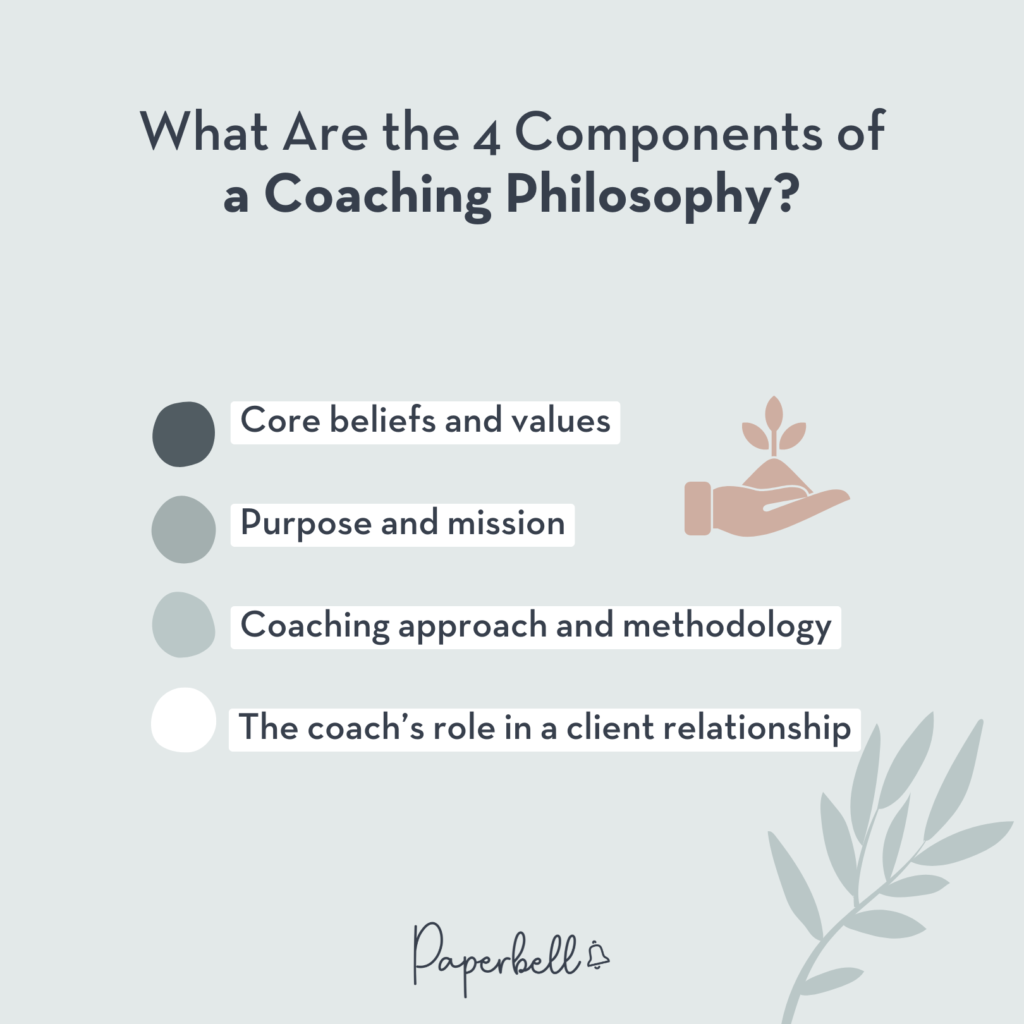
1. What is a Coaching Philosophy?
Before you build your own, let's define what a coaching philosophy is and why it's so critical for a modern, evidence-based coach.
Coaching Philosophy 101: Crafting Your Unique Approach
The article 'Coaching Philosophy 101' provides a great introduction to this concept. It explains that a philosophy is more than just a statement; it's a set of core beliefs and values that guide your every action as a coach.
Read the first two sections, 'What is a Coaching Philosophy?' and 'Why is Having a Philosophy Important?'. Focus on how a philosophy acts as your 'anchor' and builds client trust through consistency.
As the article notes, your philosophy is your "coaching compass." For a hypertrophy coach, this compass shouldn't point toward fads, tradition, or what the most popular influencer is doing. It must be oriented toward scientific first principles.
Throughout this course, we've implicitly built a framework for this. We can formalize it as the Evidence-Based Chain:
Anatomy → Biomechanics → Hypertrophy → Coaching
This chain is the bedrock of a robust coaching philosophy in our field. It provides a logical, defensible pathway from foundational science to practical application. Let's break down how to build your philosophy around it.
2. The Evidence-Based Chain: Your Philosophical Core
Your background in computer engineering has trained you to think in logical, structured systems where outputs are a direct consequence of inputs and operations. We will apply that same thinking here. A client's progress is the output; your coaching is the system that produces it.
Step 1: Anatomy ("What does the muscle do?")
Everything starts here. Before you can choose an exercise, you must understand the hardware you're trying to upgrade.
-
Origin, Insertion, Fiber Direction: These anatomical facts dictate a muscle's function. They are not opinions.
-
Joint Actions: A muscle's structure determines the actions it can produce (e.g., flexion, extension, adduction).
-
Philosophical Implication: Your exercise selection is not arbitrary or based on tradition. It is a direct answer to the question: "What movement best aligns with this muscle's anatomical function?"
Reflection Question: Think about the pectoralis major. How does knowing its multiple divisions (clavicular, sternal, costal) and their distinct fiber orientations immediately invalidate the idea that a single exercise like the flat bench press is sufficient for complete chest development?
Step 2: Biomechanics ("How do we best challenge what the muscle does?")
Anatomy tells you the function; biomechanics tells you how to load that function effectively. This is the physics engine of your coaching model.
-
Moment Arms & Resistance Profiles: These concepts determine where in the range of motion an exercise is hardest. A free weight has a different resistance profile than a cable or a well-designed machine.
-
Stability & Force Transfer: Efficient force production requires a stable base. This is why technique and controlling the movement are paramount.
-
Philosophical Implication: Your goal is not just to have the client move a weight from A to B. It is to match the exercise's resistance profile to the muscle's strength curve to create the greatest productive tension, especially at long muscle lengths.
Reflection Question: Consider the gluteus maximus. An American kettlebell swing and a hip thrust both involve hip extension. Based on your biomechanical understanding, which one creates more tension on the glutes at the top of the movement (shortened position) and why is that significant?
Step 3: Hypertrophy ("What physiological signals drive growth?")
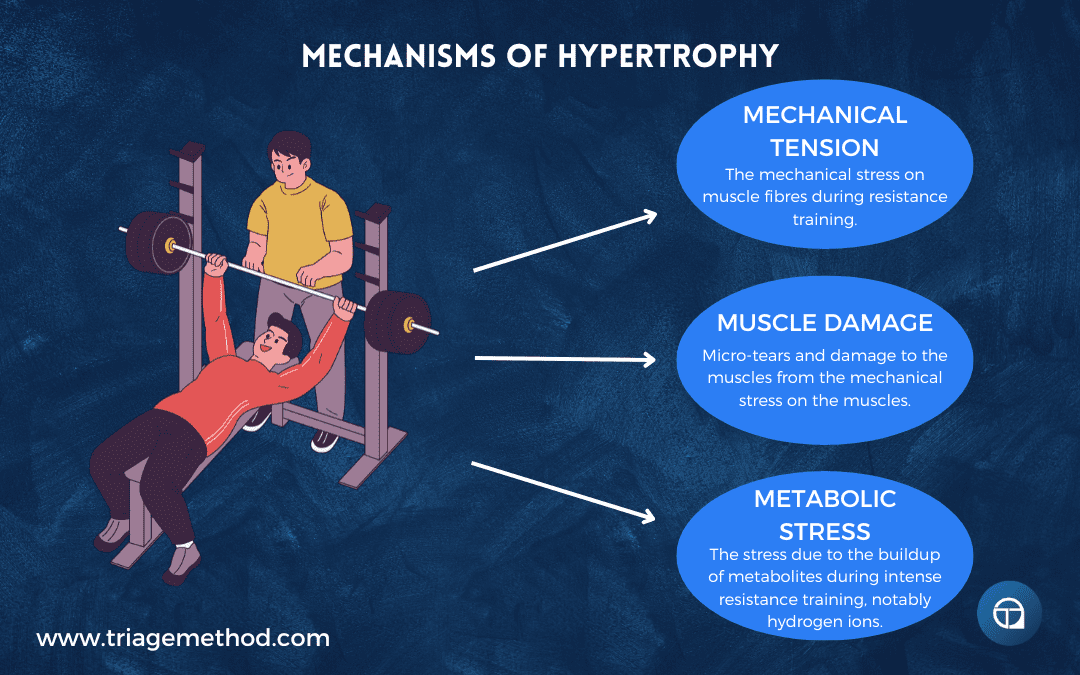
This is the "why" behind your methods. You are not just assigning reps and sets; you are targeting the specific physiological mechanisms that trigger muscle adaptation.
-
Mechanical Tension: The primary driver. This is the force experienced by the individual muscle fibers. Training close to failure and with progressively heavier loads ensures high mechanical tension.
-
Stretch-Mediated Hypertrophy: A crucial subset of mechanical tension. Loading a muscle while it is in a lengthened (stretched) position is a uniquely powerful stimulus for growth.
-
Metabolic Stress & Muscle Damage: These are secondary contributors. While important, the pursuit of mechanical tension, particularly under stretch, should be the priority.
-
Philosophical Implication: Your programming decisions (exercise selection, rep ranges, volume) are designed to maximize productive mechanical tension over a full contractile range, with a special emphasis on the lengthened position, while managing the resulting fatigue.
Reflection Question: Knowing the power of stretch-mediated hypertrophy, how would you defend the choice of a dumbbell pullover (which stretches the lats under load) over a seated row for a client whose primary goal is to increase lat width, even though they can use more weight on the row?
Step 4: Coaching ("How do I apply and communicate this?")
This is where science becomes art. You can have a perfect program on paper, but it's useless if the client can't execute it correctly or doesn't understand its purpose.
-
Intent-Based Cueing: Use cues that connect to the muscle's anatomy and function. Instead of "Lift the weight," you might say, "Drive your upper arm across your chest" for a pec fly.
-
Education and Empowerment: Explain the "why" to your clients in simple terms. This builds buy-in, improves adherence, and empowers them to be active participants in their own training.
-
Philosophical Implication: Your role is not just to be an instructor, but an educator. You translate complex science into simple, actionable steps, building client autonomy and trust.
3. A Flexible Philosophy: The Importance of Critical Thinking
A philosophy is a guide, not a dogma. The field of exercise science is constantly evolving. A strong philosophy is not one that never changes, but one that is built on a framework that allows for updates when new, high-quality evidence emerges.
Be Flexible in Your Philosophy
Bret Contreras, a prominent researcher and coach, wrote a fantastic article on this very topic. His main point is that our beliefs must be adaptable and 'flow with science.'
Please read the sections 'Flow With Science,' 'Being Wrong,' 'Confirmation Bias,' and the final two paragraphs. Pay special attention to the quote from his professor: 'This is what I know to be true today. It is subject to change next week as I continue to learn.' This mindset is the hallmark of a true scientific practitioner.
To maintain this flexible, scientific mindset, you need to become a skilled consumer of information. The following video features two of the most respected evidence-based practitioners in the industry, Dr. Eric Helms and Kassem Hanson, discussing the mindset required for this.
Strength for Hypertrophy: The Evidence-Based Way to Build Muscle
In this insightful discussion, Dr. Eric Helms explains how to navigate the modern fitness world of 'over information.' He provides a brilliant framework for developing a 'BS sensor.'
Watch from the beginning to 07:01. Focus on two key ideas: 1) The challenge is no longer access to information, but the ability to discern good information from bad. 2) How to identify a true expert—they speak with nuance, use probabilistic language ('maybe,' 'in most cases'), and are confident in what they don't know.
361: Range Of Motion & Hypertrophy - Kassem Hanson
Now, let's listen to Kassem Hanson. He embodies the 'tinkering' and 'pull around and find out' mentality. He uses scientific principles as a starting point for experimentation and refinement, which is a philosophy in action.
Watch the following three clips to see how a flexible, evidence-based philosophy works in practice: 03:16 - 08:10: Notice how his personal training is a lab for research and refinement. He sacrifices his own 'optimal' training for the sake of improving his methods. 14:55 - 20:57: Here he discusses how the new research on lengthened partials confirmed and refined a decade of his own anecdotal practice. He adjusted his model (mechanism is tension, not damage), which changed his programming. 01:22:36 - 01:28:38: Listen to how he reconciles 'bro science' with modern science. The key is intent and meticulousness—many old-school methods worked because they stumbled upon the right principles, even if they couldn't explain why.
4. Activity: Articulate Your Personal Coaching Philosophy
Now it's your turn. Using the "Evidence-Based Chain" and the principles of scientific flexibility, write a draft of your personal coaching philosophy.
Instructions:
- Start with a Mission Statement (1-2 sentences): This should be a concise summary of your overall approach.
- List Your Core Principles (3-5 bullet points): Elaborate on your mission statement. Each principle should be a clear, actionable belief grounded in the concepts from this course.
- Use the guiding questions and template below.
Guiding Prompts (from resource LINK):
- What are your non-negotiables in coaching?
- How do you define success for your clients?
- What is the true essence of coaching for you?
- What makes your coaching style different?
Template & Example:
My Coaching Philosophy: To guide clients toward their hypertrophy goals using a systematic, first-principles approach. Every programming decision is deliberately chosen and justified by the logical chain of anatomy, biomechanics, and the physiological drivers of muscle growth.
Core Principles:
- Anatomy is the Blueprint: Exercise selection is non-negotiable and begins with a rigorous analysis of the target muscle's structure and function.
- Biomechanics Determines Application: I prioritize creating optimal resistance profiles to challenge a muscle through its full contractile range—with a special emphasis on the lengthened position—over simply moving the heaviest load possible.
- Intelligent Programming: Training variables (volume, intensity, frequency, progression) are managed as a system to maximize the dose of mechanical tension while respecting the constraints of recovery and fatigue.
- Education as Empowerment: My role is to be a teacher, not just a rep-counter. I am committed to explaining the "why" behind every "what," fostering my client's understanding, autonomy, and long-term success.
- Scientific Humility: My methods are anchored in current scientific evidence, but my mind remains open. I am committed to lifelong learning and will adapt my approach as our collective understanding of human physiology evolves.
(Take 15-20 minutes to write your own version in a separate document. This is a living document that you will refine throughout your career.)
5. Your Path Forward: Formal Certification
This course has given you a deep, university-level understanding of the science of hypertrophy—far exceeding the content of most standard personal training certifications. However, a formal certification is a crucial next step for professional credibility, insurance, and employment.
Given your academic background and scientific orientation, certain certifications are a much better fit than others.
Recommended Certification Bodies:
-
NSCA (National Strength and Conditioning Association): This is widely considered the gold standard, particularly for coaches working with athletes or those who value a rigorous, research-based foundation.
- CSCS (Certified Strength and Conditioning Specialist): This is the most prestigious certification. It requires a Bachelor's degree (or to be a current college senior), making you an ideal candidate upon graduation. The exam is difficult and covers a broad scope of scientific principles and their application. This should be your long-term goal.
- NSCA-CPT (Certified Personal Trainer): An excellent, highly respected certification that you can pursue now. It is less demanding than the CSCS but is still grounded in the same scientific rigor.
-
ACSM (American College of Sports Medicine): Another top-tier, research-driven organization with a strong emphasis on health, clinical populations, and exercise as medicine. Their CPT certification is also highly respected.
Your Actionable Next Steps:
- Explore: Visit the websites for the NSCA and ACSM.
- Target the NSCA-CPT: This is the most logical and valuable starting point for you. Download the exam content outline and look at the recommended study materials.
- Leverage Your Knowledge: You will find that your knowledge from this course—especially in anatomy, biomechanics, and resistance training program design—gives you a significant head start on the material.
- Acquire the Textbook: Purchase the primary textbook for the NSCA-CPT (e.g., Essentials of Personal Training). Begin studying it, using your existing knowledge as a scaffold.
- Plan and Execute: Set a target date to take the exam within the next 6-12 months.
Conclusion
Congratulations on completing this comprehensive course. You have journeyed from the fundamental building blocks of the human body to the complex art and science of programming for muscle growth. You have not just learned what to do, but why it works.
Key Takeaways from Today's Lesson:
- A coaching philosophy is your professional compass, providing consistency, building trust, and guiding your decisions.
- Your philosophy should be grounded in the evidence-based chain of Anatomy → Biomechanics → Hypertrophy → Coaching.
- A great coach embraces scientific humility, remaining flexible and committed to lifelong learning in an ever-evolving field.
- Formal certification, particularly through a research-driven body like the NSCA, is your critical next step for professional legitimacy.
You started this course with a background in computer engineering and an interest in geopolitics and sports anatomy. You now possess a powerful, structured framework to merge your analytical mind with your passion for fitness. This is not the end of your education, but the end of the beginning. You are now equipped with the tools and the mindset to become an exceptional, evidence-based coach. Go forward and build.