Introduction
Welcome to the next lesson in our module on the shoulder complex. In the previous lesson, we took a deep dive into the "prime movers" of the shoulder—the three heads of the deltoid muscle. We established how to select optimal exercises for each head by targeting them in their lengthened positions, a key principle for maximizing hypertrophy. You now understand how to drive growth in the muscles responsible for the shoulder's powerful movements.
However, power is useless without control. For the large deltoid, pectoral, and latissimus dorsi muscles to exert force safely and effectively, the shoulder joint itself must be stable. This brings us to the unsung heroes of the shoulder: the rotator cuff.
Today, our learning outcome is to identify the four rotator cuff muscles and describe their primary individual actions and collective function as dynamic stabilizers of the shoulder joint. Think of the deltoids as the powerful engines of a high-performance vehicle. The rotator cuff is the advanced suspension and steering system that keeps the wheels on the road, allowing the engine's power to be translated into controlled, stable motion.
1. The Challenge of Shoulder Stability
The shoulder, or glenohumeral joint, is the most mobile joint in the human body. It's a "ball-and-socket" joint, but that description is a bit generous. A more accurate analogy would be a golf ball (the humeral head) sitting on a golf tee (the glenoid fossa of the scapula).
This anatomical arrangement allows for an incredible range of motion but at the significant cost of inherent instability. The joint relies very little on bony structures for support. Instead, it depends on a sophisticated system of muscles working in harmony to keep the joint centered and secure. This is where the rotator cuff comes in.
2. Identifying the Rotator Cuff: The "SITS" Muscles
The rotator cuff is a functional group of four muscles that originate on the scapula (shoulder blade) and whose tendons wrap around the head of the humerus, forming a "cuff."
To get a clear three-dimensional understanding of these muscles, let's watch an excellent anatomy tutorial.
Rotator Cuff | 3D Anatomy Tutorial
This video from AnatomyZone, 'Rotator Cuff | 3D Anatomy Tutorial,' provides a fantastic visual introduction to the four rotator cuff muscles. It will help you locate each muscle and remember their names using a common mnemonic.
Watch from the beginning to 01:46. Pay attention to the golf-ball-on-a-tee analogy and the introduction of the 'SITS' acronym, which will be our framework for this lesson.
As the video explained, the four rotator cuff muscles can be remembered with the acronym SITS:
- Supraspinatus
- Infraspinatus
- Teres Minor
- Subscapularis
Here is a clear diagram showing the location of these muscles from both a posterior (back) and anterior (front) view.
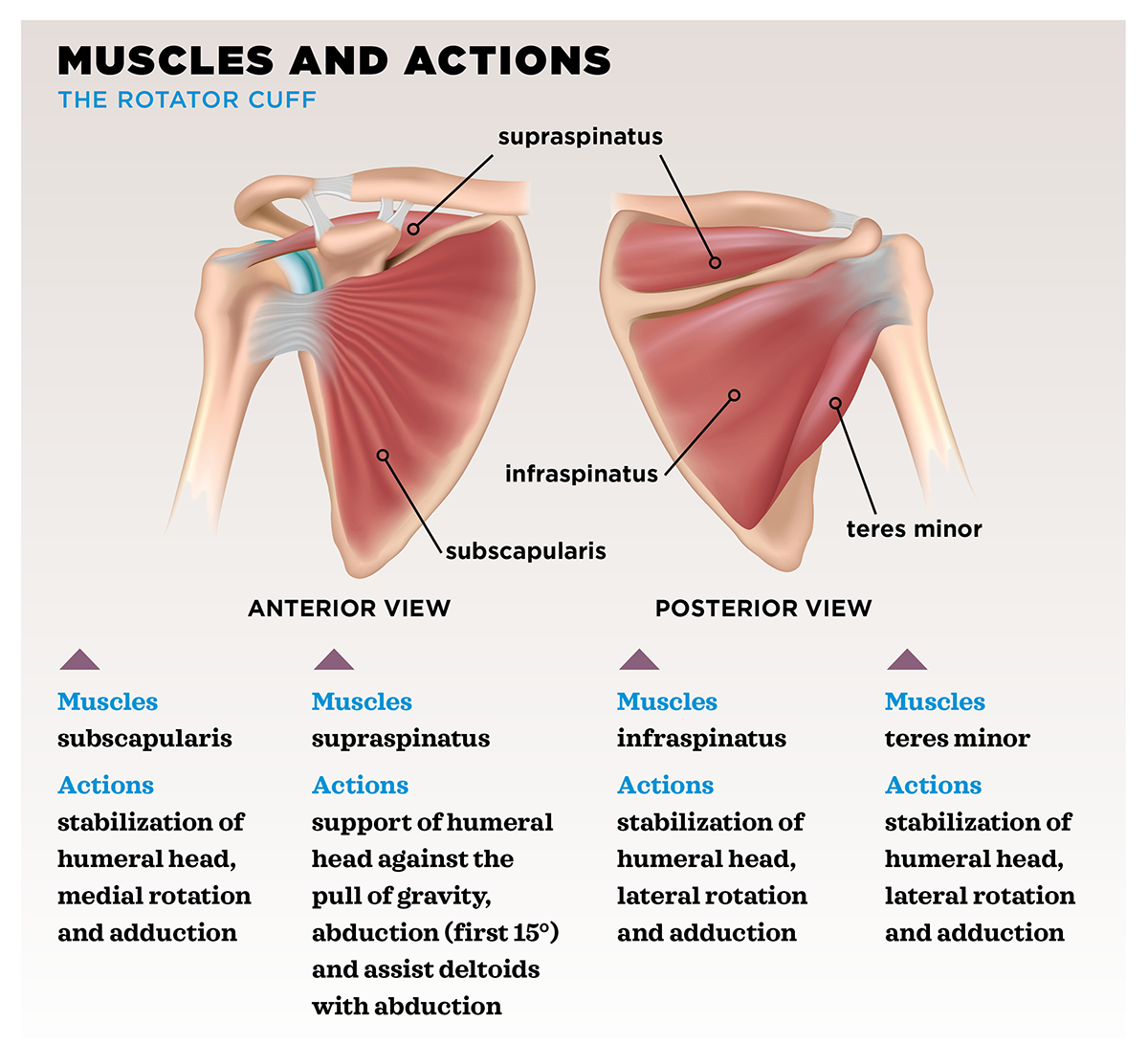
3. Individual Actions of the Rotator Cuff Muscles
While their collective function is stabilization, each of the four muscles also has a primary individual action. Understanding these actions is crucial for diagnostics and for appreciating how they contribute to overall shoulder movement.
Let's return to the AnatomyZone video to break down each muscle one by one.
Rotator Cuff | 3D Anatomy Tutorial
We will now continue with the 'Rotator Cuff | 3D Anatomy Tutorial' to learn the specific origin, insertion, and action of each SITS muscle.
Watch the following segments carefully: Supraspinatus (01:46 - 02:39): Note its action of initiating shoulder abduction. Infraspinatus (02:39 - 03:21): Note its action of external (lateral) rotation. Teres Minor (03:21 - 04:19): Note that it is a synergist for external rotation with the Infraspinatus. Subscapularis (04:19 - 05:55): Note its position on the front of the scapula and its action of internal (medial) rotation.
Let's summarize those key actions in a table for quick reference. This information is also available in the StatPearls article, "Anatomy, Rotator Cuff," a reliable clinical reference.
| Muscle | Location on Scapula | Primary Action |
|---|---|---|
| Supraspinatus | Superior (above spine) | Initiates shoulder abduction (first ~15 degrees) |
| Infraspinatus | Posterior (below spine) | External (lateral) rotation of the shoulder |
| Teres Minor | Posterior (lateral border) | External (lateral) rotation of the shoulder |
| Subscapularis | Anterior | Internal (medial) rotation of the shoulder |
4. The Collective Function: Dynamic Stabilization
While their individual actions are important, the primary, collective role of the rotator cuff is dynamic stabilization. This is a critical concept.
Dynamic Stabilisers of the Shoulder Complex
To formalize this idea, let's read a short introductory section from Physiopedia's article on 'Dynamic Stabilisers of the Shoulder Complex.' This will provide a clear definition of the concept.
Read the 'Introduction' section and the short 'Rotator Cuff muscles' section that follows. Focus on how dynamic stabilizers are defined and the main role ascribed to the rotator cuff in 'fine-tuning' and 'centralizing' the humeral head.
As the article explains, the rotator cuff muscles work in a coordinated fashion to keep the head of the humerus centered within the shallow glenoid fossa during movement. This action is often called concavity compression.
This function is most critical when working against the powerful pull of the deltoid muscle during abduction (lifting your arm to the side).
- The deltoid pulls the humerus almost straight up.
- If this force were unopposed, the humeral head would jam into the acromion (the bony roof of the shoulder), impinging the soft tissues in between (like the supraspinatus tendon).
The rotator cuff creates an opposing force couple. Three of the four cuff muscles (Infraspinatus, Teres Minor, and Subscapularis) have a line of pull that is partly downward and inward. When they contract alongside the deltoid, they "depress" the humeral head, pulling it down and into the socket, perfectly counteracting the deltoid's upward pull.
This coordinated action creates a smooth pivot point, allowing for safe and efficient elevation of the arm. The following diagram perfectly illustrates this concept.

From your computer engineering background, you can appreciate this as an elegant control system. The deltoid is the brute-force actuator, while the rotator cuff provides the continuous, fine-tuned feedback and counter-adjustments necessary to maintain system stability within tight operational parameters.
To see a final summary of this collective action, please watch the concluding part of the AnatomyZone video.
Rotator Cuff | 3D Anatomy Tutorial
Let's conclude with the final segment of the AnatomyZone tutorial, which summarizes this collective stabilizing function.
Watch from 05:55 to the end (06:33). The video explicitly describes how the cuff muscles work as a unit to provide compression and depression of the humeral head.
Conclusion
Today we shifted our focus from the large prime movers of the shoulder to the critical stabilizing system that underpins their function. A healthy rotator cuff is the foundation upon which all heavy and explosive upper body movements are built.
Key Takeaways:
- The shoulder (glenohumeral) joint is highly mobile but inherently unstable.
- The rotator cuff is a group of four muscles (Supraspinatus, Infraspinatus, Teres Minor, Subscapularis) that provide dynamic stability.
- Individual Actions: The supraspinatus initiates abduction, the infraspinatus and teres minor perform external rotation, and the subscapularis performs internal rotation.
- Collective Function: Their most vital role is working together as a force couple to keep the humeral head centered in its socket (concavity compression), especially to counteract the upward pull of the deltoid during arm elevation. This prevents injury and allows for efficient force transfer.
Preview for the Next Lesson
Now that you understand what the rotator cuff is and how it stabilizes the shoulder, our next lesson will answer the crucial question: why is this so important for a lifter? We will explain why rotator cuff health is critical for safe and effective execution of heavy compound lifts. We'll discuss common injury mechanisms like shoulder impingement and link them directly back to the anatomical principles we've covered today.