Welcome back! In our previous lesson, we confronted the crisis that arose from the conflict between Newtonian mechanics and the constant speed of light. We saw that to resolve it, Einstein proposed that our notion of absolute time had to be discarded, leading to the remarkable conclusion that simultaneity is relative.
Building directly on that foundation, this lesson explores another profound consequence of Einstein's postulates: time dilation. We will see that from the perspective of a stationary observer, a moving clock literally ticks slower. To understand this, we'll dissect the famous "light-clock" thought experiment. Finally, we'll see how the relativity of both time and simultaneity forces us to fuse space and time into a single, unified four-dimensional fabric known as spacetime.
Time Dilation: A Moving Clock Runs Slow
If observers in relative motion cannot agree on whether events happen at the same time, it's a short step to realizing they won't agree on the duration of time that passes between events either. This effect is known as time dilation. The core idea is simple: the faster you move through space, the slower you move through time, relative to a stationary observer.
To make this concept crystal clear, we can use a simple and elegant thought experiment.
From light clocks to time dilation « Einstein-Online
This article from Einstein-Online provides one of the clearest explanations of the light-clock thought experiment. It walks through the logic step-by-step, starting from the basic principles we've already covered.
First, read the section "Time measurement with light running up and down" to understand how a simple light clock works. Next, continue to the section "Light clock in motion". Pay close attention to the setup: we have one clock at rest and an identical one moving past us. Finally, read the crucial explanation in the section "Different lengths". This part connects the longer, diagonal path of the light in the moving clock to the conclusion that time itself must be passing more slowly for that clock.
The logic is inescapable and relies only on Einstein's two postulates:
- The speed of light is constant for all observers.
- The laws of physics are the same in all inertial frames.
For the stationary observer watching the moving clock, the light pulse must travel a longer, diagonal path. Since its speed cannot change, the time it takes for one "tick" must be longer.
This animated GIF perfectly visualizes the difference in the light path between a stationary clock (left) and a moving one (right).

To see this logic animated and explained, the following video provides an excellent visual summary.
Einstein’s Special Relativity Theory | Does Time really Slow down
This video from the Klonusk channel provides a clear, animated walkthrough of the light-clock experiment and its implications.
Watch the segment from the explanation of the light clock. It shows how the diagonal path in the moving clock leads to slower time. Then, watch the segment from the demonstration of how this effect becomes more pronounced as velocity increases, which reinforces the connection between speed and the magnitude of time dilation.
It is crucial to understand that this is not a mechanical illusion or a trick of one particular type of clock. Because the laws of physics must be the same for all observers, if a light clock slows down, then every clock—whether mechanical, digital, or biological—must slow down by the exact same factor. From the perspective of a stationary observer, all physical processes, including chemical reactions and human aging, will unfold more slowly in a moving reference frame.
The Fabric of Spacetime
We have now seen that measurements of time are relative (time dilation) and the very concept of "now" is relative (relativity of simultaneity). Physicists also showed that measurements of space are relative—an effect called length contraction, where a moving object appears shorter in its direction of motion.
If observers can't agree on distances in space or durations in time, our commonsense picture of a static, three-dimensional space and a separate, universal time is no longer tenable. Einstein's former teacher, Hermann Minkowski, realized that the only way to create a consistent picture of reality was to merge space and time into a single, four-dimensional continuum: spacetime.
DOE Explains...Spacetime | Department of Energy
This article from the U.S. Department of Energy gives a great non-technical introduction to the concept of spacetime.
Start at the beginning and read the introduction, which defines spacetime as an interwoven fabric. Continue reading to see how this leads to effects like time dilation and length contraction. Note the important point that an observer within a moving frame of reference perceives nothing unusual about their own time or space. Finally, read the crucial insight that while measurements of space and time are relative, there is a quantity called the spacetime interval that all observers, regardless of their motion, will agree on.
In this new framework, an "event" is a point in spacetime, specified by three spatial coordinates (like x, y, z) and one time coordinate (t). The path of an object through spacetime as it ages and moves is called its worldline.
This new reality can be visualized using a spacetime diagram.
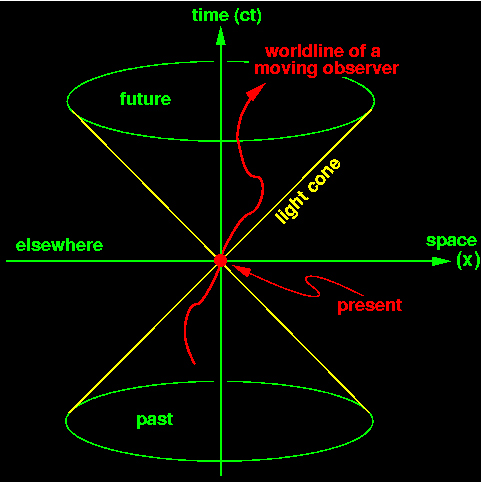
This diagram illustrates several key ideas:
- The Present: The single point at the origin where the cones meet.
- The Past: The bottom cone, containing all events in spacetime that could have causally affected the present event.
- The Future: The top cone, containing all events that the present event can causally affect.
- Elsewhere: The region outside the light cones. Events in "elsewhere" cannot affect, nor be affected by, the event at the origin. To get there would require traveling faster than light, which is forbidden.
The concept of spacetime is not just a mathematical convenience; it represents a deeper, more accurate description of the universe.
Conclusion
In this lesson, we have taken another major step away from the classical world of Newton and into the strange reality of Einstein.
Key Takeaways:
- A direct consequence of the constant speed of light is time dilation: a clock moving relative to an observer will be measured to run slower than a clock that is at rest relative to that observer.
- The light-clock thought experiment provides a clear, logical way to understand why time dilation must occur. The light in a moving clock travels a longer path at the same constant speed, so each "tick" must take more time.
- Because time and space measurements are relative to the observer, we must abandon them as separate, absolute concepts. They are instead fused into a single four-dimensional entity called spacetime.
- An object's journey through spacetime is its worldline, and the structure of spacetime, visualized by light cones, enforces the universal speed limit of light.
So far, we have been exploring "special" relativity, which deals with uniform motion. But what about acceleration? And what about gravity? In our next lesson, we will begin our transition to General Relativity by exploring Einstein's "happiest thought": the equivalence principle. Using another famous thought experiment involving an elevator, we will see how gravity and acceleration are deeply intertwined, a realization that will lead us to predict that gravity itself must bend both space and time.