¡Hola! Welcome back to our course on English-Spanish cognates.
In our last few lessons, we've focused on adjective patterns, like converting -oso to -ous and -ente/-ante to -ent/-ant. We saw how spelling changes are often accompanied by important shifts in pronunciation and stress.
Today, we will build on that foundation by looking at adverbs. Adverbs often describe how an action is done, and many are formed from the adjectives we've just studied. You're about to learn one of the most useful and frequent patterns between Spanish and English. By the end of this lesson, you will be able to convert Spanish adverbs ending in -mente to English -ly.
What is an Adverb? The -mente Suffix
First, let's quickly review what an adverb is and how it's formed in Spanish. An adverb modifies a verb, telling you how, when, where, or how much something is done. In Spanish, you are very familiar with adverbs ending in -mente.
To see a simple example, please read the first two short sections of the following article.
Spanish Adverbs Made Simple for Beginners
The article 'Spanish Adverbs Made Simple for Beginners' from Migaku provides a clear definition of an adverb and the -mente rule.
Please read the sections titled 'What is an adverb?' and 'Adverbs ending in -mente'. Focus on the example 'Ella corre rápidamente' and how 'rápidamente' is formed from 'rápido'.
As the article explains, you form these adverbs in Spanish by taking an adjective (usually its feminine form) and adding -mente. For example, rápida (from rápido) becomes rápidamente.
The Main Cognate Pattern: -mente becomes -ly
The good news is that English has a very similar system, which creates a very reliable cognate pattern.
The Rule: Spanish adverbs ending in -mente almost always correspond to English adverbs ending in -ly.
Watch this short video clip for a direct comparison. The explanation is in Spanish, which will help make the connection crystal clear.
ADVERBIOS EN INGLÉS: adverbios de modo en inglés
In his video 'ADVERBIOS EN INGLÉS', the creator of 'Inglés con el Güero' directly compares the Spanish -mente suffix to the English -ly suffix.
Watch from 01:29 to 02:18. Notice how he explains that adjetivo + mente is the same concept as adjective + ly.
As the video showed, the process is parallel in both languages:
- Spanish:
adjetivo+-mente→adverbio(e.g.,lento→lentamente) - English:
adjective+-ly→adverb(e.g.,slow→slowly)
This simple rule unlocks a huge number of words. Let's look at how the adjectives and adverbs align.
| Spanish Adjective | Spanish Adverb | English Adjective Cognate | English Adverb Cognate |
|---|---|---|---|
rápido |
rápidamente |
rapid | rapidly |
normal |
normalmente |
normal | normally |
final |
finalmente |
final | finally |
total |
totalmente |
total | totally |
perfecto |
perfectamente |
perfect | perfectly |
The image below shows another great example of this transformation.

Test your understanding!
Using the -mente to -ly pattern, what are the English adverbs for the following Spanish words?
posiblementegeneralmentenaturalmente
Show answer
- possibly (from the adjective
possible) - generally (from the adjective
general) - naturally (from the adjective
natural)
A Special Case: Adjectives ending in -ic
Do you remember from a previous lesson that many Spanish adjectives ending in -ico have English cognates ending in -ic?
clásico→classicpúblico→publicespecífico→specific
When we form adverbs from these words, there's a small change to the rule.
The Special Rule: If an English adjective ends in -ic, we add -ally to form the adverb.
Let's see the pattern:
- Spanish:
específico→específicamente - English:
specific→specific**ally**
Here are more examples:
automático→automáticamente|automatic→automatic**ally**histórico→históricamente|historic→historic**ally**trágico→trágicamente|tragic→tragic**ally**
Pronunciation of the -ally Suffix
You might think -ally is pronounced ah-lee, but this is where your knowledge of the schwa sound (/ə/) becomes important again. The pronunciation is much softer.
To learn how to pronounce this correctly, we will watch a video from a pronunciation coach.
-ally suffix | how to pronounce it
The video '-ally suffix | how to pronounce it' from Accent's Way English with Hadar is excellent for this. She clearly explains and demonstrates the two common pronunciations.
Watch from 01:05 to 03:21. Pay close attention to her two key points: the use of the schwa sound, and how the 'a' sometimes disappears completely.
Let's summarize the key points from the video:
-
The Schwa Pronunciation: The
-allyending is typically pronounced with a schwa sound: /əli/ (uh-lee). The 'a' is weak and unstressed.naturally→NATUR-/əli/culturally→CULTUR-/əli/
-
The "Disappearing A" Pronunciation: When the adjective ends in
-ic(a 'k' sound), the schwa often disappears. The-callyending is simply pronounced /kli/.specificallyis pronouncedspe-CI-fic-/li/(sounds like "specifiklee")practicallyis pronouncedPRAC-tic-/li/(sounds like "practiklee")automaticallyis pronouncedau-to-MA-tic-/li/(sounds like "automaticklee")
This is a very common feature of spoken English, and getting it right will make your pronunciation sound much more natural.
Practice Activity
Let's put all this together. The table below shows the connections between Spanish and English adjectives and adverbs. Try to fill in the missing words based on the patterns we've learned today.
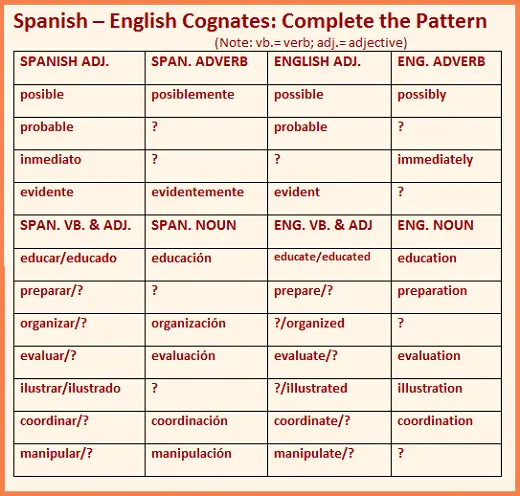
Check your answers!
Here are the completed rows from the image:
- Spanish:
final(adj),finalmente(adv)
English:final(adj),finally(adv) - Spanish:
normal(adj),normalmente(adv)
English:normal(adj),normally(adv)
How did you do? The pattern is very consistent.
Conclusion
Great job! You have now mastered the adverb pattern that corresponds to -mente in Spanish. This is one of the most productive rules for expanding your English vocabulary quickly.
Key Takeaways:
- Main Rule: Spanish adverbs ending in -mente correspond to English adverbs ending in -ly.
- Formation: Both are typically formed by adding the suffix to an adjective (e.g.,
rápido→rápidamente;rapid→rapidly). - Special Case: English adjectives ending in -ic form adverbs by adding -ally (e.g.,
specific→specifically). - Pronunciation: The
-allysuffix is pronounced/əli/(with a schwa) or, after-ic, often just/kli/.
This lesson concludes our module on adjective and adverb patterns. You now have a powerful set of tools to recognize and pronounce hundreds of English words.
In our next lesson, we will begin a new module focusing on verb cognates. We'll start with a simple but common pattern: recognizing English verbs by simply dropping the Spanish infinitive ending (e.g., decidir → decide).