Welcome to your second lesson! In our last session, we established the first fundamental rule for national income: converting between 'gross' and 'net' values using depreciation. You did a great job grasping that, which is a solid foundation for what's next.
Today, we'll master the second "golden rule" of national income conversions. This lesson tackles the difference between Market Price (MP) and Factor Cost (FC). You'll learn how government actions—specifically taxes and subsidies—create a gap between the cost of producing a good and the price it's sold for in the market. By the end of this 60-minute lesson, you will be able to confidently convert between MP and FC, bringing you one major step closer to solving any national income numerical thrown your way.
1. Understanding Factor Cost vs. Market Price
Let's start with the core distinction.
-
Factor Cost (FC): Think of this as the price from the producer's point of view. It is the total cost incurred by a firm in producing a good or service. This includes payments made to the factors of production: wages to labour, rent for land, interest on capital, and profit for the entrepreneur. It is what the producer receives.
-
Market Price (MP): This is the price from the consumer's point of view. It's the actual price you pay for a good or service in the market. This price is influenced by the government.
The bridge between these two prices is built by two government tools:
- Indirect Taxes: These are taxes levied on goods and services, such as the Goods and Services Tax (GST). They increase the price of a product above its factor cost.
- Subsidies: These are financial assistance given by the government to producers to lower the price of a product (e.g., subsidies on cooking gas or fertilizers). They decrease the price of a product.
2. The Role of Net Indirect Taxes (NIT)
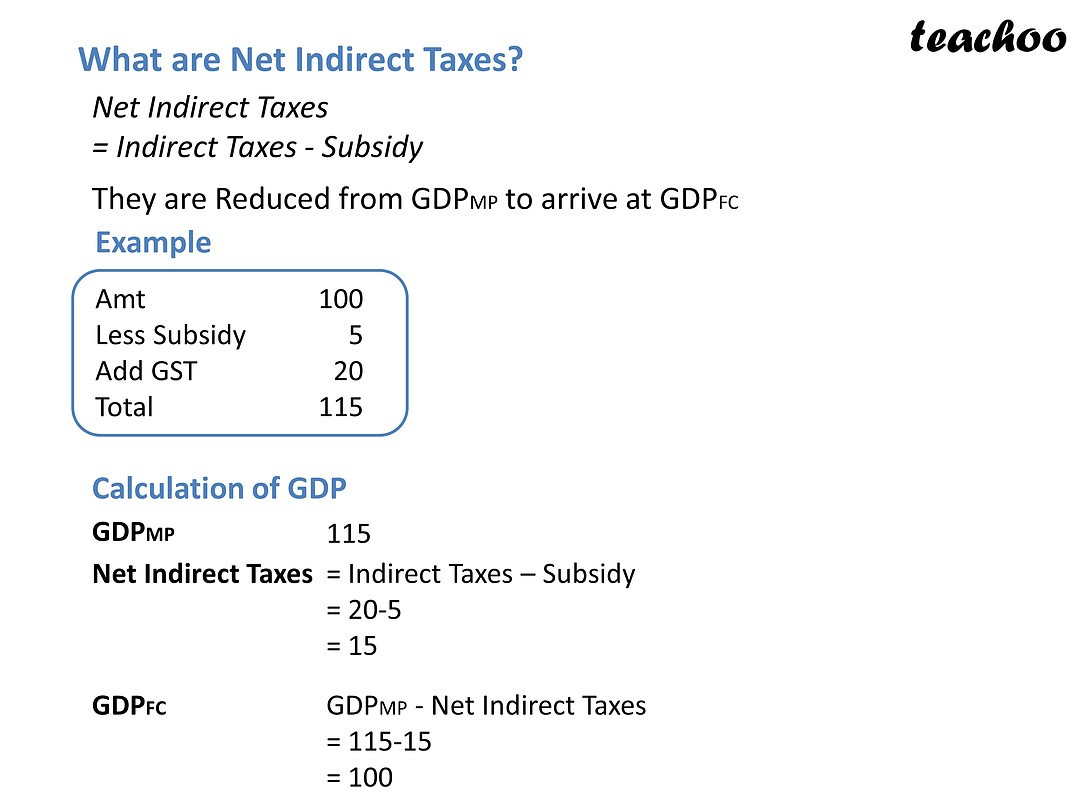
To simplify calculations, we combine the effect of these two government tools into a single concept: Net Indirect Taxes (NIT).
The formula is straightforward:
This gives us the second golden rule for conversions:
- To go from Factor Cost (FC) to Market Price (MP), you add Net Indirect Taxes.
- To go from Market Price (MP) to Factor Cost (FC), you subtract Net Indirect Taxes.
The following image provides a clear visual summary of this conversion.
To hear this concept explained and see the formulas in action, please watch the following segment from the video by Rajat Arora.
National Income numericals | Complete Basics | Class 12 | Macro eco
This video clearly explains the difference between Factor Cost and Market Price and introduces the formula for Net Indirect Taxes.
Watch the section from Factor Cost vs. Market Price. Pay close attention to how he defines NIT and presents the conversion rules. Note that if NIT is not given directly, you must calculate it using Indirect Taxes - Subsidies.
3. Combining the Conversion Rules: Practice Time
Now, let's combine what you've learned in this lesson and the previous one. A typical numerical will require you to convert from Gross to Net and from Market Price to Factor Cost.
The key is to apply the rules one by one. For example, to convert GDP at MP to NDP at FC:
- Gross → Net: Subtract Depreciation.
- Market Price → Factor Cost: Subtract Net Indirect Taxes (NIT).
The combined formula would be:
Let's watch a practical demonstration of how these rules are applied together to solve a numerical problem.
National Income numericals | Complete Basics | Class 12 | Macro eco
This segment shows a step-by-step solution to a numerical problem, applying the conversion rules for Depreciation and NIT simultaneously.
Watch the worked example from the first numerical. Notice how the instructor identifies what needs to be calculated and what is given, and then systematically applies the conversion for each component (Gross to Net, National to Domestic, and MP to FC). We will cover the "National to Domestic" part in the next lesson.
4. Your Turn to Solve
With the theory clear, it's time for active practice as you requested.
Problem 1: Walkthrough
Let's solve a question from a past paper. This is Problem 3 from the "Important Numerical of National Income" resource (LINK).
Calculate National Income (NNP at FC).
| Particulars | ₹ in crores |
|---|---|
| GDP at MP | 4,800 |
| Indirect Taxes | 300 |
| Net Factor Income from abroad | 80 |
| Consumption of fixed capital | 200 |
| Subsidies | 60 |
Solution Steps:
- Identify Goal and Given: We need to find
NNP at FCfromGDP at MP. - Set up the equation:
NNP at FC = GDP at MP - Apply conversions one by one:
- GDP → NNP: To go from Gross to Net, we subtract Depreciation (
Consumption of fixed capital).
... - Consumption of fixed capital - GDPMP → NNPFC: To go from Market Price to Factor Cost, we subtract Net Indirect Taxes (
Indirect Taxes - Subsidies).
... - (Indirect Taxes - Subsidies) - We will handle the D → N conversion in the next lesson. For now, we add NFIA.
- GDP → NNP: To go from Gross to Net, we subtract Depreciation (
- Final Equation & Calculation:
Problem 2: Your Turn
This problem requires you to work backwards, a common trick in board exams.
Calculate Indirect taxes from the following data:
| Particulars | ₹ in crores |
|---|---|
| NDP at FC | 55,915 |
| Subsidies | 1,540 |
| Factor income from abroad | 625 |
| Consumption of fixed capital | 1,625 |
| Factor income to abroad | 865 |
| GNP at MP | 58,350 |
Hint: Start by finding NDP at MP first. Then use the formula that connects NDP at MP and NDP at FC to find the value of Net Indirect Tax.
Click here for the solution steps
- Our goal is to find Indirect Tax. We know that
Indirect Tax = Net Indirect Tax + Subsidies. So, first, we need to findNet Indirect Tax (NIT). - We also know that
NIT = NDP at MP - NDP at FC. We are givenNDP at FC, so we need to calculateNDP at MP. - Calculate
NDP at MPfrom the givenGNP at MP.NDP at MP = GNP at MP - Consumption of fixed capital - NFIANFIA = Factor income from abroad - Factor income to abroad= 625 - 865 = -240NDP at MP = 58,350 - 1,625 - (-240)NDP at MP = 58,350 - 1,625 + 240 = 56,965
- Now, calculate Net Indirect Tax (NIT).
NIT = NDP at MP - NDP at FCNIT = 56,965 - 55,915 = 1,050
- Finally, calculate Indirect Tax.
Indirect Tax = NIT + SubsidiesIndirect Tax = 1,050 + 1,540Indirect Tax = ₹ 2,590 crores
Conclusion
Fantastic work today. You have now mastered the second critical conversion for national income accounting. Combining this with your knowledge of depreciation puts you in a strong position to handle numerical problems.
Key Takeaways:
- Factor Cost (FC) is the producer's cost, while Market Price (MP) is the consumer's price.
- The difference is Net Indirect Taxes (NIT), calculated as
Indirect Taxes - Subsidies. - The core conversion rule is:
FC = MP - NIT, orMP = FC + NIT.
In our next lesson, we will complete the puzzle by learning the third and final conversion rule: distinguishing between Domestic Income and National Income using Net Factor Income from Abroad (NFIA). Once you have that, you will be fully equipped to convert between any of the eight national income aggregates. Keep up the great pace