Welcome back. In our previous lesson, we established the precise definitions and formulas for the three key budget deficits. Knowing what they are is the first step. Today, we focus on the second and arguably more important step: understanding why they matter.
This lesson directly addresses the learning outcome of analyzing the implications of each type of budget deficit. We will explore the economic consequences of a Revenue Deficit, the wide-ranging effects of a Fiscal Deficit, and the specific information revealed by the Primary Deficit. This understanding is crucial for the analytical questions on your board exam and provides the essential context for the numericals we'll solve next.
1. Implications of Revenue Deficit
Let's begin with the Revenue Deficit. As a quick recap, we know:
A Revenue Deficit means the government's regular, recurring income isn't enough to cover its regular, recurring expenses. Think of it as a company not generating enough sales revenue to pay for salaries and operational costs. This has several important implications.
To understand these consequences, please watch the following video segment.
Government Budget and the economy | Macroeconomics | Class 12 | chapter 10 | Part 3
This video by Rajat Arora clearly explains the meaning and, more importantly, the key implications of a revenue deficit.
Please watch the section covering Revenue Deficit and its implications. Pay attention to the five main points he discusses: inability, dissaving, use of capital receipts, inflation, and the 'warning signal'.
Based on the video and your textbook knowledge, let's summarize the key implications:
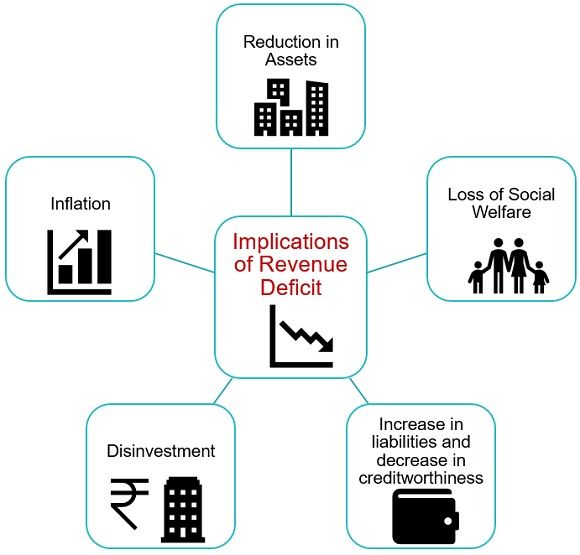
- Indicates Dissaving: The government is consuming more than its income. To finance this, it has to use the savings of other sectors of the economy, which is a sign of poor financial health.
- Financing Consumption with Capital: It implies that the government must cover this gap using its capital budget, for instance, by borrowing (creating a liability) or through disinvestment (selling assets). Your accounting background makes it clear why using one-time capital receipts to fund recurring operational expenses is an unsustainable practice.
- Inflationary Pressure: If the government resorts to borrowing from the RBI (deficit financing) to meet the revenue deficit, it increases the money supply in the economy, which can lead to inflation.
- Warning Signal: A high revenue deficit acts as a warning to the government to either reduce its wasteful or non-essential expenditure or increase its revenue through taxes and other sources.
This mind map provides a great visual summary of these points for quick revision.
2. Implications of Fiscal Deficit
The Fiscal Deficit is often considered the most critical measure of a government's financial position because it directly indicates the total amount the government needs to borrow.
This total borrowing requirement has significant and far-reaching consequences for the entire economy.
Let's watch another segment from the same video which details these effects.
Government Budget and the economy | Macroeconomics | Class 12 | chapter 10 | Part 3
This part of the video explains the serious implications that arise from a high fiscal deficit.
Watch the segment on the implications of Fiscal Deficit. Focus on understanding the concepts of the debt trap, inflation, foreign dependence, and the impact on future growth.
To solidify your understanding, please read the following text, which lays out these points in a format ideal for exam answers.
Government Budget and the Economy - CBSE Notes for Class 12 ...
This section from the LearnCBSE notes provides a concise, point-wise explanation of the implications of a fiscal deficit.
In the document, find the heading 3. Fiscal deficit. Read subsection (b) Implications of fiscal deficit. Notice how it lists four key points: Causes Inflation, Increase in Foreign Dependence, Financial Burden for Future Generation, and Debt Trap.
Let's consolidate the major implications of a high fiscal deficit:
- Debt Trap: This is a vicious cycle. The government borrows to finance its deficit. This borrowing requires future interest payments. These interest payments are a revenue expenditure, which increases the revenue deficit and, in turn, the fiscal deficit in subsequent years. This leads to even more borrowing just to pay the interest on past loans. The country gets "trapped" in a cycle of debt.
- Inflation: When the government borrows from the central bank (RBI), the RBI may print new currency to lend this money. This increases the money supply in the economy, which can cause a persistent rise in the general price level (inflation).
- Foreign Dependence: If the government borrows heavily from other countries or international financial institutions, it increases its dependence on them. This can sometimes lead to political and economic interference by the lending entities in the borrowing country's domestic policies.
- Hampers Future Growth: Borrowings are a financial burden on future generations, who will have to pay them back through higher taxes. This reduces their future disposable income and welfare. Furthermore, high government borrowing can raise interest rates, making it more expensive for private businesses to invest, thus "crowding out" private investment and hampering economic growth.
3. Implications of Primary Deficit
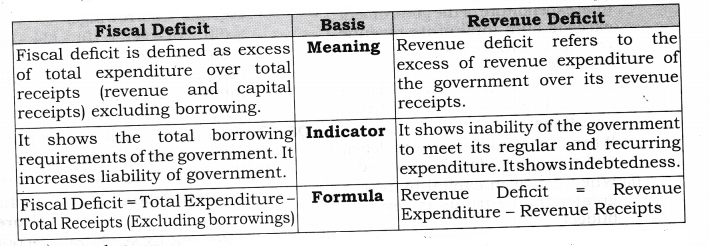
Finally, we come to the Primary Deficit. Its formula is simple, but its meaning is precise.
The implication of the primary deficit is not about a chain of negative consequences like the other two; rather, it is about what it indicates about the government's current fiscal health.
The following video clip explains this distinction perfectly.
Government Budget and the economy | Macroeconomics | Class 12 | chapter 10 | Part 3
This final segment clarifies the purpose of calculating the primary deficit and the special significance of a zero primary deficit.
Watch the part explaining the Primary Deficit and its significance. The key takeaway here is understanding what a zero primary deficit implies about the government's borrowing.
The core implication is:
- It shows the borrowing required to finance current spending, excluding past debt obligations. By removing interest payments from the fiscal deficit, the primary deficit reveals the shortfall arising from the current year's fiscal activities alone.
The most important analytical point here is the implication of a zero primary deficit.
- If Primary Deficit = 0, then Fiscal Deficit = Interest Payments.
- This means the government's entire borrowing for the year is solely to pay the interest on its accumulated past debt. Its current revenues and expenditures are balanced. While the country is still in debt, a zero primary deficit is a sign of fiscal discipline in the current period.
Conclusion
Today, we've moved beyond formulas to understand the real-world consequences of government deficits. This analytical understanding is vital for scoring well in your economics exam.
Key Takeaways:
- Revenue Deficit implies the government is dissaving and using one-time capital receipts to fund recurring expenses, which is unsustainable and inflationary.
- Fiscal Deficit signifies the total borrowing need, which can lead to a debt trap, inflation, increased foreign dependence, and a burden on future generations.
- Primary Deficit isolates the borrowing for current year expenses. A zero primary deficit is a key indicator of current fiscal discipline, showing that borrowing is only being done to service past debts.
You now have a solid grasp of what deficits are and why they are a major concern for policymakers. With this theoretical foundation secure, you are perfectly positioned for our next lesson, where we will apply this knowledge to solve numerical problems on budget deficits from past CBSE board papers.