Welcome to the next major unit in our Macroeconomics crash course. In the previous lessons, we focused on determining income and employment in an economy. Now, we shift our attention to the government's role in the economy through its budget.
Today, we will tackle the first part of the 'Government Budget' chapter. Our goal is to master the classification of all government income, or budget receipts, into two primary categories: revenue receipts and capital receipts. Understanding this distinction is crucial, as it forms the basis for many theoretical and practical questions in your board exam.
Let's begin by looking at the overall structure of a government budget.
1. The Structure of Budget Receipts
The government budget is a statement of the estimated receipts and expenditures of the government for a financial year. The receipts side represents the different sources from which the government gets its money. These receipts are broadly divided into two categories.
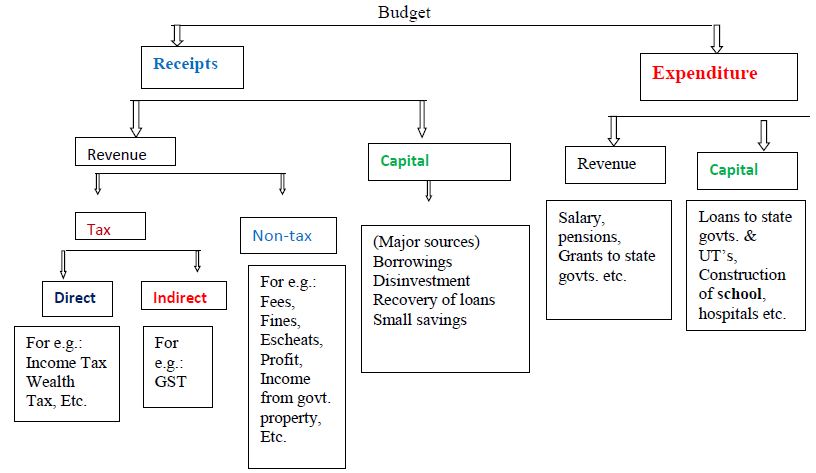
As you can see, Budget Receipts are split into Revenue Receipts and Capital Receipts. The key to classifying any receipt lies in understanding its impact on the government's assets and liabilities.
To learn this crucial rule, let's watch a short video.
Recharge Chapter 10 | Government Budget | Class 12 | Boards 2025
This video from Rajat Arora provides a very clear and simple rule to differentiate between revenue and capital receipts.
Watch the section from Budget Receipts where the presenter introduces the fundamental rule. Pay close attention to the "Neither-Nor" condition for revenue receipts. Then, watch from Capital Receipts to understand the "Either-Or" condition that applies here.
To summarize the core principle:
- Revenue Receipts (RR): These are receipts that NEITHER create a liability NOR reduce an asset for the government. They are regular and recurring in nature. Think of them as the government's regular income.
- Capital Receipts (CR): These are receipts that EITHER create a liability (e.g., taking a loan) OR reduce an asset (e.g., selling government property). They are generally irregular and non-recurring.
This "Neither-Nor" vs. "Either-Or" framework is the single most important tool for correctly classifying any government receipt.
2. A Closer Look at Revenue and Capital Receipts
Now, let's break down the components of each category with specific examples, which are frequently asked in exams.
A. Revenue Receipts
Revenue receipts are further divided into Tax Revenue and Non-Tax Revenue.
Recharge Chapter 10 | Government Budget | Class 12 | Boards 2025
Let's continue with the same video to explore the examples within revenue receipts.
First, watch the section on examples of revenue receipts, which covers both tax and non-tax sources like fees, fines, and escheats. Next, watch the detailed comparison of Tax Revenue, which explains the difference between Direct Taxes (like Income Tax) and Indirect Taxes (like GST).
Here's a breakdown of the key examples:
1. Tax Revenue: This is a compulsory payment made to the government without any expectation of a direct benefit in return.
- Direct Taxes: The burden cannot be shifted. Examples: Income Tax, Corporate Tax.
- Indirect Taxes: The burden can be shifted. Examples: Goods and Services Tax (GST), Customs Duty.
2. Non-Tax Revenue: These are receipts from sources other than taxes.
- Interest Receipts: Interest received on loans given by the government to states or other countries.
- Profits and Dividends: Income from Public Sector Undertakings (PSUs).
- Fees and Fines: License fees, registration fees, penalties for breaking laws.
- Escheat: Income from property left by a person without any legal heir.
- Grants and Donations: Financial help received from foreign governments or international organizations (e.g., for disaster relief).
Notice how none of these create a liability or reduce an asset for the government.
B. Capital Receipts
These receipts change the asset-liability status of the government. The three main sources are:
- Borrowings: When the government borrows money from the public (e.g., National Saving Certificates), the Reserve Bank of India, or the rest of the world, it creates a liability. The money has to be paid back. Therefore, it's a capital receipt.
- Recovery of Loans: When the government recovers a loan it had previously given to a state or a foreign country, its financial assets are reduced. The "loan" was an asset (a receivable), and now it's gone. This reduction in assets makes it a capital receipt.
- Disinvestment: This means the government sells its shares in Public Sector Undertakings (PSUs) to private entities. This sale reduces the government's assets (its ownership in the company). Hence, it is a capital receipt.
To solidify your understanding, quickly review these specific cases in a Q&A format.
NCERT Solutions for Class 12 Macro Economics Government ...
This resource from LearnCBSE provides concise reasoning for classifying common items.
Read through the following questions and their answers to reinforce the "why" behind the classification: Question 7: Why is tax not a capital receipt? Question 8: Why is interest termed as a revenue receipt? Question 9: Why are borrowings a capital receipt? Question 12: Why is recovery of loans treated as a capital receipt?
3. Practice with Board Exam Questions
Your preference for active learning is key, so let's apply these rules to questions similar to what you'll face in the exam.
First, let's watch a video focused solely on solving past paper questions related to this topic.
Government Budget - Important Questions | Economics | PYQ'S | Class 12
This video by Rajat Arora walks through several classification questions, explaining the reasoning for each one.
Watch the following segments to see the rules in action: First set of questions: Classifies interest received, disinvestment, and financial assistance. Second set of questions: Classifies dividends, sale of shares, and debt cleared by another government. Diagram-based question: A great example of how this can be presented visually in an exam.
Now, try one from a recent board paper yourself.
Question (CBSE 2024 Board Paper)
With valid reasons, classify the following into Capital receipts or Revenue receipts of the government:
(i) Dividend received by the government from a Maharatna company.
(ii) Receipts of the government from sale of shares of a Public Sector Undertaking (PSU) in open market.
(iii) Debt cleared by Sri Lanka Government to the Indian Government.
Think through each item before reading the solution.
- For (i), does receiving a dividend create a liability or reduce an asset?
- For (ii), what happens to the government's assets when it sells shares?
- For (iii), what was the "debt owed by Sri Lanka" to the Indian government? An asset or a liability? What happens when it's cleared?
Solution:
- (i) Revenue Receipt: Receiving a dividend is part of the government's profits from its investments. It neither creates a liability nor reduces an asset.
- (ii) Capital Receipt: Sale of shares is disinvestment. This reduces the assets of the government (its ownership in the PSU).
- (iii) Capital Receipt: The loan given to Sri Lanka was a financial asset for the Indian government. When the debt is cleared, it is a 'recovery of loan', which reduces the assets of the government.
To get more practice, work through the extensive list of examples in the resource below. This is an excellent way to test your understanding against a variety of items.
NCERT Solutions for Class 12 Macro Economics Government ...
This section provides a large set of classification problems with answers and reasons.
Find the section titled "Categorize the following items into Revenue and Capital Receipts". Go through each of the 20 statements (from "Loan from the Australian government" to "Profits of LIC") and for each one, first decide the category yourself and then check your answer against the reason provided.
Conclusion
In this lesson, we have thoroughly covered the classification of government receipts. You are now equipped to handle one of the most common questions from the Government Budget unit.
Key Takeaways:
- Budget Receipts are the government's estimated money inflows.
- The classification depends on the impact on assets and liabilities.
- Revenue Receipts: Follow the "Neither-Nor" rule. They do not create a liability or reduce an asset. Key examples are taxes, interest, fees, and grants.
- Capital Receipts: Follow the "Either-Or" rule. They either create a liability or reduce an asset. Key examples are borrowings, recovery of loans, and disinvestment.
In our next lesson, we will examine the other side of the coin: Budget Expenditure. We will learn to classify government spending into revenue and capital expenditure, which will prepare us to calculate the various budget deficits.