Hello! Let's dive into your next lesson.
In our last session, we established a clear understanding of what sustainable development is: a balanced approach to progress that meets our current needs without preventing future generations from meeting theirs. We discussed its three pillars—economic, social, and environmental—and why it's a necessary response to the environmental crisis.
Today, we transition from the "what" to the "how." This lesson will focus on the specific, practical strategies that India can implement to achieve sustainable development. Mastering these points is vital, as they frequently appear as direct questions in the CBSE board exams.
Your learning outcome is to: Outline key strategies for achieving sustainable development in India.
We'll cover the main strategies, see how they are explained for exam purposes, and then practice with questions from past board papers.
1. Key Strategies for Sustainable Development
Achieving sustainable development requires a multi-pronged approach. It's not about one single solution, but a collection of strategies that work together to reduce our environmental impact while promoting economic and social well-being.
The main strategies for India, which you should be familiar with for your exam, include:
- Using non-conventional energy sources.
- Switching to cleaner fuels.
- Developing mini-hydel plants.
- Adopting traditional knowledge and practices.
- Shifting towards organic farming and bio-pest control.
- Changing unsustainable consumption patterns.
To get a clear and efficient overview of these strategies, let's watch a detailed explanation.
Environment and Sustainable development | Chapter 7 | Indian Economic Development | One Shot
This video from Rajat Arora's "one-shot" series is perfect for a quick and thorough revision. It directly explains the strategies you need to know for your exam.
Please watch the section from Sustainable Development Strategies. The instructor clearly breaks down each of the key methods, from using non-conventional energy to the importance of bio-composting and traditional knowledge.
2. Consolidating the Strategies
The video provides a strong verbal explanation. Now, let's consolidate this knowledge with a concise, written list that is easy to memorize for the exam. The following resource presents these strategies in a clear, point-wise format.
[PDF] Revision Notes for Class 12 Indian Economic Development Chapter 9
These revision notes provide a perfect summary of the strategies, which you can use for last-minute review.
Find the heading "Strategies for Sustainable Development." Read through the list of nine strategies provided. Notice how they correspond to the points discussed in the video, such as using cleaner fuels (LPG, CNG), solar/wind power, and organic farming.
To visualize how these strategies fit into the bigger picture of tackling climate change, consider the following diagram. It connects the major challenges with high-level strategic approaches, aligning with the UN's Sustainable Development Goals (SDGs).
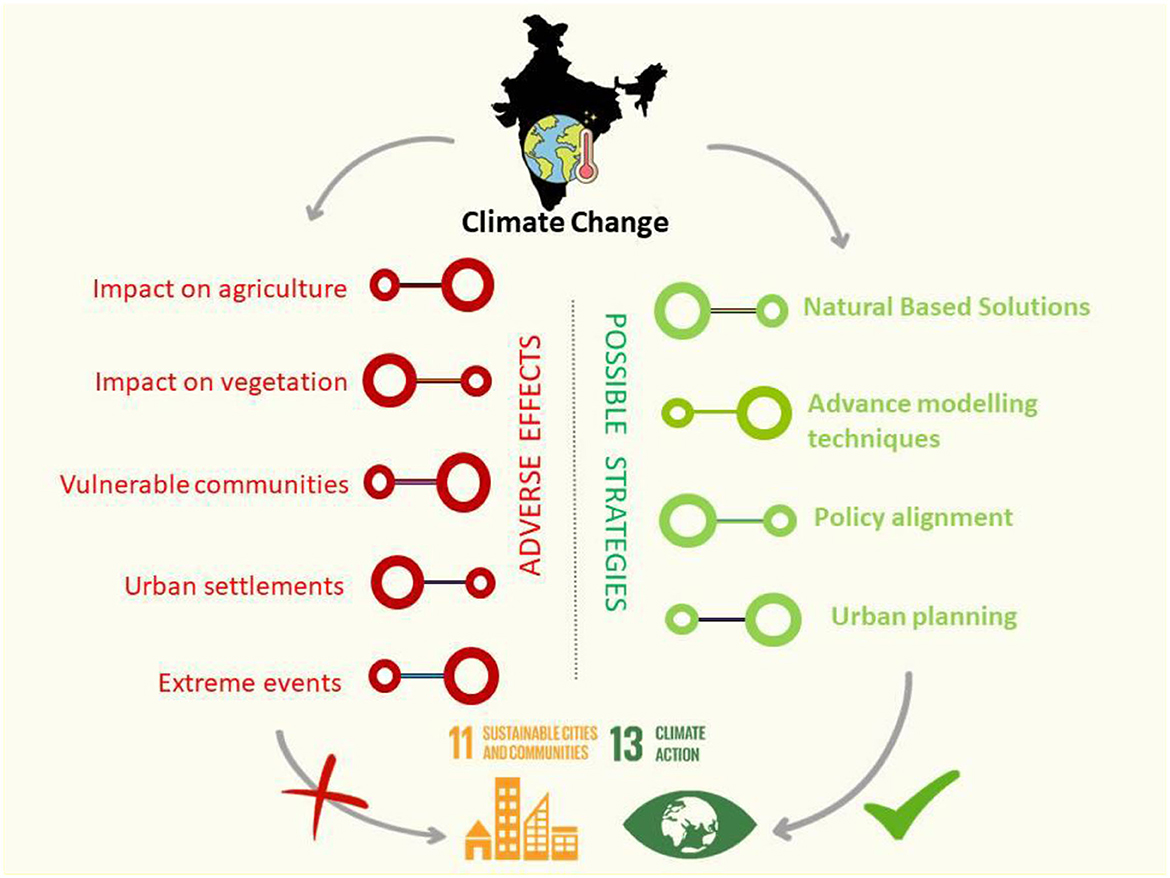
3. Application: How Strategies are Tested in Exams
You've expressed a preference for active learning and solving past papers, which is the most effective way to prepare at this stage. Let's now look at how these concepts of sustainable development strategies are framed in actual CBSE board exam questions.
The following video discusses several previous year questions on this very topic.
Most Important Previous year questions | Indian eco Chapter 7 & 8 | Class 12 Economics Board 2025
This video by Sunil Panda focuses on important past questions, giving you direct insight into what the examiners are looking for.
Watch the following segments to see different types of questions: Direct question: Here, the instructor discusses a straightforward question asking you to state and explain one strategy. Two strategies: This clip shows a question requiring an elaboration of two different strategies, giving examples like public transport and renewable energy. Image-based question: This part analyzes a question where you have to identify a problem (global warming) from a picture and suggest a strategy (like using wind/solar energy) to solve it.
Watching these clips will help you understand that the same core knowledge about these strategies can be applied to answer direct questions, case studies, and even image-based problems.
Conclusion
In this lesson, we have moved from the theory of sustainable development to the practical strategies for achieving it in India. You now have a clear framework for understanding and explaining these crucial methods.
Key Takeaways:
- Energy Strategies: A key focus is shifting from conventional, polluting energy sources to non-conventional sources (solar, wind) and cleaner fuels (CNG, LPG). Small-scale solutions like mini-hydel plants are also important.
- Agricultural Strategies: Moving towards organic farming by using bio-compost and bio-pest control helps reduce soil and water degradation from chemical inputs.
- Socio-Cultural Strategies: Reviving traditional knowledge (like Ayurvedic healthcare or water harvesting) and promoting responsible consumption patterns are vital for long-term sustainability.
- Exam Focus: Questions on this topic can be direct ("List the strategies") or applied (case-study, image-based), but they all test the same fundamental concepts.
We are now at the end of the "Current Challenges" unit. In our next lesson, we will begin the final module of your syllabus, "Comparative Development Experiences of India and its Neighbours." We will start by examining the development strategies adopted by China and Pakistan, which will provide an interesting contrast to the path India has followed. Keep up the focused effort; you're making excellent progress.