Hello! Welcome to your next lesson.
In the previous session, we practiced how to approach various types of board exam questions using examples from the "Current Challenges" unit. We briefly touched on rural cooperatives. Today, we'll dive deep into the theory behind one of the most important topics in this unit: Rural Development.
This lesson focuses on explaining the two fundamental challenges that hinder progress in rural India: the availability of credit and the effectiveness of agricultural marketing. Mastering these concepts is crucial, as they are frequently tested in the board examinations. By the end of this lesson, you will be able to explain the key difficulties related to rural credit and agricultural marketing and the steps taken to overcome them.
Let's get started.
1. The Challenge of Rural Credit
For the rural economy to grow, it needs a steady infusion of capital. This is where credit becomes vital. Farmers often face a long time gap between sowing a crop and earning an income from it. During this period, they need money for seeds, fertilizers, and other family expenses.
To build a strong foundation on this topic, let's begin with the core text.
[PDF] Chapter-6-Rural-Development.pdf - AWS
This section from your NCERT textbook explains why credit is essential for the rural economy and outlines the evolution of the rural credit system in India.
Please read the section titled Credit under the main heading Credit and Marketing in Rural Areas. This starts right after the introductory paragraphs. Focus on: The reasons farmers need to borrow money. The problems with non-institutional sources like moneylenders. The institutional sources of credit that were developed. The roles of NABARD and Self-Help Groups (SHGs). The "Critical Appraisal" of the rural banking system.
The reading gives you the official terminology and context. Now, let's watch a video that breaks down these concepts in a more dynamic way.
Recharge Chapter 5 | Rural Development | Indian Eco | Class 12 | Boards 2025
This video by Rajat Arora provides a clear and concise summary of the key points related to rural credit, which will help reinforce what you've just read.
Watch the segment from Rural Credit Challenges. Pay close attention to: The distinction between non-institutional and institutional sources. The specific examples of institutional sources, like Commercial Banks and Regional Rural Banks (RRBs). The list of problems plaguing the rural banking system, such as insufficient funds and growing overdue loans.
To summarize, the challenges in rural credit can be broken down into a few key areas:
Sources of Credit:
- Non-Institutional: Moneylenders, traders, relatives. These are often exploitative due to high interest rates and manipulation of accounts.
- Institutional: These are formal sources established by the government to provide credit at fair rates. They include:
- Commercial Banks (like SBI)
- Cooperative Credit Societies
- Land Development Banks
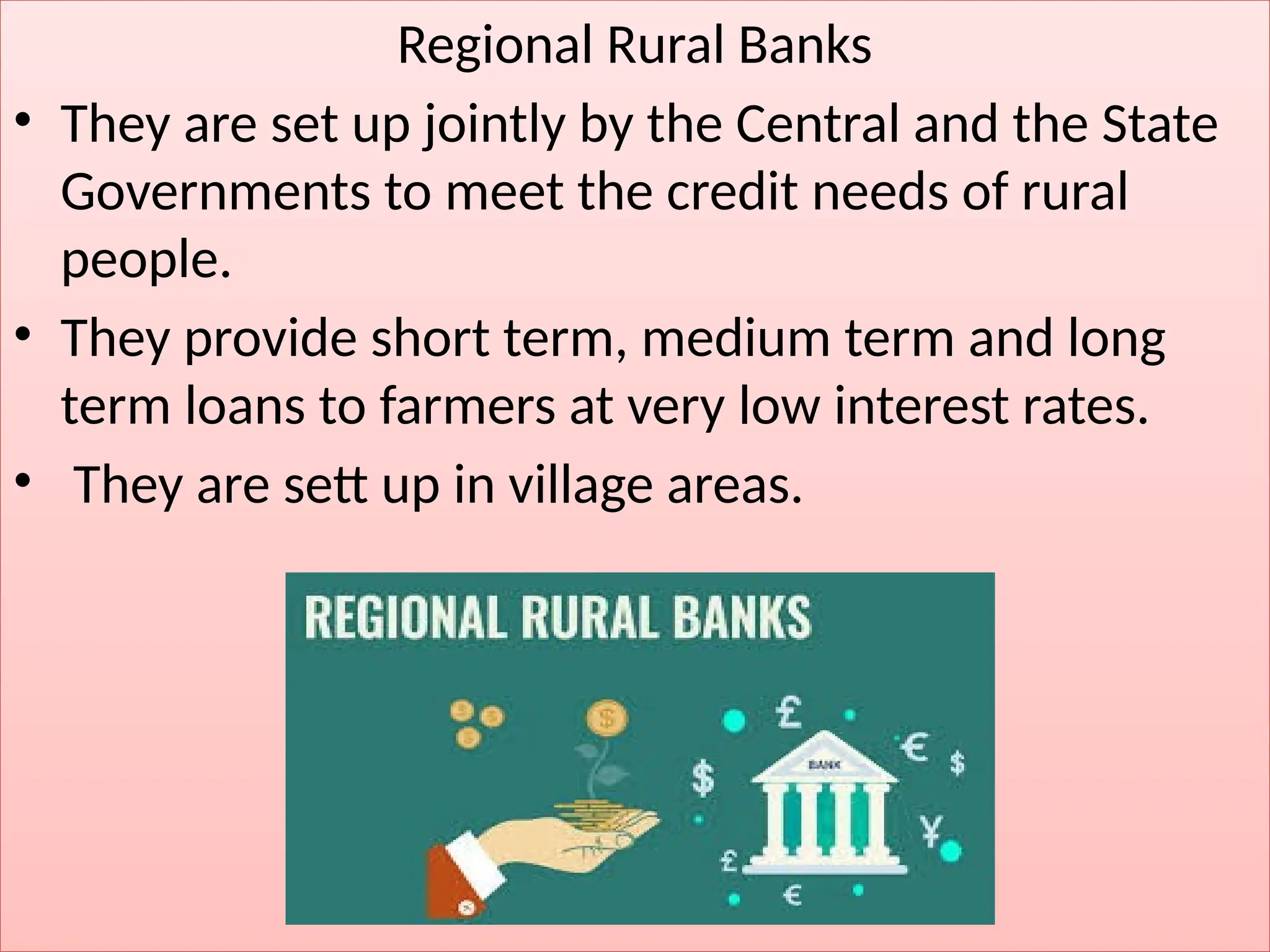
- Regional Rural Banks (RRBs)
Key Institutions:
- NABARD (National Bank for Agriculture and Rural Development): Established in 1982, it is the apex body that coordinates all institutions in the rural financing system. It doesn't lend directly to farmers but refinances the institutions that do.
- Self-Help Groups (SHGs): These are small, informal groups of people who pool their savings and provide loans to their members. They are a form of micro-credit and are crucial for helping the poor, especially women, who lack the collateral required by formal banks.
Problems with Rural Banking:
- Insufficiency: The total amount of credit available is still not enough to meet the demand.
- Inadequate Coverage: Many poor households are still outside the reach of formal banking.
- High Overdues: A significant number of farmers default on their loans, which makes banks more cautious about future lending. This is often due to crop failures and the high risks associated with agriculture.
2. The Challenge of Agricultural Marketing
Having a good harvest is only half the battle. Farmers also need to be able to sell their produce at a fair price. Agricultural marketing is the entire process that covers everything from harvesting the crop to getting it to the final consumer.
Let's go back to the NCERT text to understand this process and its challenges.
[PDF] Chapter-6-Rural-Development.pdf - AWS
This section details the marketing process, the problems farmers traditionally faced, and the government's initiatives to improve the system.
Read the section titled Agricultural Market System and the following short section on Emerging Alternate Marketing Channels. Focus on: The definition and components of agricultural marketing (assembling, storage, etc.). The problems faced by farmers, such as faulty weighing and distress sales. The four main government initiatives to improve marketing. The examples of new, alternative marketing channels.
Now, let's reinforce this with a video that simplifies the marketing process and the government's response.
Recharge Chapter 5 | Rural Development | Indian Eco | Class 12 | Boards 2025
This segment of the video will help you remember the key steps in agricultural marketing and the government's major policy actions.
Watch from Agricultural Marketing. The instructor uses a helpful mnemonic, "GPGPSS" (Gathering, Processing, Grading, Packing, Storage, Selling), to explain the process. Note down the problems faced by farmers and the government's solutions.
Here is a summary of the key points on agricultural marketing:
Problems Faced by Farmers:
- Manipulation by Traders: Private traders and moneylenders often use faulty weights and manipulate accounts to cheat farmers.
- Lack of Market Information: Farmers are often unaware of the prevailing market prices and are forced to sell at lower rates.
- Lack of Storage Facilities: Without proper storage (warehouses, cold storage), farmers are forced into "distress sales"—selling their produce immediately after harvest at low prices to avoid spoilage.
Government Measures to Improve Agricultural Marketing:
- Regulation of Markets: Establishment of regulated market yards where sales are transparently monitored.
- Provision of Physical Infrastructure: Building roads, railways, warehouses, and cold storage to support the marketing process.
- Cooperative Marketing: Encouraging farmers to form marketing societies to sell their produce collectively and improve their bargaining power (e.g., the success of Amul in Gujarat).
- Policy Instruments:
- Minimum Support Price (MSP): An assured minimum price at which the government will buy produce from farmers, acting as a safety net.
- Buffer Stocks: Maintaining stocks of key grains (like wheat and rice) by the Food Corporation of India (FCI).
- Public Distribution System (PDS): Distributing food grains from buffer stocks to the poor at subsidized prices through ration shops.
Alternative Channels: To help farmers sell directly to consumers and get better prices, new channels have emerged, such as Apni Mandi (Punjab, Haryana) and Rythu Bazars (Andhra Pradesh).
3. Exam-Oriented Practice
Now that we have covered the theory, let's apply it to the type of questions you'll see in your board exam. This is a crucial step to solidify your understanding.
Question 1: The Role of Micro-Credit
A common 3-mark question is to "critically appraise" a policy. This means you need to state both its positive impacts and its limitations.
CBSE PYQs Rural Development - Economics Class 12 - EduRev
This resource contains past CBSE questions. We will use it to practice a typical question on micro-credit.
Find Question 8: "Critically appraise the micro-credit programmes in rural India." Read the question and the provided answer. Notice how the answer is structured with a "Positive Impact" and a "Critical Gap."
Question 2: Government Measures in Marketing
Let's try another one. This question asks you to list specific government actions.
Important Questions | PYQ'S | HCF | Rural Development | Must Watch
This video focuses on solving important questions from this chapter.
Watch the segment from Developing Rural Markets. The instructor quickly lists the key steps taken by the government to develop rural markets, which is a direct answer to a common exam question.
Your Turn: Solve a PYQ
Based on what you've learned, try to answer this question from a past paper.
Question (CBSE): Explain the importance of credit availability in rural development. (4 Marks)
Hint: Think about the long gestation period, the need for investment in modern inputs, escaping the debt trap of moneylenders, and meeting family expenses.
Click to check your answer's structure
A good answer would include these four points, as detailed in the NCERT text and the "CBSE PYQs" resource (Question 12):
- Long Gestation Period: Credit is needed to sustain farmers during the long gap between sowing a crop and earning an income.
- Productivity Enhancement: Loans allow farmers to buy better seeds, fertilizers, and technology, which increases their output.
- Breaking the Debt Trap: Access to formal credit at reasonable interest rates helps farmers avoid the exploitative practices of informal moneylenders.
- Meeting Social Obligations: Credit is also required for non-farm expenses like marriages and medical emergencies, preventing families from falling into deeper poverty.
Conclusion
Well done on completing this lesson. You have now covered two of the most significant challenges in Indian rural development and the government's response to them.
Key Takeaways:
- Rural Credit: Is vital for agricultural growth. The main challenges are the insufficiency of formal credit, the lack of collateral among the poor, and high loan defaults. Key solutions include the institutional framework (NABARD, RRBs) and micro-credit (SHGs).
- Agricultural Marketing: The main challenges are exploitation by traders, distress sales due to lack of storage, and inadequate market information. Government interventions include regulated markets, infrastructure development, cooperative marketing, and policy instruments like MSP and PDS.
- Keywords: Make sure you are comfortable defining and using terms like NABARD, SHG, micro-credit, MSP, PDS, and distress sale.
In our next lesson, we will continue with the theme of rural development by looking at two emerging areas: the importance of agricultural diversification and the rise of organic farming. These are seen as key strategies for creating sustainable livelihoods in rural India. Keep up the focused effort