Hello! In our last lesson, we focused on calculating the various propensities to consume and save. Today, we'll use that knowledge to tackle one of the most important numerical question types in Macroeconomics: finding the equilibrium level of income.
This lesson directly addresses your goal of mastering numericals. We will learn to solve categorized board paper numericals (2019–2024) on finding equilibrium income. We'll break down the core formulas and then apply them to different variations of questions you're likely to see on your exam. The process is very systematic, which should feel familiar given your background in accounting.
1. The Equilibrium Toolkit: Formulas and Concepts
An economy is in equilibrium when the total planned spending (Aggregate Demand, AD) equals the total planned output (Aggregate Supply, AS). In a simple two-sector economy (households and firms), this leads to our master equation.
Let's quickly review the essential formulas.
- Aggregate Demand (AD): The total planned spending.
Where is Consumption Expenditure and is Investment Expenditure. - Aggregate Supply (AS): The total value of output, which is equal to National Income ().
- The Equilibrium Condition (AD-AS Approach):
- The Alternative Equilibrium Condition (Saving-Investment Approach): At equilibrium, planned savings must equal planned investment.
- The Consumption Function: Remember this from our last lesson? It's crucial.
Where is autonomous consumption (consumption at zero income) and is MPC.
To see how these all fit together for solving numericals, let's watch a quick refresher.
Important Numericals | 12th Commerce | Determination Of Income & Employment🔥
This video by Commerce Wallah by PW provides a concise summary of all the key formulas we'll use today.
Watch from the formulas. Focus on how the instructor links the equilibrium condition (AD = AS) to the more practical equation we use for calculations: Y = C + I.
2. Category 1: Calculating Equilibrium Income (Y), C, and S
This is the most common question you'll encounter. You will be given a consumption function (or the data to find it) and a value for autonomous investment (), and you'll be asked to find the equilibrium income ().
The steps are always the same:
- Write down the equilibrium condition: .
- Substitute the full consumption function and the given value of into the equation.
- You will get an equation with on both sides. Solve it algebraically.
- Once you have the equilibrium , you can calculate the equilibrium consumption () by plugging back into the consumption function.
- You can then calculate equilibrium savings () using the identity .
Let's see this in action.
Important Numericals | 12th Commerce | Determination Of Income & Employment🔥
The same video provides two excellent, step-by-step walkthroughs of this exact problem type.
Watch the first example from the first problem, where the instructor calculates equilibrium Y and C. Then, watch the second, similar example from the second problem to solidify the method. Notice how he methodically substitutes values and solves the equation.
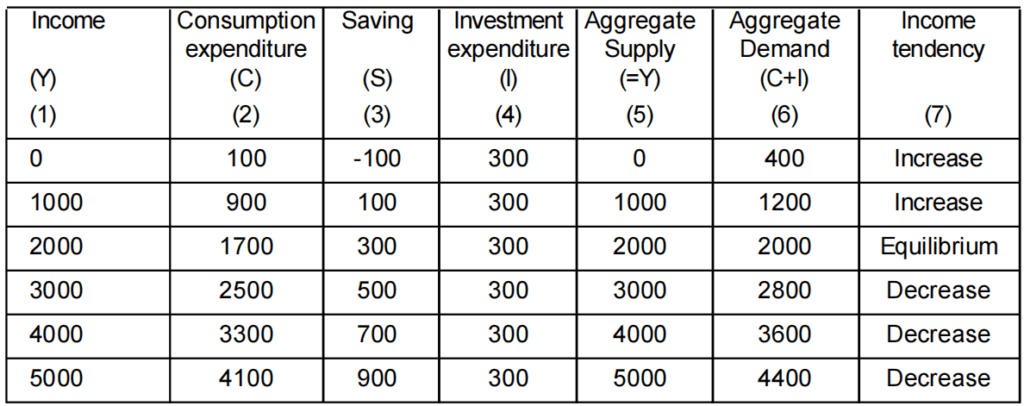
This table illustrates the concept. Equilibrium is the point where AD equals AS (which is Y).
3. Category 2: Finding a Missing Component
In this variation, you are given the equilibrium income () and asked to find a missing piece of the puzzle, such as Autonomous Consumption () or Investment (). The process is reversed, but the formula is the same.
A common trick here is that the question might give you MPS instead of MPC. You must first calculate MPC using the relationship we learned: .
Let's see how to solve for a missing investment value.
Important Numericals | 12th Commerce | Determination Of Income & Employment🔥
The video now tackles these 'missing value' problems.
Watch the segment on finding investment. Pay close attention to how he first calculates MPC from the given MPS. Then, watch the next part on finding autonomous consumption. The logic is identical: substitute all known values into Y = \bar{C} + bY + I and solve for the one unknown variable.
Your Turn: Practice Problem
Now, apply this logic to solve a typical board question.
CBSE Class 12 Economics HOTs - Determination of Income and ...
This resource contains a straightforward, solved problem from past papers. We'll use it as a practice question.
Read the question titled "An economy is in equilibrium. Find ‘autonomous consumption’...". Cover the answer and try to solve it yourself on paper using the method from the video. Given: National Income (Y) = 1,000 MPC (b) = 0.8 Investment (I) = 100 Your Task: Find Autonomous Consumption (\bar{C}). Once you have an answer, check it against the provided solution.
4. An Alternative Method: The Saving-Investment Approach
Remember the second equilibrium condition, ? This provides a powerful and often faster way to find equilibrium income, especially if you are given the saving function directly.
The saving function is: , where 's' is the MPS.
Example:
An economy has a saving function . Planned investment is ₹2,000 crores. Find the equilibrium income.
Solution:
- Start with the equilibrium condition:
- Substitute the given values:
- Solve for Y:
The equilibrium income is ₹9,000 crores. This method is demonstrated in the problem found in the resource LINK under the title "The saving function of an economy is given as..." (section 4).
Conclusion
You've done an excellent job working through these numericals. Finding the equilibrium income is a foundational skill for this chapter, and mastering the algebraic manipulation is key.
Key Takeaways:
- Equilibrium income can be found using two main conditions: or .
- The AD-AS approach () is the most versatile. It can be used to find Y, C, S, , or I.
- The S-I approach is a quick shortcut if you are given the saving function and investment.
- Always check if the question provides MPC or MPS. If MPS is given, your first step should be to calculate MPC () before using the consumption function.
In our next lesson, we will tackle the final numerical type from this unit: the investment multiplier. We will see how a change in investment causes a multiplied change in national income, and we will solve board questions related to it.