Hello! In our last session, we wrapped up the 1947-1990 era by tackling past board exam questions, where we noted the inefficiencies and slow growth that began to plague the Indian economy. Those issues didn't just disappear; they built up over time and culminated in a major turning point for the country.
Today, we begin a new module on the Economic Reforms since 1991. This lesson will focus on understanding the critical situation India faced in 1991. We will explore the specific economic problems that pushed the country to the brink of a financial collapse and understand why the government had no choice but to introduce a sweeping set of changes known as the New Economic Policy (NEP).
1. The Background of the 1991 Crisis
By the end of the 1980s, the Indian economy was in a dire state. For decades, the government's spending on development programs, defence, and social sectors far exceeded its income from taxes and public sector enterprises. To cover this gap, the government resorted to heavy borrowing, both domestically and from international sources. This created a cycle of problems that came to a head in 1991.
To get a comprehensive overview of this situation, let's start with the explanation provided in the NCERT textbook. It clearly lays out how inefficient management led to a severe financial crisis.
[PDF] D:\Textbooks\Rationalised Books\11100 - NCERT
This section from the official NCERT textbook provides the essential context for the 1991 reforms. It explains the root causes of the financial crisis and the circumstances that led India to approach the World Bank and IMF.
Please read the section titled 3.2 BACKGROUND. As you read, focus on understanding the answers to these key questions: Why was the government's expenditure so much higher than its revenue? What happened to India's foreign exchange reserves, and why was this a critical problem? What is meant by the term "unsustainable" borrowing? Who did India approach for help, and what conditions did they impose?
The reading makes it clear that India was caught in a vicious cycle. The country was facing a severe Balance of Payments (BOP) crisis, meaning it was spending far more foreign currency on imports than it was earning from exports. This led to a dramatic fall in foreign exchange reserves, leaving India with barely enough to pay for two weeks' worth of essential imports like petroleum.
This image provides a simple visual summary of the key issues.

2. The Main Causes of the Economic Crisis
Let's now break down the specific causes of the crisis. While the NCERT text gives a great overview, a video explanation can help reinforce these concepts. The following video explains each cause clearly and concisely.
ECONOMIC REFORMS SINCE 1991 | FINAL ONE SHOT REVISION 🔴LIVE | 12th INDIAN ECONOMY BOARD EXAM 2026
This video from Sunil Panda-The Educator provides a detailed breakdown of the five primary reasons that led to the 1991 reforms.
Watch the segment from Causes of the Crisis. Pay close attention to the explanation of each of the following points: Rise in Prices (Inflation): The government was financing its deficit by asking the RBI to print more currency, which increased the money supply and caused prices of essential goods to skyrocket. Rise in Fiscal Deficit: The gap between government expenditure and revenue grew so large that borrowings became unsustainable. Notice the powerful statistic mentioned: by 1991, interest payments alone consumed over 36% of the government's total expenditure. This is a classic sign of a debt trap. Poor Performance of Public Sector Enterprises (PSUs): The PSUs, which were expected to generate profits for the government, were instead running into huge losses, becoming a major financial drain. Deficit in Balance of Payments (BOP): As discussed, imports grew much faster than exports, leading to a deficit. Critically Low Foreign Exchange Reserves: This was the most immediate problem. Without foreign currency, India couldn't pay its import bills or the interest on its foreign loans, pushing it to the verge of a sovereign default.
3. The Response: The New Economic Policy (NEP)
Facing an imminent default and with no other country or international institution willing to lend, India approached the International Monetary Fund (IMF) and the World Bank. They agreed to provide a $7 billion loan to manage the crisis, but this help came with strict conditions. India was required to fundamentally change its economic structure.
This led to the announcement of the New Economic Policy (NEP) in July 1991, spearheaded by Prime Minister P.V. Narasimha Rao and Finance Minister Dr. Manmohan Singh.
The NEP consisted of a two-pronged strategy, as shown in this flowchart.
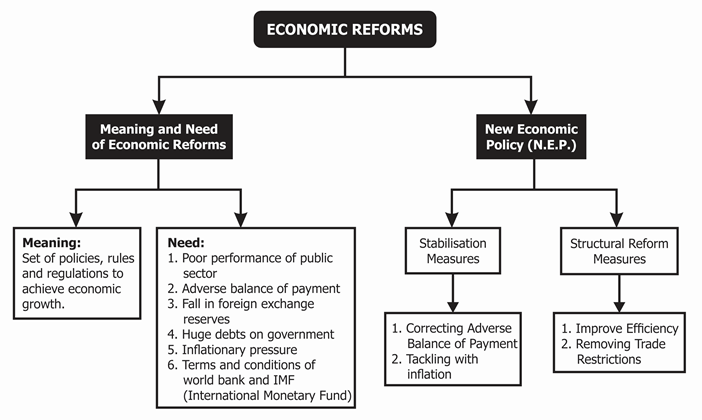
The two main types of measures were:
-
Stabilisation Measures: These were short-term policies aimed at tackling the immediate crisis. Their goal was to control inflation by reining in prices and to correct the adverse Balance of Payments situation by building up foreign exchange reserves.
-
Structural Reform Measures: These were long-term policies designed to address the deep-rooted inefficiencies in the economy. Their goal was to improve the efficiency of the economy and increase its international competitiveness. These reforms are broadly classified under three headings:
- Liberalisation
- Privatisation
- Globalisation
Let's watch a short clip that clearly differentiates between these two types of measures.
GNG Economics | Day 21 | Chapter 3 | New economic policy 1991
This clip from Rajat Arora neatly summarises the two categories of reforms under the NEP.
Watch from Types of Measures. Focus on the key difference: stabilisation was about correcting immediate weaknesses (short-term), while structural reform was about changing the entire economic framework for long-term efficiency and competitiveness.
Conclusion
In this lesson, we have explored the severe economic crisis that gripped India in 1991. We saw how years of government overspending, inefficient public sector performance, and a growing trade deficit led to an unsustainable situation.
Key Takeaways:
- The 1991 economic crisis was caused by a combination of high fiscal deficit, a Balance of Payments deficit, soaring inflation, and the poor performance of PSUs.
- The immediate trigger was the depletion of foreign exchange reserves to a point where India could barely finance two weeks of imports and was on the verge of defaulting on its international loans.
- The rationale for the New Economic Policy (NEP) was twofold: to manage the immediate crisis and to address the underlying structural flaws of the economy.
- The NEP consisted of stabilisation measures (short-term crisis management) and structural reform measures (long-term changes to improve efficiency), which included Liberalisation, Privatisation, and Globalisation (LPG).
This crisis and the resulting policy shift marked a new chapter in India's economic history. In our next lesson, we will begin to unpack the structural reforms by examining the first component: Liberalisation. We will explore the specific measures taken to dismantle the "License Raj" and open up the Indian economy.