Welcome to the final lesson of your crash course. Over the last few lessons in this module, we've explored the development paths of India, China, and Pakistan. We first compared what their development outcomes were across various indicators and then analyzed why these differences emerged by appraising their unique strategies.
Today, we put all that knowledge into practice. This session is designed to meet your specific goal of mastering exam questions. We will focus exclusively on solving representative CBSE board paper questions from recent years (2019-2024) for this chapter. By the end of this lesson, you will be able to confidently identify, structure, and answer the various types of questions that appear on this topic in your board exam.
1. Understanding the Question Patterns
This chapter is a favorite for examiners as it tests analytical and comparative skills. The questions are rarely direct definitions. They often involve interpreting data, evaluating policies, or justifying statements.
Let's watch a video that breaks down the most common question types with solved examples. This will give you a solid framework for how to approach them.
Revision | Important questions | Indian Economic Development | Chapter 10 | India,China and Pakistan
The video "Revision | Important questions" by Rajat Arora is an excellent compilation of past questions from this chapter. It demonstrates exactly how to deconstruct and answer them.
We will watch this video in parts, focusing on different question categories. First, watch the sections covering objective and assertion-reason questions: Multiple Choice Questions: Pay attention to how dates (GLF, reforms) and policies (One-Child Policy) are tested. Assertion-Reason & True/False: Notice how these questions test the cause-and-effect relationship between policies and outcomes, like the impact of the one-child policy on China's demographic structure. Next, focus on how to tackle descriptive and analytical questions: Similar Development Strategies: This is a classic question comparing India and Pakistan. Note the key points: mixed economy, planning, and public sector focus. Reasons for Pakistan's Slow Growth: Observe how the answer is structured around key themes like agricultural dependence and reliance on foreign loans. The 70-Year Journey: This is a model for a high-value evaluative question, comparing the performance of all three nations over the long term. Finally, let's master data-based questions: Interpreting Demographic Data: See how to compare population growth and sex ratio from a table and provide the reasons behind the numbers. Interpreting GDP Data: This shows how to analyze trends in GDP growth rates for India and China. Interpreting Trade Data: This example on exports and imports demonstrates how to identify trade imbalances and economic dependence from a data table.
2. Key Takeaways from Question Analysis
From the video, we can identify three main categories of questions from this chapter:
- Fact-Based & Policy Questions: These require you to know key dates and the specifics of policies.
- Examples: China's Great Leap Forward (1958), introduction of reforms (China: 1978, Pakistan: 1988, India: 1991), the One-Child Policy, Special Economic Zones (SEZs).
- Comparative & Evaluative Questions: These ask you to compare strategies, justify statements, or analyze reasons for success and failure.
- Examples: "Why did Pakistan's economy slow down?", "Compare the development strategies of India and Pakistan," "Justify that India, Pakistan, and China have travelled different developmental distances."
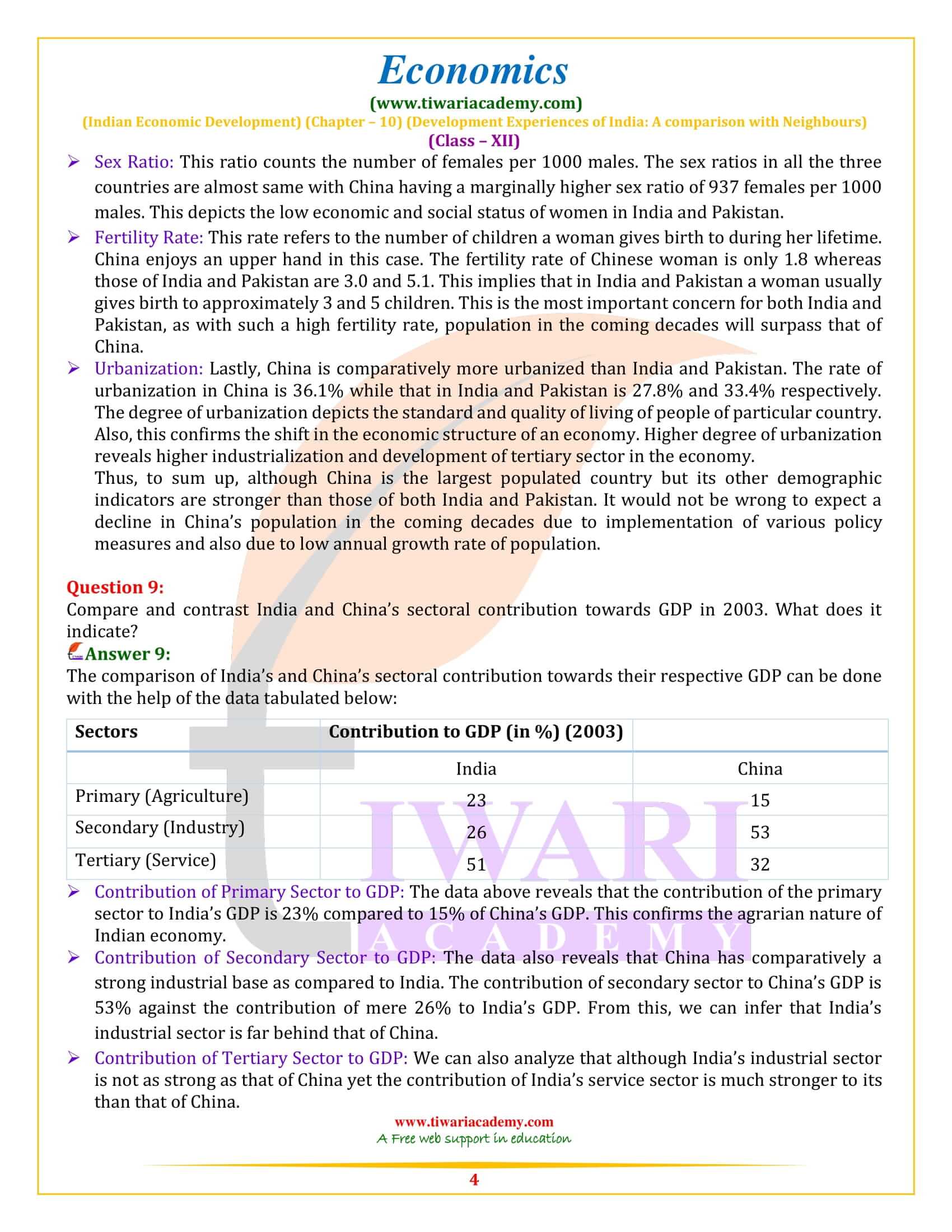
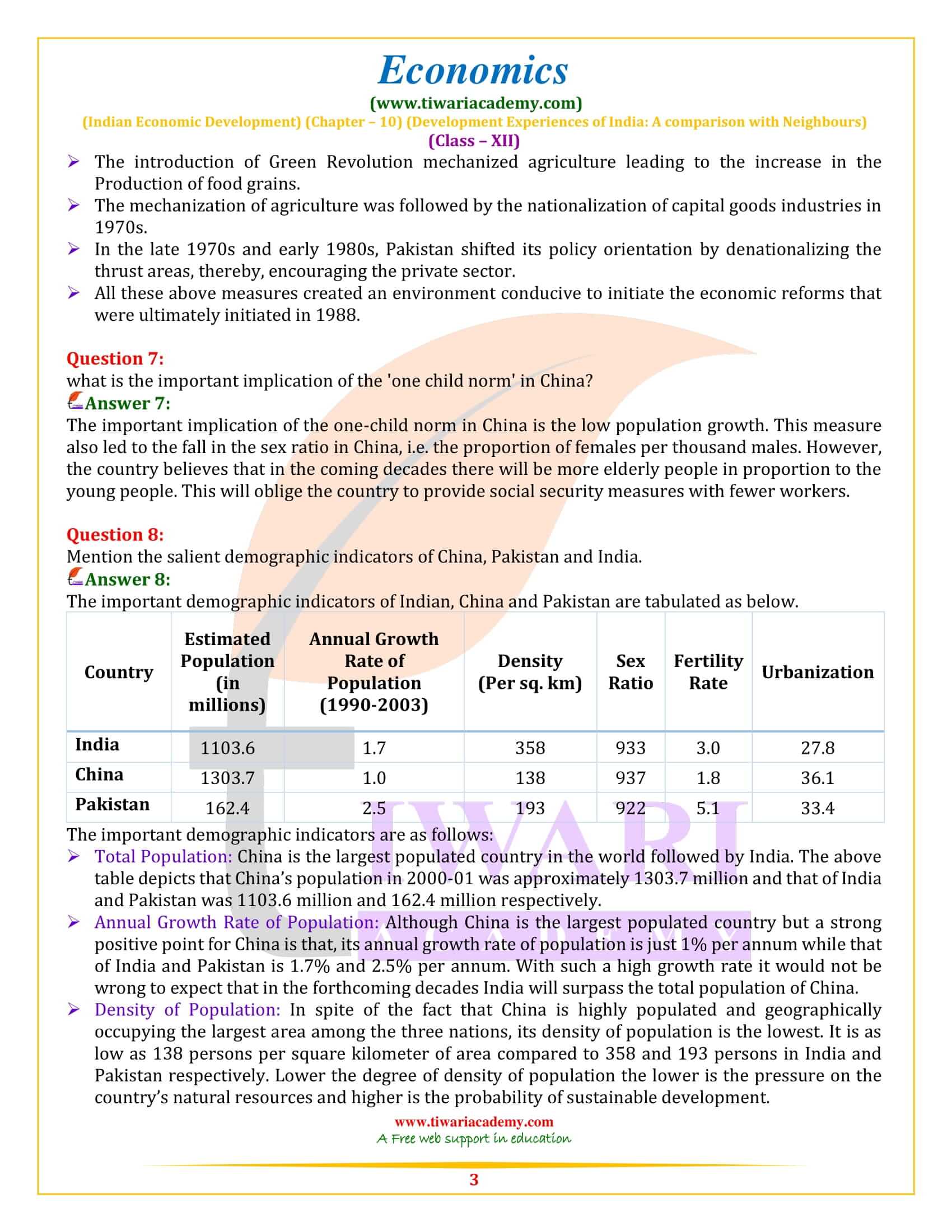
- Data Interpretation Questions: You are given a table (with demographic, GDP, or trade data) and asked to analyze it. The key is to:
- State the observation: "As per the data, China's population growth rate (0.5%) is significantly lower than Pakistan's (2.1%)."
- Provide the reason: "This is primarily due to China's strict 'one-child policy' implemented in the late 1970s."
- Conclude/Imply: "This has led to a demographic imbalance in China with an aging population."
Let's look at a couple of static examples of well-structured answers for data-based questions.
3. Practice with the Latest CBSE Paper (2024)
Now, let's apply these skills to questions from the most recent board exam. This will confirm the patterns we've discussed and ensure you're prepared for what to expect.
CBSE Class 12 Economics Question Paper 2024 (Set 1
This resource contains questions and solutions from the 2024 Economics board paper. We'll focus on the questions from the 'Indian Economic Development' section related to our chapter.
Read through the following questions. Before looking at the solution, try to formulate the key points for your answer based on what we've learned. Question 19: "In the decade of the 1970s, Pakistan nationalized its ________ industries." (Fact-based) Question 23 (Assertion/Reason): (A) China used market mechanisms. (R) Social infrastructure creation brought positive results. (Analytical) Question 25: "Economic reforms were introduced in India and Pakistan in the years ________ and _________, respectively." (Fact-based) Question 30(a): "Explain the consequences of the one-child policy adopted by China in the 1970s." (Policy-based) Question 30(b): "Discuss the impacts of Special Economic Zones (SEZs) on the economic growth of China." (Policy-based) After you've thought about your answers, review the provided solutions on the webpage to see how they align.
Did you notice the trend? The 2024 paper heavily featured questions on Chinese economic policies (One-Child Policy, SEZs, Market Mechanism) and key timelines, reinforcing the importance of these specific topics.
4. Your Final Practice
Your strategy of practicing with past papers is the most effective way to prepare. You now have the theoretical foundation and a clear understanding of the question patterns. The final step is independent practice.
CBSE Class 12 Economics Previous Year Question Paper PDF with ...
This webpage from Vedantu provides links to CBSE Class 12 Economics question papers from 2019 to 2024, with solutions. It's the perfect resource for your final revision.
I encourage you to download the papers for 2019, 2020, 2022, and 2023. Go to the 'Indian Economic Development' section and solve all the questions from the chapter on 'Comparative Development'. As you practice, remember the three-step process for data questions: State the Data: What does the table show? Give the Reason: Why is the data the way it is? (Link to a policy or strategy). Analyze the Impact: What is the consequence?
Conclusion
This lesson, and with it, our course, concludes your preparation for the Economics board exam. You have covered all the content and, most importantly, have practiced applying it in the context of actual board questions.
Key Takeaways from Today's Practice Session:
- Master the Key Policies: Be very clear about China's GLF, Cultural Revolution, One-Child Policy, and SEZs.
- Know Your Timelines: The years of economic reforms for all three countries are frequently asked.
- Practice Data Interpretation: Use the 'State-Reason-Analyze' framework to structure your answers for data-based questions.
- Structure Your Comparisons: When comparing countries, use clear headings (e.g., Population Growth, Urbanization, Sectoral Contribution) to make your answer easy to follow.
You have worked incredibly hard under a very tight schedule. You are now equipped with the knowledge and skills needed to tackle the exam. Stay confident, read the questions carefully, and structure your answers clearly.
All the very best for your board examination