Hello! Welcome to the final module of your Economics course.
In our previous session, we concluded the unit on "Current Challenges" by practicing a range of board exam questions. Now, we shift our focus to the last chapter: a comparative study of India's development with its neighbours. Given your time constraints, we'll be extremely focused on the core concepts required for the exam.
Today's lesson addresses the learning outcome: Outline the key development strategies adopted by China and Pakistan. We will break down the major economic policies of each country, establishing the foundation needed to compare them with India in our next lesson. This is a theory-heavy topic, but understanding these distinct paths is crucial for answering the 6-mark comparative questions.
Let's get started.
1. The Development Path of China
China, formally the People's Republic of China, was established in 1949. Unlike India and Pakistan, it adopted a one-party state-controlled (or command) economy. Let's examine the key phases and policies that shaped its economic journey.
The following video provides an excellent and concise overview of China's most important development strategies.
Comparative experience of India and Its neighbours | India China and Pakistan | Class 12 | One shot
This video from Rajat Arora's channel will quickly bring you up to speed on the key policies that drove China's development.
Please watch the segment from China's Development Strategies. As you watch, pay close attention to the timeline and goals of these major initiatives: The Great Leap Forward (GLF) campaign. The Great Proletarian Cultural Revolution (GPCR). The Economic Reforms of 1978, including Dual Pricing and Special Economic Zones (SEZs).
To solidify your understanding, here is a summary of the key strategies discussed in the video.
Key Chinese Development Strategies:
-
The Great Leap Forward (GLF) Campaign (1958):
- Goal: To trigger massive industrialization and transform the agrarian economy.
- Key Features:
- People were encouraged to set up industries in their backyards.
- The Commune System was introduced in agriculture, where people collectively cultivated land. By 1958, there were about 26,000 communes.
- Setbacks: The campaign faced major problems, including a severe drought that led to famine and the withdrawal of Russian technical experts due to political conflicts.
-
Great Proletarian Cultural Revolution (1965-1976):
- Goal: Introduced by Mao Zedong to assert his ideology.
- Key Features: Students and professionals were sent to work and learn from the countryside. This disrupted the education system and caused political and social turmoil.
-
Economic Reforms (1978):
- Context: China's new leadership was dissatisfied with the slow pace of economic growth under Maoist rule. Unlike India and Pakistan, China initiated these reforms on its own, not under pressure from international agencies like the World Bank or IMF.
- Phased Approach:
- Initial Phase: Focused on agriculture, foreign trade, and investment. Commune lands were divided and allocated to individual households, who could keep the income after paying taxes. This boosted agricultural productivity.
- Later Phase: Focused on the industrial sector. Private firms and local enterprises were allowed to operate, creating competition for State-Owned Enterprises (SOEs).
- Key Policies under Reforms:
- Dual Pricing: The government fixed the prices and quantities for some industrial and agricultural inputs/outputs, while the rest could be traded at market prices.
- Special Economic Zones (SEZs): These were established to attract foreign investment by offering tax incentives and other benefits.
2. The Development Path of Pakistan
Pakistan gained independence in 1947, at the same time as India. Its development path shares some similarities with India's, especially in the early decades.
Let's return to the video to learn about Pakistan's key economic policies.
Comparative experience of India and Its neighbours | India China and Pakistan | Class 12 | One shot
This segment of the video outlines Pakistan's economic model and its major policy shifts.
Please watch from Pakistan's Economic Policies. Focus on understanding these core strategies: The adoption of a Mixed Economy model. The policy of Import Substitution. The impact of the Green Revolution. The cycle of Nationalisation and Denationalisation. The timing of its Economic Reforms.
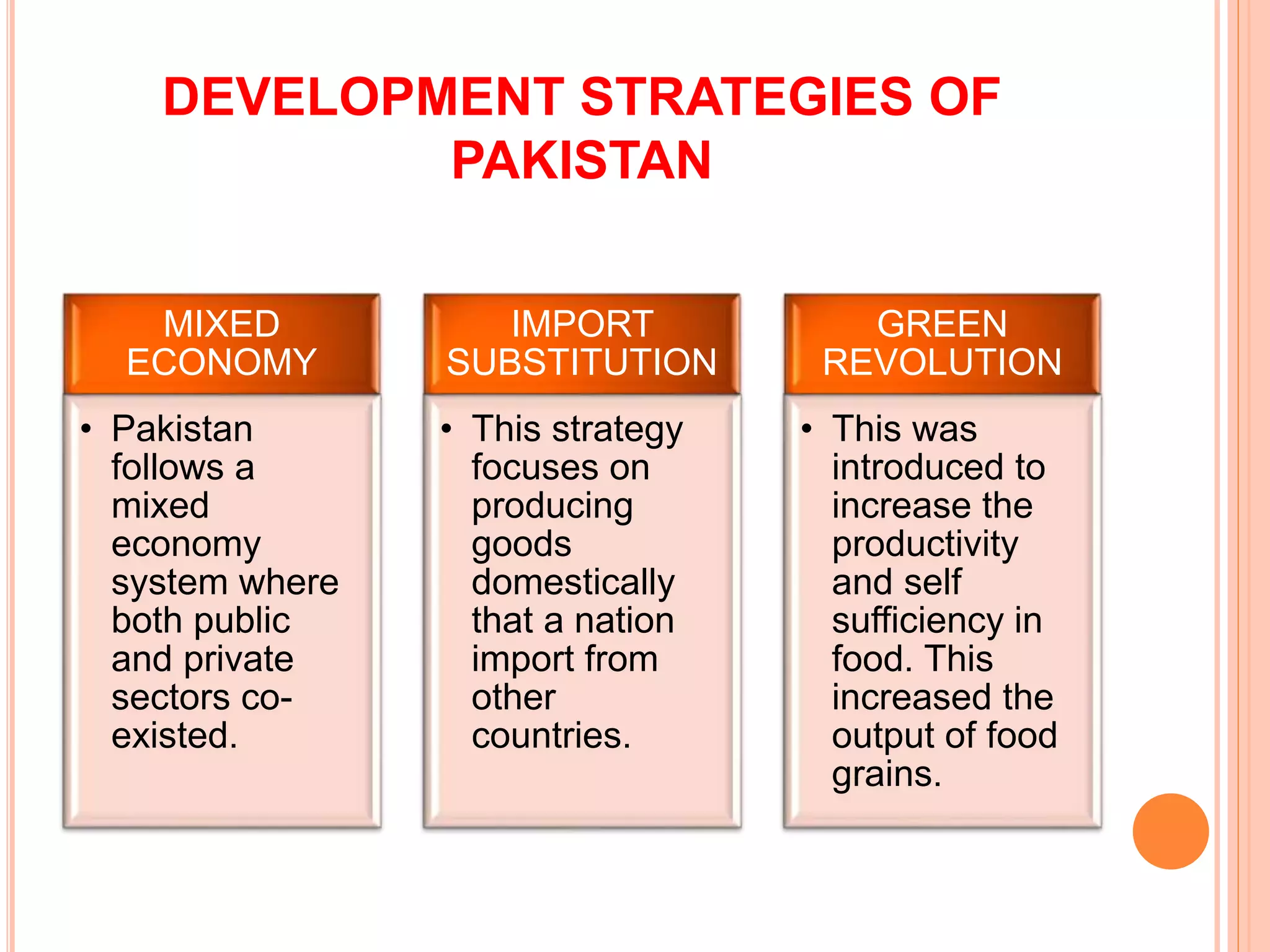
As you saw, Pakistan's strategies evolved significantly over time. Here is a visual summary of the key early initiatives.
Let's consolidate these points.
Key Pakistani Development Strategies:
- Mixed Economy Model: Similar to India, Pakistan adopted a mixed economy, allowing for the co-existence of a large public sector and a private sector.
- Import Substitution (1950s-1960s): Pakistan implemented a regulated policy framework aimed at protecting domestic industries by using tariffs and import controls. The goal was to produce consumer goods domestically rather than importing them.
- The Green Revolution: This initiative led to the mechanization of agriculture and increased public investment in infrastructure. As in India, it significantly raised the production of food grains.
- Nationalisation (1970s): The government took control of capital goods industries.
- Shift in Policy (Late 1970s-1980s): The policy focus shifted towards denationalisation and encouragement of the private sector. The economy also received a boost from financial support from Western nations and remittances from workers in the Middle East.
- Structural Reforms (1988): Facing an economic crisis, Pakistan initiated structural reforms, a few years before India did in 1991.
3. Practice and Reinforcement
Now that you have reviewed the core strategies of both countries, let's test your knowledge with some past board exam questions. Your preference for active learning through PYQs is the most effective way to prepare.
PYQ's | Most important | Environment | Employment and India China and Pakistan | Class 12
This video on PYQs will help you practice identifying and arranging key events and policies, a common question format in the exam.
Watch the following segments. Try to pause the video and answer the questions yourself before the instructor provides the solution. Chronological Questions: This section tests your memory of key dates for Five-Year Plans, reforms, and major campaigns. Quick Facts: These rapid-fire questions cover the years of reforms and the main aim of the GLF. Conceptual Questions: This part discusses the factors behind China's growth and outlines Pakistan's development initiatives, reinforcing what you've just learned.
For further practice, you can refer to the NCERT textbook questions. Answering these will ensure you have a firm grasp of the material.
- Explain the Great Leap Forward campaign of China as initiated in 1958.
- Describe the path of developmental initiatives taken by Pakistan for its economic development.
- Evaluate why China’s rapid industrial growth can be traced back to its reforms in 1978.
These questions are covered in the resources for this lesson, particularly in the NCERT PDF (resource_id="[LINK](https://ncert.nic.in/textbook/pdf/keec108.pdf)") and the LearnCBSE webpage (resource_id="[LINK](https://www.learncbse.in/comparative-development-experience-india-itsneighbours-ncert-solutions-class-11-indian-economic-development/)").
Conclusion
Excellent work today. We have covered the essential development strategies of China and Pakistan, fulfilling a key learning outcome for this chapter. This foundational knowledge is critical for the comparative analysis that follows.
Key Takeaways:
- China's Path: Marked by radical state-led campaigns like the Great Leap Forward (1958) and the Cultural Revolution (1965-76), followed by pragmatic, self-initiated Economic Reforms in 1978 that sparked rapid industrial growth.
- Pakistan's Path: Followed a Mixed Economy model similar to India initially, with policies of Import Substitution and a Green Revolution. Its path was also characterized by a cycle of nationalisation (1970s) and later denationalisation, with structural reforms beginning in 1988.
- Key Dates: Remember the years reforms were initiated: China (1978), Pakistan (1988), and India (1991).
In our next lesson, we will build directly on this foundation to compare the development paths and strategies of India, China, and Pakistan. We will analyze how their different policy choices led to varying sectoral growth and human development outcomes.