Hello! In our last session, we dove deep into the numericals of credit creation and saw how changing the Legal Reserve Ratio (LRR) can expand or contract the total money supply. This was a glimpse into one of the powerful tools used by a country's central bank.
Today, we will explore the complete toolkit that the Reserve Bank of India (RBI) uses to manage the money supply and achieve its economic objectives. This set of tools is known as monetary policy. You will learn to describe the key instruments like the Repo Rate, Cash Reserve Ratio (CRR), Statutory Liquidity Ratio (SLR), and Open Market Operations (OMOs), and understand how each one works to control credit and money supply in the economy. This is a crucial topic for your board exam, often tested through direct and application-based questions.
What is Monetary Policy?
Monetary policy refers to the actions undertaken by a central bank to manage the money supply and credit conditions to foster price stability and achieve economic growth. In simple terms, the RBI uses these tools to either increase or decrease the amount of money flowing in the economy.
- To control inflation (excess demand): The RBI will use tools to reduce the money supply. This is called a dear money policy.
- To combat deflation/recession (deficient demand): The RBI will use tools to increase the money supply. This is called a cheap money policy.
The instruments of monetary policy are broadly classified into two categories:
- Quantitative Instruments: These are general tools that affect the overall volume of credit in the economy. This is our main focus today.
- Qualitative Instruments: These are selective tools that target the flow of credit to specific sectors.
The following video provides an excellent and comprehensive overview of all the instruments we will discuss. We will break it down piece by piece.
Macroeconomics | Banking | Class 12 | chapter 6 | Part 1
This video by Rajat Arora, "Macroeconomics | Banking | Class 12," is the main resource for this lesson. It systematically explains each instrument of monetary policy.
First, watch the introduction to the "Controller of money supply" function from this segment. The instructor lays out the classification of instruments into Quantitative and Qualitative, which provides a clear roadmap for the topic.
Quantitative Instruments
These instruments influence the total quantity of money and credit available in the economy without targeting any specific sector.
1. Legal Reserve Ratios (LRR)
We have already worked extensively with LRR in the context of the money multiplier. It consists of two parts:
- Cash Reserve Ratio (CRR): The minimum percentage of a commercial bank's total deposits that it must keep as cash reserves with the RBI. Banks earn no interest on these reserves.
- Statutory Liquidity Ratio (SLR): The minimum percentage of a commercial bank's total deposits that it must maintain with itself in the form of liquid assets (like cash, gold, or government-approved securities).
How it works:
- To reduce money supply (control inflation): The RBI increases the CRR and/or SLR. This forces banks to hold more reserves, reducing their excess reserves and thus their capacity to lend. This directly contracts credit creation.
- To increase money supply (fight recession): The RBI decreases the CRR and/or SLR, leaving banks with more funds to lend out, which expands credit creation.
Macroeconomics | Banking | Class 12 | chapter 6 | Part 1
Now, let's revisit the explanation of LRR from the same video.
Watch the section on Legal Reserve Requirements. Focus on how increasing CRR and SLR reduces the amount of money available for banks to lend to the public.
2. Policy Rates: Repo Rate and Bank Rate
- Repo Rate (Repurchase Rate): This is the interest rate at which the RBI lends money to commercial banks for their short-term needs, against government securities. It is the key policy rate in India.
- Bank Rate: This is the interest rate at which the RBI lends money to commercial banks for their long-term needs, typically without requiring collateral.
How it works:
The mechanism for both is the same. An increase in these rates makes borrowing from the RBI more expensive for commercial banks.
- To reduce money supply (control inflation): The RBI increases the Repo Rate/Bank Rate.
- Commercial banks' cost of borrowing increases.
- They, in turn, increase their own lending rates for the public (e.g., for home loans, car loans).
- Loans become more expensive for the public and businesses, discouraging borrowing.
- This reduces the flow of money and credit in the economy.
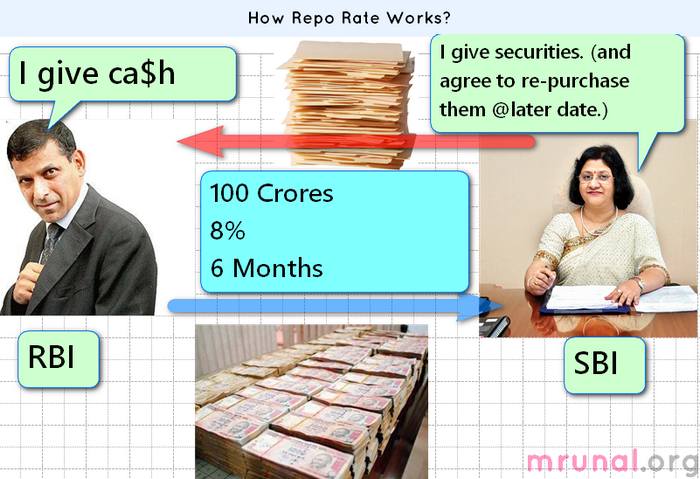
Macroeconomics | Banking | Class 12 | chapter 6 | Part 1
The next part of the video explains these policy rates.
Watch the explanation on Bank Rate and Repo Rate. Pay close attention to the cause-and-effect chain: RBI increases rate -> bank loans get costlier -> public borrows less -> money supply is controlled.
3. Reverse Repo Rate
This is the interest rate at which the RBI absorbs liquidity from commercial banks. In simpler terms, it's the rate commercial banks get for parking their surplus funds with the RBI.
How it works:
- To reduce money supply (control inflation): The RBI increases the Reverse Repo Rate.
- It becomes more profitable for commercial banks to park their excess funds with the RBI instead of lending them to the public.
- This reduces the funds available for lending.
- Credit in the economy contracts.
Macroeconomics | Banking | Class 12 | chapter 6 | Part 1
Let's continue with the video to understand the Reverse Repo Rate.
Watch the segment from this timestamp. Note how it is the "reverse" of the Repo Rate and incentivizes banks to deposit money with the RBI.
4. Open Market Operations (OMO)
This refers to the buying and selling of government securities (like bonds) by the RBI in the open market.
How it works:
- To reduce money supply (control inflation): The RBI sells government securities.
- Commercial banks and the public buy these securities.
- The money they use for the purchase flows from the banking system to the RBI.
- This reduces the cash reserves of commercial banks, curtailing their ability to lend. This process is known as absorption of liquidity.
- To increase money supply (fight recession): The RBI buys government securities from the market.
- It pays for these securities, and the money flows into the commercial banks.
- This increases the banks' cash reserves, enhancing their lending capacity. This is called injection of liquidity.
Macroeconomics | Banking | Class 12 | chapter 6 | Part 1
The video explains Open Market Operations very clearly.
Watch the explanation from this part. The key takeaway is: selling securities soaks up money, and buying securities injects money.
Qualitative Instruments (Briefly)
These are selective tools used to regulate credit for particular purposes or sectors.
- Margin Requirements: The margin is the difference between the market value of the security offered for a loan and the amount of the loan granted. To control credit, the RBI can increase the margin, which makes it harder for people to get large loans against their securities.
- Moral Suasion: This involves persuasion, advice, and requests made by the RBI to commercial banks to follow its policy directives, for instance, to restrict or expand credit.
- Selective Credit Controls (SCCs): This involves giving directions to banks to give or not to give credit for certain purposes or to particular sectors. For example, restricting credit for speculative activities.
Summary: Fighting Inflation
Let's consolidate how these tools are used in the most common scenario for your exam: controlling inflation (dear money policy).
| Instrument | Action Taken by RBI to Control Inflation |
|---|---|
| CRR / SLR | Increase |
| Repo Rate / Bank Rate | Increase |
| Reverse Repo Rate | Increase |
| Open Market Operations | Sell Securities |
| Margin Requirement | Increase |
Now, let's see how these concepts are applied in a typical board exam question.
Money and Banking - Important Questions | Economics | PYQ'S | Class 12
This video from Rajat Arora on past year questions shows how different instruments are combined to tackle a situation.
Watch this question analysis from this segment. An image shows that the RBI has increased the repo rate, sold government securities, and increased the reverse repo rate. The question asks you to identify the economic situation. As you now know, all these actions are taken to combat inflation by reducing the money supply.
Conclusion
You now have a comprehensive understanding of the RBI's monetary policy toolkit. You can describe the main quantitative and qualitative instruments and, most importantly, explain how they are used to either contract or expand the money supply in the economy. Your accounting background gives you a solid footing in understanding these financial mechanisms.
Key Takeaways:
- Monetary policy is used to manage money supply to control inflation or recession.
- Quantitative tools affect the overall credit volume:
- Increasing CRR, SLR, Repo Rate, Reverse Repo Rate reduces money supply.
- Selling securities through OMOs reduces money supply.
- The opposite actions are taken to increase the money supply.
- Qualitative tools are selective and target credit for specific sectors.
In our next lesson, we will put everything from this module together. We will dedicate the entire session to solving a range of representative CBSE board paper questions (2019–2024) on Money and Banking, covering both numerical problems and theory.