Welcome back to your course on advanced networking topics. In our last session, we established the core architectural pattern of Software-Defined Networking (SDN): a centralized controller communicating "down" to network hardware via southbound APIs and "up" to applications via northbound APIs. This model provides the foundation for network automation.
Today, we'll move from this architectural blueprint to a concrete, industry-leading implementation. We will explore Cisco's Digital Network Architecture (DNA) Center, a powerful platform that embodies the principles of SDN. By the end of this lesson, you will be able to describe the capabilities and purpose of Cisco DNA Center in modern enterprise network management. This will bridge the gap between the theory of SDN and its practical application in the field.
From SDN to Intent-Based Networking
Cisco DNA Center is the heart of what Cisco calls Intent-Based Networking (IBN). IBN is a direct evolution of SDN, designed to make networks more agile, efficient, and aligned with business objectives.
Where traditional networking requires you to manually configure devices with specific commands (like setting up an ACL on a specific router interface), IBN allows you to state your high-level goal, or intent, and lets the system figure out the low-level implementation details.
For example, your intent might be: "Prevent users in the 'Guest' group from accessing servers in the 'Production' group."
An IBN system, orchestrated by a controller like DNA Center, takes this intent and performs three essential functions:
- Translation: It translates your business intent into a network policy.
- Activation: It automatically configures all the necessary devices across the network (routers, switches, firewalls) to enforce that policy.
- Assurance: It continuously monitors the network to verify that the intent is being met and the network is performing as expected.
This shift from manual configuration to automated intent is the core purpose of DNA Center.
Cisco DNA Center: The Controller in Action
Cisco DNA Center is the physical and software appliance that acts as the central controller for Cisco's IBN fabric. It is the "single pane of glass" for managing, automating, and analyzing the enterprise network.
Let's revisit the architecture from our previous lesson. The diagram below shows how DNA Center fits perfectly into the SDN model, serving as the intermediary between the network administrators (or their scripts) and the underlying network hardware.
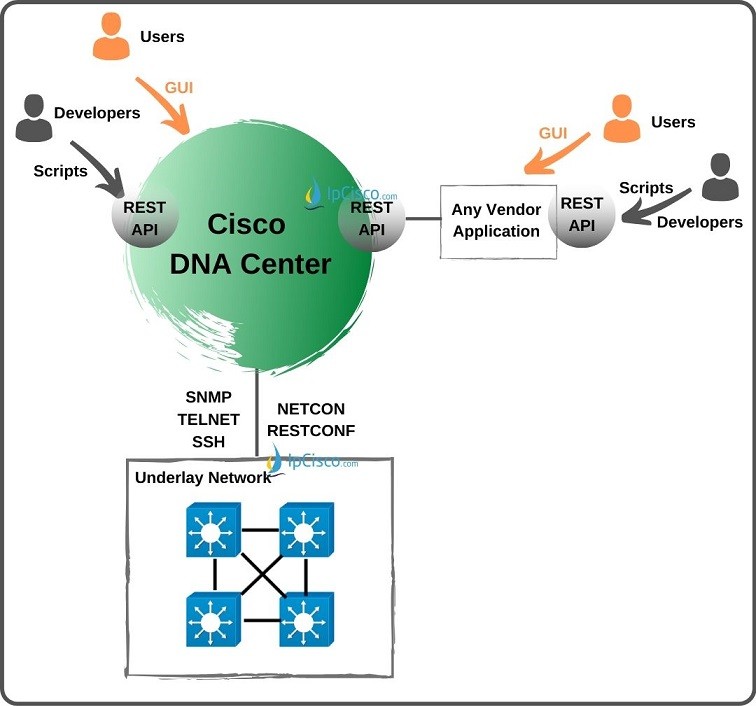
As you can see, DNA Center is the brain of the operation. It receives intent from the north (via its GUI or APIs) and pushes configuration and policy down to the south (to the physical and virtual devices).
DNA Center fulfills two primary roles in an enterprise:
- SDN Controller: For networks built on Cisco's Software-Defined Access (SD-Access) fabric, DNA Center is the full-fledged SDN controller, managing the control and data planes using protocols like LISP and VXLAN.
- Network Management Platform: For traditional networks that aren't using the full SD-Access fabric, DNA Center still provides immense value as a centralized platform for automation, monitoring, and analytics, using protocols like SSH and SNMP to manage devices.
The following video provides an excellent explanation of Cisco's SD-Access and the central role DNA Center plays.
Free CCNA | Software-Defined Networking | Day 62 | CCNA 200-301 Complete Course
This video from Jeremy's IT Lab will help you understand how DNA Center functions as the controller within Cisco's SD-Access solution. It introduces key SDN terms like "fabric," "underlay," and "overlay" in a practical context.
Please watch the section that explains the basic SD-Access architecture from this segment. Then, focus on the explanation of the "fabric," "underlay," and "overlay" from this part. Finally, watch the summary of DNA Center's two main roles from this concluding clip.
The Five Core Capabilities of DNA Center
The functionality of DNA Center is organized into five main areas, which you can see in its user interface. These five pillars represent the lifecycle of network management in an IBN model.
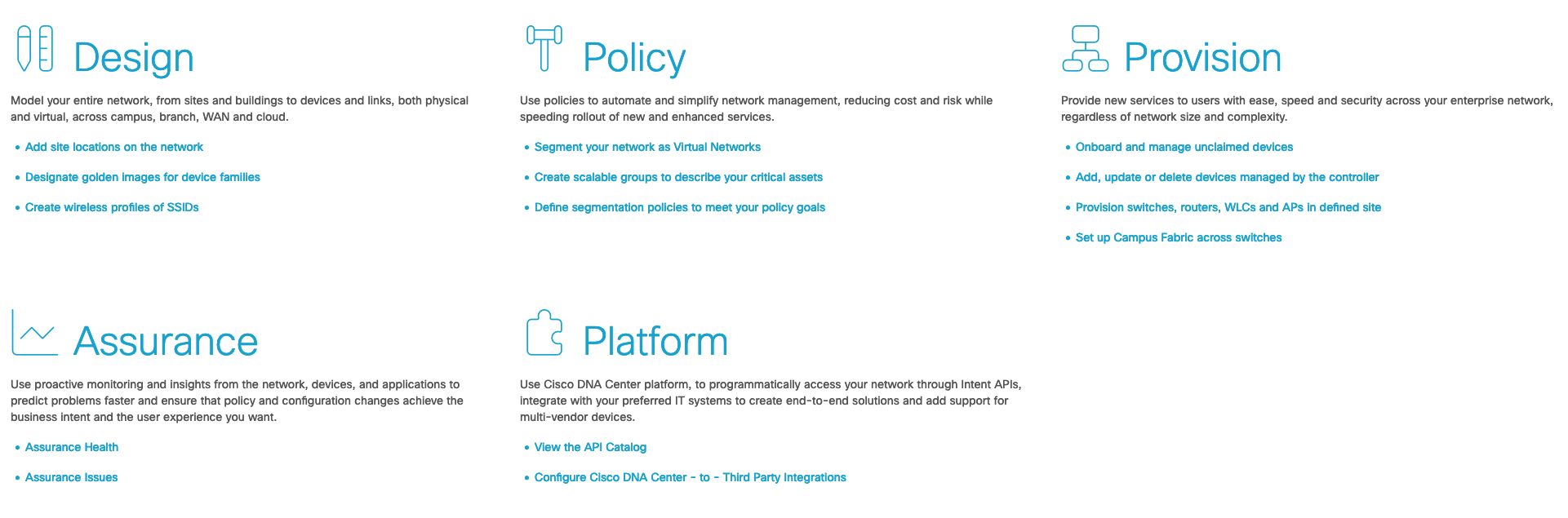
Let's explore what each of these does.
-
Design: This is where you model your network's physical and logical structure. You can create a hierarchy of sites (e.g., global regions, countries, cities, individual buildings), import floor plans, define IP address pools, and configure global settings for services like DHCP and DNS. It's the blueprint for your entire network.
-
Policy: This is the heart of IBN. Instead of writing complex, device-specific ACLs, you define high-level policies based on user groups and application types. For instance, you can create a simple matrix that defines which groups of users (e.g., "Employees," "Developers," "Guests") can access which application categories. DNA Center then translates this into the necessary device configurations across the fabric. This also includes QoS policies to prioritize traffic like voice and video.
-
Provision: This area deals with deploying and managing network devices. A key feature here is "Plug and Play" (PnP), or Zero-Touch Provisioning. A new device can be shipped to a remote office, plugged in by someone with no technical expertise, and it will automatically contact DNA Center, download its correct configuration, and join the network. This drastically reduces deployment time and the potential for human error.
-
Assurance: This is the "continuous validation" loop of IBN. Assurance collects a massive amount of telemetry data from devices, clients, and applications across the network. It uses analytics and machine learning to proactively monitor network health, identify performance issues, and pinpoint the root cause of problems. It can even offer remediation suggestions. Its "time travel" feature allows you to review the state of the network at the exact time an issue occurred.
-
Platform: This exposes the power of DNA Center to other systems. The Platform consists of a rich set of REST APIs that allow for deep integration with other IT systems (like ServiceNow for ticketing) and enable custom automation scripts. This is the Northbound Interface we discussed, allowing you to programmatically control every aspect of the network.
To see these five areas in action, the following video provides a concise tour of the DNA Center graphical interface.
This video by Kevin Wallace provides a clear, high-level overview of the five main areas of Cisco DNA Center, demonstrating where each function is located in the GUI and what it's used for.
Please watch the segment from the main areas. As you watch, notice how each section (Design, Policy, Provision, Assurance, Platform) corresponds to a different stage of the network management lifecycle.
DNA Center vs. Traditional Network Management
Given your background in CCNA topics, you're familiar with the traditional, CLI-centric way of managing network devices. The contrast with the DNA Center approach is stark and highlights the purpose of this technology.
What Does Cisco DNA Center Do? - NetCom Learning
This article from NetCom Learning includes a very effective table that directly compares the features of DNA Center with traditional management tools.
Please read the section titled "Cisco DNA Center vs Traditional Network Management Tools" and focus on the comparison table. Consider how each point in the "Cisco DNA Center" column addresses a limitation in the "Traditional Tools" column.
As the table shows, the move to DNA Center is a move from a reactive, manual, and device-centric model to a proactive, automated, and intent-centric one. It doesn't just make things faster; it changes the fundamental way network engineers interact with the infrastructure, moving from managing individual boxes to orchestrating a holistic system.
Conclusion
In this lesson, we've brought the abstract concepts of SDN into the real world by examining Cisco DNA Center. You now have a solid understanding of its purpose and capabilities as a cornerstone of modern enterprise networking.
Key Takeaways:
- Cisco DNA Center is the controller at the heart of Cisco's Intent-Based Networking (IBN) architecture.
- IBN allows administrators to define high-level business intent, which the system then translates, activates, and assures across the network.
- DNA Center's functionality is organized into five core areas: Design, Policy, Provision, Assurance, and Platform.
- It serves as both a full SDN controller for SD-Access fabrics and a powerful management platform for traditional networks.
- The platform represents a paradigm shift from manual, per-device CLI management to centralized, automated, and policy-driven network operations.
In our next lesson, we will zoom in on a critical component of the "Platform" capability: the data format used by REST APIs. We will take a closer look at JSON (JavaScript Object Notation), the language that allows applications and scripts to communicate their intent to controllers like DNA Center.