Hello and welcome back.
In our last lesson, we delved into the husband's psyche using semifactual thinking. By exploring his "even if..." thoughts, we moved his character beyond simple anger, fostering a sense of inevitability about the situation. This complex internal state is the foundation for his potential journey toward consent.
Today, we pivot from the husband's sense of inevitability to the hinge's sense of agency. We will apply Counterfactual thinking—the classic "what if..."—to explore the branching paths of her future. While her husband grapples with a reality that feels unavoidable, the hinge must actively choose which reality to create. Our focus will be on using these alternate possibilities to heighten her personal stakes, making her decisions feel fraught with genuine risk and consequence.
1. Counterfactuals: From Causal Inference to Narrative Stakes
As a statistician, you are deeply familiar with the concept of counterfactuals as the unobserved outcomes in causal inference—what would have happened. This same "what if" logic is the engine of narrative tension.
Let's begin with a short video that beautifully bridges the world of social science with the world of fiction writing.
Counterfactuals: Causal Inference Bootcamp
This video from Mod•U on 'Counterfactuals' frames the concept in a context you'll find familiar. It defines counterfactuals and then explicitly connects this analytical tool to the creative act of writing novels.
Please watch from the beginning until 03:51. Pay close attention to: The definition of a counterfactual outcome as 'what would have occurred if something different had happened' (00:17 - 00:53). The idea that causality boils down to comparing actual vs. counterfactual outcomes (00:53 - 01:21). The direct link made between researchers constructing plausible counterfactuals and novelists writing 'alternate history' (02:52 - 03:51). The key insight for us is that a novelist's primary goal isn't plausibility, but creating an interesting story.
As the video suggests, a writer's job is to construct these "what would have happened" scenarios. In doing so, we define what our characters have to lose. This is the core of narrative stakes.
Stakes aren't always about life-or-death situations. More often, especially in relationship dramas, they are deeply personal and emotional.
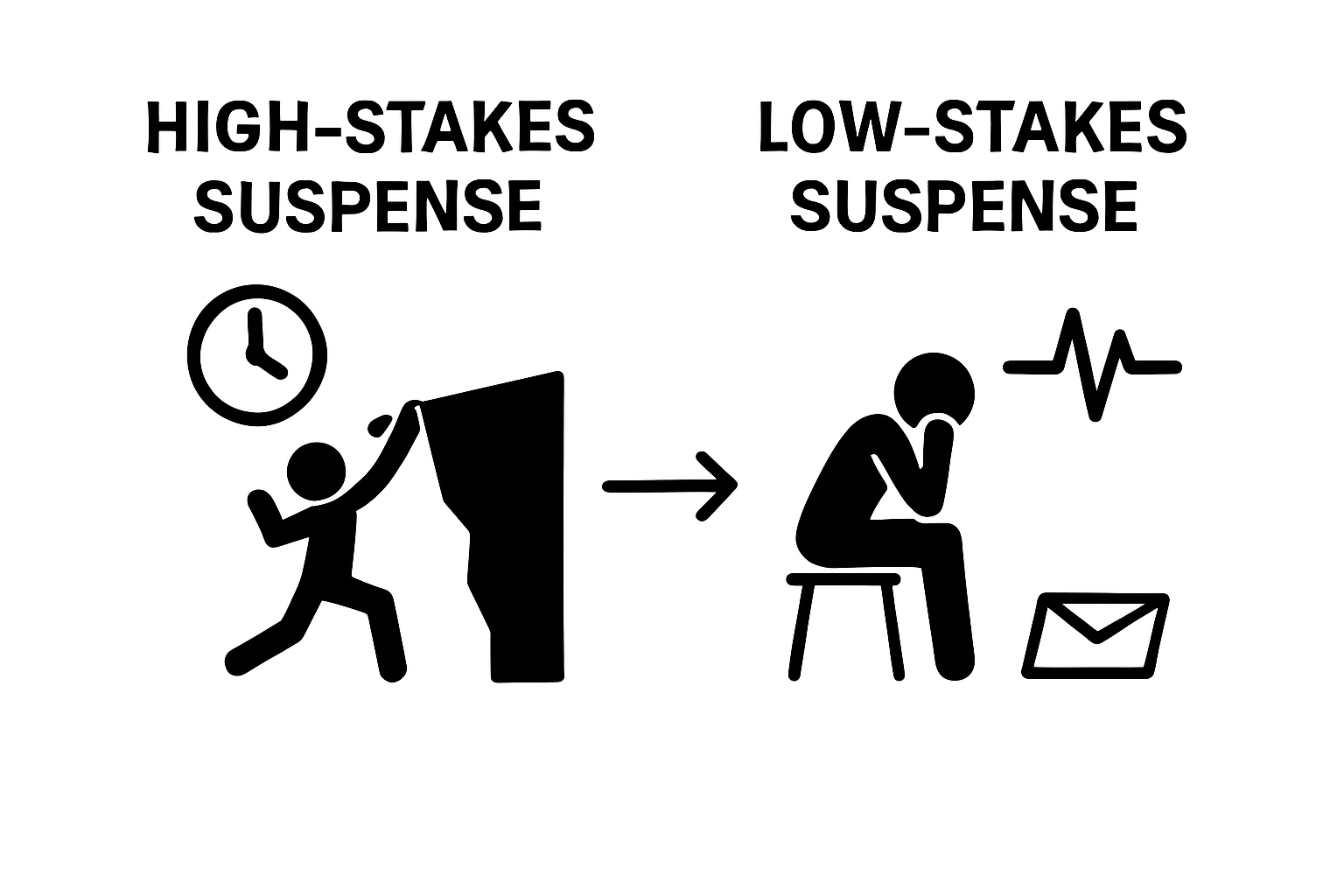
To build on this, let's explore how to translate "what if" scenarios into tangible, emotional stakes for the hinge.
8 Ways to Raise Your Story's Stakes
This video from Reedsy provides a practical framework for thinking about what your characters stand to lose and how to make those losses feel significant.
Please watch the following sections: Introduction (0:00 - 1:08): This gives a clear definition of stakes as 'what the character has to lose if they don't succeed.' Raise the Emotional Stakes (2:58 - 4:15): This is critical for your story. Note the emphasis on tying a character's external goal to a deeper internal investment. Create a Necessary Sacrifice (5:38 - 6:31): This involves forcing a character to choose between two things they want, where something is guaranteed to be lost. This is a direct application of counterfactual choice. Moral No-Win Situations (8:21 - 9:24): This explores choices where every option compromises a character's core values—a powerful way to heighten internal conflict.
2. The Hinge's Dilemma: Exploring Branching Pathways
Now that we have a framework for stakes, let's apply it. At this point in your story, after the confrontation, the hinge is at a decision point. She can no longer maintain the status quo. She must act, and any action will have profound consequences.
This is a "Branching Pathways" moment. Every choice she considers creates an alternate future, a different version of her life.

We are going to use this concept to map out the hinge's core dilemma by exploring the potential losses associated with her most likely paths.
3. Writing Exercise: Charting the Hinge's "What Ifs" (35 minutes)
Your task is to step into the hinge's shoes as she contemplates her future. For each of the three counterfactual scenarios below, write a short paragraph (3-5 sentences) of internal monologue. Capture her thoughts and feelings as she imagines that specific path and confronts what she stands to lose.
This exercise is about exploring the cost of each choice to raise the story's emotional temperature.
Scenario 1: The Path of Sacrifice
-
Counterfactual: "What if I end things with my new lover right now to save my marriage?"
-
Goal: Preserve the history, stability, and love within her marriage.
-
Stake (What she loses): The joy, self-discovery, and passion of the new relationship. Risks a future of regret and resentment, where her marriage feels like a cage she chose.
Write her internal monologue for this scenario here...
Scenario 2: The Path of Assertion
-
Counterfactual: "What if I tell my husband this new relationship is non-negotiable, and he has to accept it or I'll leave?"
-
Goal: Pursue her desires and authentic self without compromise.
-
Stake (What she loses): Her marriage and the man she has built a life with. Risks being seen as selfish or destructive, potentially losing both men and facing profound loneliness.
Write her internal monologue for this scenario here...
Scenario 3: The Path of Deception
-
Counterfactual: "What if I try to keep both, but secretly? What if I lie to my husband to 'protect' him while continuing to see my lover?"
-
Goal: Avoid immediate confrontation and loss by keeping both relationships separate.
-
Stake (What she loses): Her integrity. The foundation of both relationships becomes deceit. Risks the immense psychological stress of a double life and the catastrophic fallout of inevitable discovery.
Write her internal monologue for this scenario here...
Take your time with these. The goal is to feel the weight of each potential loss from her perspective. The more keenly you, the author, feel these stakes, the more powerfully you can convey them to the reader.
Conclusion
Fantastic work. Today you've used counterfactual thinking not just as a logical exercise, but as a tool for generating profound emotional conflict. By exploring the branching paths available to the hinge, you've clearly defined what she stands to lose with every choice she makes. These high personal stakes are what will make her journey toward the final resolution so compelling.
Key Takeaways:
- Counterfactuals Create Stakes: "What if..." thinking is the mechanism by which we define the negative consequences of failure for our characters.
- Stakes are Personal: In your story, the stakes are not about physical danger but about the potential loss of love, integrity, selfhood, and stability.
- Choices Have Costs: By exploring the "branching pathways" of sacrifice, assertion, and deception, you have loaded the hinge's next decision with immense weight. There is no easy way out.
In our next lesson, we will move to Predictive reasoning. We have explored the husband's internal state (semifactuals) and the hinge's potential choices (counterfactuals). Now, we will focus on how to use these elements to build suspense by showing the hinge trying to predict her husband's reactions, and how those predictions—right or wrong—drive her actions.