Introduction
Welcome back. In our last lesson, we focused on 'Platforms'—the foundational agreements and rules that govern your characters' relationships. You designed a specific rule or boundary for your vee relationship, creating a structure that will inevitably be tested.
Today, we will turn from the external architecture of the relationship to the internal landscape of your protagonist. This lesson addresses the LAPS SEE technique of 'Slow Hunches.' Your learning outcome is to use 'Slow Hunches' to develop tension through the hinge's gradually revealed deeper motivations.
A 'Slow Hunch' in fiction is the dawning awareness a character has about what they truly want or believe. It’s not a sudden epiphany but a gradual, often unsettling, accumulation of feelings and insights. For your story, this means exploring the hinge's growing realization that her stated goal—getting consent—might be masking a much deeper, more fundamental need. By revealing this deeper motivation slowly, you create a powerful undercurrent of tension that makes the final resolution feel both inevitable and earned.
1. From Creative Spark to Character Insight
The term 'Slow Hunch' comes from author Steven Johnson, who uses it to describe how great ideas form. They rarely arrive in a single "eureka!" moment. Instead, they are partial, fragmented ideas that linger in the back of our minds, waiting for the right connection to make them whole.
Why Slow Hunches Can Beat Fast Ideas
Let's start with the origin of the term 'Slow Hunch' from Steven Johnson. Understanding the concept as he defines it will provide a strong foundation for applying it to a character's internal journey.
Read the first few paragraphs of this conversation, starting from Steven Johnson's first line down to the end of his second block of text (ending with '...you've had since then.'). Focus on his description of a hunch as a 'half-baked' idea that needs time to connect with other ideas before it becomes fully formed.
Now, let's apply this to your protagonist. Her 'slow hunch' is a dawning truth about herself that she hasn't fully articulated, perhaps even to herself. It’s the feeling that drives her actions, even if her conscious mind tells her she wants something simpler.
Revealing this inner truth gradually is far more powerful than stating it plainly. The hosts of the Writing Excuses podcast discuss this very challenge.
13.18: Naturally Revealing Character Motivation | Writing Excuses
This podcast transcript explains why simply announcing a character's motivation can fall flat and why a more layered, natural reveal is crucial for reader engagement.
Please read two short sections from this transcript. First, read from Brandon's opening line ('This is, in my opinion, the thing that new writers get wrong the most.') down to Howard's line ending with '...because I'm hungry.' Second, read Brandon's 'King died, Queen died of grief' example. These illustrate the importance of showing the 'why' behind an action, which is the core of revealing a slow hunch.
Your story isn't just about a woman who wants to sleep with a new man. That's the event. The story is about why this desire has become so powerful that she is willing to risk her primary relationship for it. Her slow hunch is the key to that 'why'.
2. The Layers of Motivation: From Goal to Deep Belief
To craft a compelling 'slow hunch,' we need a model for a character's inner world. A character's motivations exist in layers, moving from a tangible surface goal to a deep, often unconscious, belief about the world.
This video provides an excellent framework for understanding these layers.
Character Goals and Motivations (Writing Advice)
Writer Brandon McNulty breaks down character motivation into four distinct stages. This framework will give you a practical tool to build the hinge's complex inner life.
Watch from 00:36 to 02:04 to understand the distinction between a Goal (the 'what') and a Motivation (the 'why'). Then, watch the key section from 04:39 to 07:56, which introduces the 'Deep Dark Belief' and its 'Origin.' This 'Deep Belief' is the substance of your character's slow hunch.
Let's apply this 4-stage framework to your hinge character:
- Goal (The "What"): To gain her husband's consent for sexual intimacy with her new lover. This is the tangible, plot-driving objective.
- Motivation (The "Why"): Because she feels a profound connection with the new lover and wants the freedom to explore it without deceit.
- Deep Belief (The Slow Hunch): This is the core of her character arc. What fundamental belief about herself or the world is driving this motivation? Perhaps she believes: "A relationship that requires me to hide parts of myself is not true love," or "I am only worthy if I am desired for my complete, authentic self."
- Origin (The Backstory): Where does this deep belief come from? A past relationship where she felt suffocated? A family dynamic where she was only praised for being compliant? This links back to the 'Liquid Networks' you developed earlier.
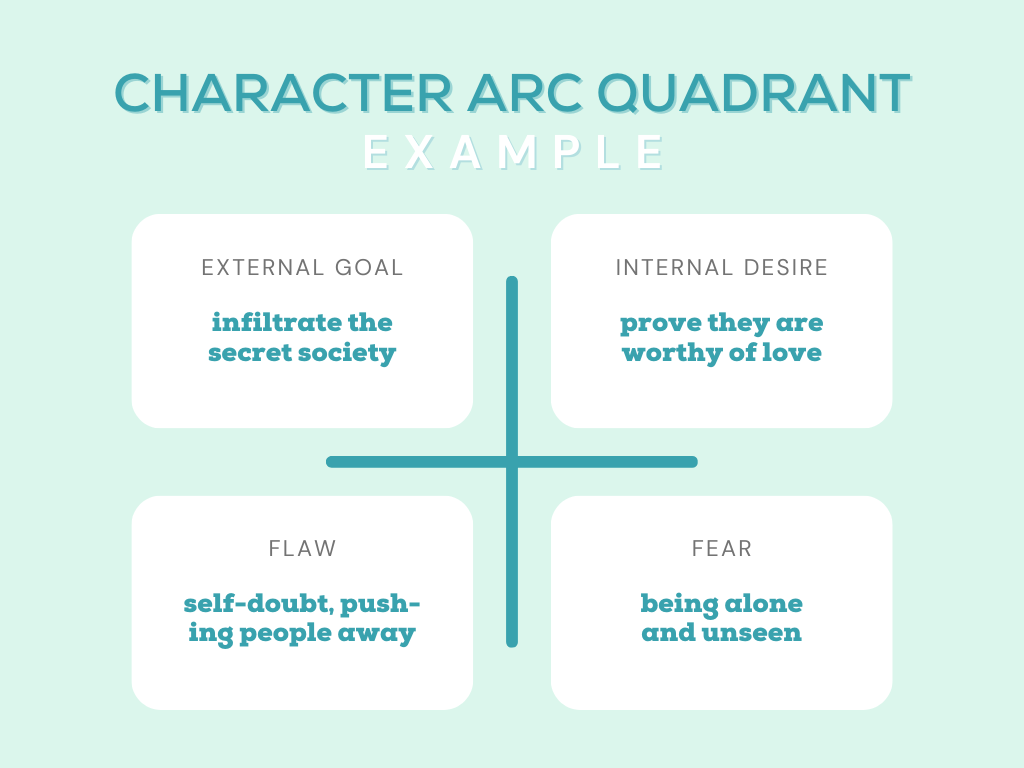
This framework shows how a simple goal is actually the peak of a deep psychological structure. The "Character Arc Quadrant" visualizes this relationship between the external and internal.
3. Making the Hunch Visible: The 'Push and Pull' Dynamic
You can't just tell the reader about the hinge's 'Deep Belief.' You have to show it emerging. The 'slow burn' romance trope offers a perfect technique for this: the 'push and pull.' Characters are drawn together by an unspoken attraction, then pull back out of fear or external pressure.
This dynamic isn't just for romantic tension; it's a powerful way to dramatize any internal conflict.
The Secret to Writing Slow Burn ROMANCE (spoiler: it's simpler than you think) 👩❤️💋👨
While this video focuses on romantic tension, its explanation of the 'push and pull' strategy is a brilliant method for gradually revealing any character's hidden desires or fears.
Watch from 11:40 to 15:56. Pay close attention to the analogy of characters as two lines that move closer together and then farther apart. In your story, 'closer' means the hinge is acting on or acknowledging her deep belief, and 'farther' means she is retreating from it out of fear or guilt.
For the hinge, the push and pull could look like this:
- PUSH (Moving closer to her truth): A moment where she challenges one of the relationship 'platforms' you designed. She might share an unexpectedly intimate detail about her new connection, or question a rule her husband has set. This is her deep belief leaking out.
- PULL (Retreating from her truth): After pushing, she sees her husband's pain or feels a surge of guilt. She immediately pulls back, apologizing, minimizing the significance of her feelings, and reaffirming the existing rules.
This cycle of push and pull creates immense tension. The husband and the lover (and the reader) sense that there is a powerful current under the surface, making them question the hinge's stated intentions and anticipate what she will do next.
4. Writing Exercise: Unearthing the Hinge's Deeper Motivation (30 minutes)
This exercise will guide you in defining and dramatizing the hinge's 'slow hunch'.
Part 1: Define the Deep Belief (10 minutes)
Using the 4-stage framework, articulate the hinge's deeper motivation. Answer these questions:
- Deep Belief: What is the fundamental belief about love, self-worth, or freedom that is driving her desire for this new relationship? Write it as a single, powerful sentence (e.g., "To feel alive, I must be desired for all of who I am, not just the convenient parts.").
- Origin: Briefly, what past experience (a past relationship, family dynamic, etc.) installed this belief in her? This is the "origin of the deep dark belief."
Part 2: Brainstorm 'Push' and 'Pull' Moments (10 minutes)
Based on the 'Deep Belief' you just defined, list two 'push' moments and two 'pull' moments. These actions should directly interact with the 'platform' (the rule or boundary) you designed in the previous lesson.
- Platform Rule Example: The husband's rule is, "I don't want to hear any details about your emotional connection with him."
- Push 1:
- Pull 1:
- Push 2:
- Pull 2:
Part 3: Outline a 'Push' Scene (10 minutes)
Choose one of your 'push' moments and outline it as a brief scene. Describe how the hinge's action reveals a hint of her 'slow hunch' without her having to state it explicitly. Use the "free indirect speech" technique mentioned in the Writing Excuses transcript—let the narration reflect her internal state.
- Trigger: What prompts her to act? (e.g., The new lover asks her a question that cuts to the heart of what she wants.)
- Action: What does she say or do that pushes against the established boundary? (e.g., She tells her husband, "I felt seen today in a way I haven't in years.")
- Subtext: What is the unspoken message? What does her husband hear, versus what she is trying to express?
- Reaction: How does her husband react, and how does this reaction set up her next 'pull' moment (the retreat)?
Conclusion
Today, we've explored 'Slow Hunches' as the gradual emergence of a character's deepest motivations. By moving beyond surface-level goals, you can build a rich, complex inner life for your protagonist that drives the story's tension.
Key Takeaways:
- A 'Slow Hunch' is a character's dawning awareness of a deep belief that motivates their actions.
- Revealing this motivation slowly, rather than stating it, creates natural and compelling tension.
- The 4-stage model (Goal, Motivation, Deep Belief, Origin) provides a clear structure for designing these hidden depths.
- The 'push and pull' dynamic is an effective technique to dramatize a character's internal conflict as they grapple with their emerging 'hunch'.
In our last few lessons, you've explored how your characters are connected ('Liquid Networks'), the steps they can take ('Adjacent Possible'), the rules they operate under ('Platforms'), and the hidden truths they are slowly discovering ('Slow Hunches').
In our next lesson, we will explore 'Serendipity.' We'll look at how a chance encounter or an unexpected event can act as a catalyst, forcing a character's slow hunch into the open and escalating the conflict dramatically.