Introduction
Welcome back. In our last lesson, you applied the Decision-Making Paradox with devastating effect. Henry, seeking to escape the torture of ambiguity, demanded honesty from Vera about her date with Leo. He got it. The "data" he received didn't bring clarity or peace; it transformed his vague fears into a sharp, known, and undeniable pain. His position is now significantly worse. The chasm between them has widened, not because of a lie, but because of a truth his rational mind was unprepared to emotionally process.
Today, we explore Henry's response to this new, painful reality. What does a man who values logic and control do when his emotions are in chaos? He tries to regain control. This brings us to the Willpower Paradox, our focus for this lesson. You will apply this paradox to generate tension by showing how a character's attempt at self-restraint undermines their own happiness.
We'll examine the psychological principle that trying not to think about something only makes you think about it more. For Henry, this means his effort to suppress his jealousy will paradoxically amplify it, exhaust his emotional resources, and lead to a breakdown that pushes him further from the supportive, rational partner he wants to be.
1. The Science of Backfiring Willpower
Before we apply this to Henry, let's look at the robust psychological research behind this phenomenon. You're familiar with frameworks and models, and the "Willpower Paradox" is grounded in several well-documented theories.
To start, please watch this video from the channel Acceptance and Commitment Therapy. It introduces the foundational concept of "Ironic Process Theory" through the famous "white bear" experiment.
The Art and Science of Thought Suppression
This video, titled 'The Art and Science of Thought Suppression,' explains why telling yourself 'don't think about X' is a failing strategy. It will give you the core mechanism to build Henry's internal conflict.
Please watch the first section, from 00:20 to 09:52. Focus on the two processes at play: the conscious 'intentional operating process' (finding distractions) and the unconscious 'ironic monitoring process' (scanning for the forbidden thought). Notice how this creates a rebound effect, making the suppressed thought even stronger.
As the video explains, Henry's mind, in trying to follow the command "don't be jealous," engages two parts of itself:
- A conscious part that actively looks for other things to think about (his work, a book, the news).
- An unconscious, automatic part that constantly scans his mind to check, "Are we being jealous yet?" This scanning process is what keeps bringing the jealousy—and the images of Vera with Leo—back to the forefront of his mind.
This is the central engine of the paradox. But there are two other concepts that add crucial layers for our story.
Willpower as a Limited Resource
Think of self-control as a muscle. The more you use it, the more tired it gets. This concept is often called ego depletion.
In the resource "Want-Should Conflict" by Bitterly et al., this is described clearly. The authors state that self-control resembles a muscle that "can be weakened through repeated use." After resisting temptations, we have less "strength" for subsequent choices. They note the core paradox: "by exercising self-control now, we increase the likelihood that we will give in to our desires to indulge later."
For Henry, this means the mental energy he spends all day suppressing jealous thoughts at work depletes his emotional reserves. By the time he's home, his "willpower muscle" is exhausted, making him more likely to snap at a minor trigger.
Willpower and Moral Judgment
The struggle is not just mechanical; it's also moral. In another key resource, "Discipline and desire" by Berman and Small, the authors distinguish between willpower for non-moral temptations (like skipping dessert) and moral ones (like staying faithful). They find that for moral issues, we judge the mere presence of a tempting desire as a sign of impure character, even if the person resists.
For Henry, who has agreed to this new relationship structure, feeling jealous isn't just an unpleasant emotion; it feels like a moral failure. He shouldn't feel this way. The fact that he is tempted by jealousy makes him feel "tainted," impure, and like a bad partner. This self-judgment adds a heavy layer of shame to his struggle, further undermining his happiness.
2. Henry's Vicious Cycle of Self-Restraint
Let's synthesize these ideas and apply them directly to Henry's situation the day after his painful conversation with Vera.
- The Goal: Henry's "should self" is in command. He tells himself, "I need to be rational. I need to support Vera. I will not feel jealous. I will control this."
- The Attempt (Ironic Process): He tries to focus on work, but the "ironic monitor" keeps serving up images of Vera and Leo. The more he pushes them away, the more vividly they return.
- The Drain (Ego Depletion): This internal battle is exhausting. He's using immense energy to hold the line, depleting his self-regulatory resources minute by minute.
- The Self-Judgment (Moral Impurity): Each time a jealous thought breaks through, he feels a pang of shame. "Why can't I handle this? I'm failing her. I'm failing myself." His self-worth erodes.
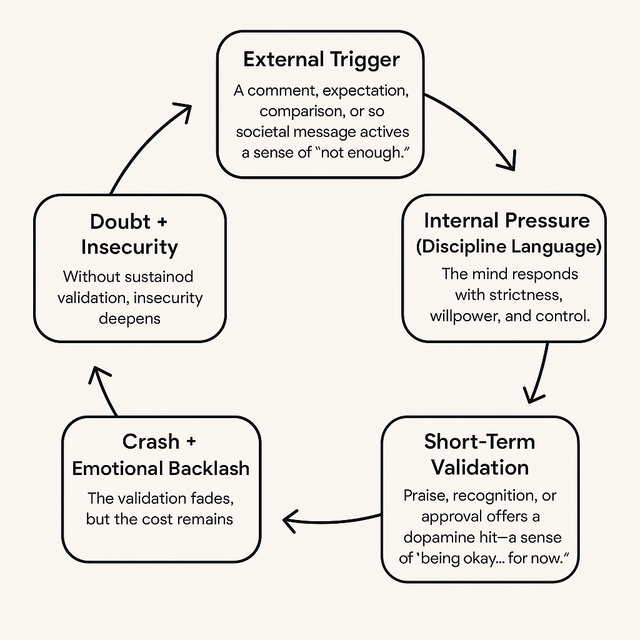
This creates a downward spiral. The harder he tries to control his feelings, the more out of control he feels, the more exhausted he becomes, and the more he despises himself for failing.
This cycle can be visualized perfectly by adapting the "External Validation Cycle" you've seen before into an internal struggle.
3. Writing Exercise: The Snap (30 minutes)
Your task is to write a scene where Henry's willpower finally breaks. The goal is not a screaming match, but a small, sharp moment that reveals the failure of his self-restraint and escalates the tension.
Instructions:
- Set the Scene: It's the evening after the "honest" talk. Henry has just come home from a long day at work where he has been actively fighting his thoughts. Show, don't just tell, his exhaustion. He might be quieter than usual, his movements heavy.
- Internal Monologue: Give us a brief glimpse into his internal battle. Show the "white bear" effect. He's trying to focus on a simple task (making dinner, reading an email), but the intrusive thoughts of Vera and Leo are persistent. Show him actively pushing them away.
- The Minor Trigger: Vera does something completely innocent. Perhaps she smiles at a text message, hums a song happily, or mentions Leo's name in a neutral context (e.g., "Leo recommended a great book today"). This is the feather that breaks the camel's back.
- The Snap (The Backfire): Because his ego is depleted, Henry doesn't have the resources for a measured response. He says something cold, sarcastic, or passive-aggressive. It should feel out of character for the rational man he tries to be.
- Example (if Vera smiles at her phone): "Good news?" with a tone that's just a little too sharp.
- Example (if she mentions Leo's name): "Right. The oracle."
- The Aftermath: End the scene right after his comment lands. Show Vera's look of surprise or hurt and Henry's immediate internal reaction: a flash of regret and shame. He has failed. The very thing he tried all day to prevent—letting his jealousy impact Vera—has just happened. His attempt at control has resulted in a loss of control, leaving him (and the relationship) in a worse place.
Conclusion
In this lesson, you explored the Willpower Paradox as a powerful tool for generating authentic character-driven conflict. You've seen how a character's attempt to suppress unwanted thoughts and emotions can paradoxically make them stronger, deplete their mental resources, and lead to self-sabotaging behavior.
Key Takeaways:
- The Willpower Paradox is driven by psychological mechanisms like Ironic Process Theory (the "white bear" effect) and ego depletion (self-control as a limited resource).
- For moral commitments, like Henry's promise to be open, the mere presence of a forbidden desire (jealousy) can feel like a character failure, adding a layer of shame.
- Applying this paradox shows how a character's internal struggle can spill out into their actions, creating friction that feels earned and psychologically real. Henry's attempt to be "strong" made him weak, undermining his own happiness and damaging his connection with Vera.
Preview of the Next Lesson:
Vera and Henry have tried honesty, and it backfired. Henry has tried self-control, and it backfired. They might now conclude that what they need are clear, explicit rules to manage the situation—to remove the guesswork and emotion. In our next lesson, we will explore Motivation Crowding Theory, and see what happens when external incentives and rules are imposed on a situation that requires intrinsic goodwill, often destroying the very motivation they are meant to encourage.