Introduction
Welcome to our next lesson. In the previous session, you placed Henry in the agonizing grip of a Morton's Fork. Faced with the imminent date between his wife, Vera, and her new lover, Leo, Henry found himself trapped. Intervening would prove him to be controlling and insecure, while doing nothing would mean silently enduring a night of intense jealousy. You concluded with him paralyzed, knowing both choices led to the same devastating outcome: confirming his deepest fears about his marriage.
Now, the choice has been made for him through his inaction. The date is happening. He has been forced to accept the path of letting it go forward. This plunges him from the "known hell" of his Morton's Fork into a new kind of torment: the torment of the unknown.
This lesson focuses on the learning outcome: Apply 'Ellsberg's Paradox' to build tension from the husband's aversion to the ambiguity of the new relationship dynamic. We will use this paradox to explore how the lack of information—the complete ambiguity of what is happening on the date—can be even more torturous than a predictable, negative outcome.
1. Understanding Ellsberg's Paradox and Ambiguity Aversion
As a statistician, you are intimately familiar with the difference between risk and ambiguity.
- Risk involves known probabilities. You can calculate the odds of drawing a red card from a standard 52-card deck.
- Ambiguity (or uncertainty) involves unknown probabilities. You have no idea what the odds are of drawing a red card from a deck with an unknown number of cards and suits.
Ellsberg's Paradox is a famous thought experiment that reveals a powerful cognitive bias: most people would rather take a known risk than an ambiguous one, even if the ambiguous option might offer better odds. We have an aversion to the unknown.
These images provide a clear, concise definition of this bias.
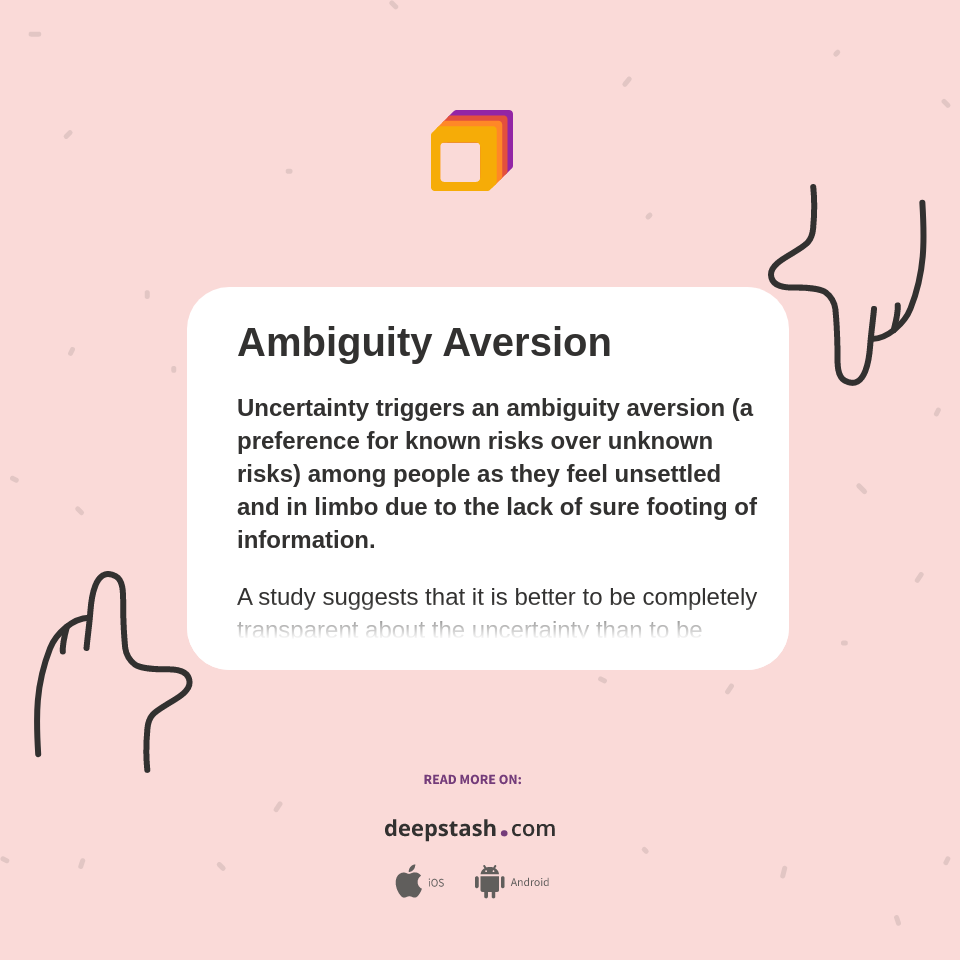
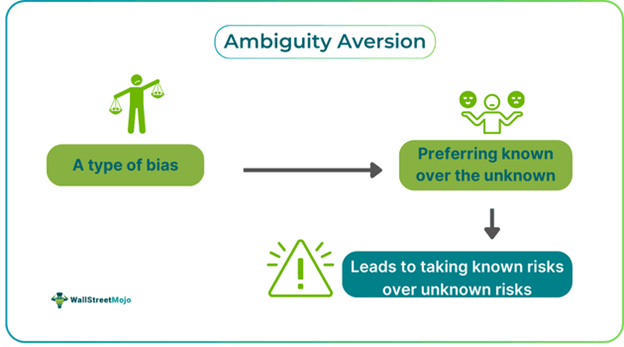
The core takeaway is that the human mind finds ambiguity deeply uncomfortable. We crave data, and when we don't have it, we tend to fill the void with our worst fears. This is the psychological engine we will use to drive Henry's conflict.
2. Translating the Paradox into Henry's Story
Let's reframe Henry's dilemma from the last lesson through the lens of Ellsberg's Paradox. He was faced with two "urns":
-
Urn 1: The Known Risk. This was his option to interfere and stop the date. The outcome is painful but predictable. He knows Vera would be angry, he knows it would cause a fight, and he knows he would be seen as the "jealous husband." The probability of damaging their trust is high, but the scenario is known.
-
Urn 2: The Ambiguous Unknown. This is the path of letting the date happen. He has no data. What is the probability that Vera and Leo are just having a friendly dinner? 50%? 10%? What are the chances they are connecting on a deeply emotional level? That they are physically intimate? The probabilities are a complete blank. This situation is ambiguous.
By being paralyzed, Henry has been forced to "bet" on Urn 2. He is now locked in a room with a black box, and his mind, which thrives on data and predictability, is left to its own devices. The tension no longer comes from a choice, but from the complete inability to quantify the consequences of the path he is on.
3. Turning Ambiguity into Narrative Tension
Henry's aversion to ambiguity is the source of our scene's tension. His statistical and research-oriented mind is his greatest tool professionally, but here it becomes his personal torture device. It is a machine built to analyze probabilities, but it has no data to process.
Here’s how this manifests as escalating tension:
- Failed Calculations: His mind will try to impose order on the chaos. He might try to logically deduce what's happening based on the time. "They've been gone for an hour. That's enough time for appetizers. The conversation is probably still light." But this rationalization is immediately undermined by emotional fear: "But what if it's not? What if they skipped dinner and went straight to his apartment?"
- Filling the Void with Fear: Since there is no real data, his imagination provides its own, and it will exclusively draw from his worst fears. The "unknown proportion" of balls in the ambiguous urn starts to look like 100% black balls.
- The Hunt for Data: His discomfort will drive him to seek any scrap of information to reduce the ambiguity. This creates action. Does he check Vera’s location on his phone? Does he text her with a seemingly innocent question, just to see how quickly she replies? Each action is a desperate attempt to turn ambiguity into risk, to get a single data point, no matter how small.
4. Writing Exercise: The Torment of the Unknown (30 minutes)
Your task is to write a scene from Henry's point of view while Vera and Leo are out on their date. He is alone, and the ambiguity of the situation is closing in on him.
Instructions:
- Set the Scene: Henry is alone in their home. The silence is heavy. It’s been an hour since Vera left.
- Show his Mind at War: Portray the conflict between his rational, statistical self and his emotional, fearful self.
- Let him try to calculate probabilities, only to realize he has no priors, no data. He might even think in statistical terms ("The sample size is one, the error bars are infinite").
- Contrast his attempts at logic with vivid, intrusive flashes of imagination—sensory details of what he fears is happening between Vera and Leo.
- Drive Action from Ambiguity: Show his aversion to the unknown pushing him to act.
- Does he open his laptop, intending to work, but instead finds himself typing the restaurant's name into a search bar, looking at photos of the interior?
- Does he compose a text to Vera, then delete it, then re-write it? Show the internal debate over whether asking for information is worth the risk of appearing needy.
- End on Unresolved Tension: The scene should not provide him with any relief. Any "data" he finds should only create more questions. For example, maybe he checks her location and sees she isn't at the restaurant. Now he has one data point, but it has only increased the ambiguity and his panic. End the scene with him in a state of heightened, not resolved, anxiety.
This exercise will transform the abstract concept of Ellsberg's Paradox into a palpable, character-driven conflict, pushing Henry deeper into his emotional crisis.
Conclusion
In this lesson, you've weaponized ambiguity. By applying Ellsberg's Paradox, you've moved Henry's conflict beyond a simple choice between two bad options and into the psychological torment of the unknown. His aversion to ambiguity, a natural human bias, becomes a powerful engine for internal conflict and narrative tension.
Key Takeaways:
- Ellsberg's Paradox highlights our preference for known risks over ambiguous situations with unknown probabilities.
- In narrative, this "ambiguity aversion" can be more agonizing for a character than a predictable bad outcome.
- Tension arises from the character's desperate, and failing, attempts to find data and impose certainty on an unknowable situation.
- For a character like Henry, whose mind is geared toward logic and data, this specific paradox is an especially potent source of conflict.
Preview of the Next Lesson:
Henry's suffering is currently driven by a lack of information. This may tempt him to seek more clarity. However, getting more information isn't always the solution. In our next lesson, we will explore the Decision-Making Paradox, where the act of gathering more information or communicating more openly can unexpectedly make a character's position even worse. Henry's attempt to escape ambiguity might just lead him into a different, more dangerous trap.