Hello! Welcome to the final lesson of our module on the three-act structure. In our last session, we focused on analyzing existing brand campaigns, deconstructing how companies like Apple and Nike use this narrative framework to create powerful stories.
Today, we shift from analysis to creation. Our goal is to learn how to map a customer's problem-solution journey onto the three-act structure. Instead of just recognizing the structure in finished work, you will learn to use it as a blueprint for building your own compelling brand narratives from the ground up. This skill is the bridge between understanding storytelling theory and applying it effectively in your branding work.
The Core Shift: Your Customer is the Hero
Before we start mapping, let's reinforce the most crucial principle in brand storytelling: your brand is not the hero of the story. Your customer is.
Great brand stories don't talk about how great the company is. They tell the story of a customer who has a problem, embarks on a journey to solve it, and is ultimately transformed. The brand's role is not to be the star, but the trusted guide or the magical tool that helps the hero succeed.
This image visualizes the journey perfectly: the customer starts in an ordinary or struggling state, and with the brand's help, they are transformed into the hero of their own story.

With this customer-centric mindset, the three-act structure becomes a powerful tool for mapping their journey.
The Three-Act Map: Problem, Journey, Transformation
Every customer who buys a product or service is trying to get from a "before" state (the problem) to an "after" state (the solution). The three-act structure provides the perfect framework to tell that story.
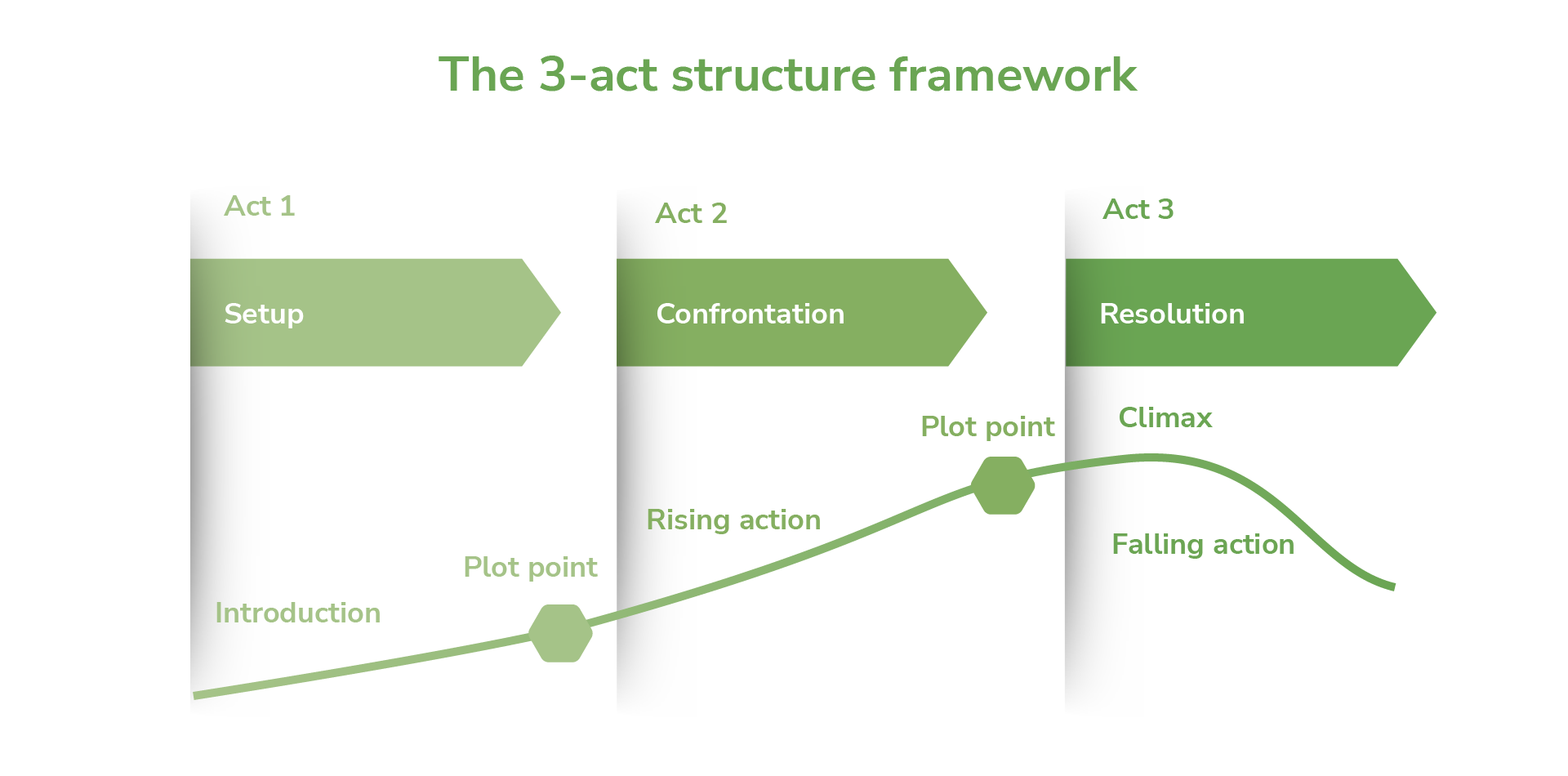
To understand how this applies directly to branding, let's read an article that frames the three acts in terms of a customer's experience.
The article 'Brand Storytelling in 3 Acts' by Lyn Chamberlin provides an excellent, straightforward guide on how to frame your brand's narrative around the customer's problem and desired transformation.
Please read the main sections of the article, from the start down to (but not including) the 'Why This Works' section. Focus on how each act is defined from the customer's perspective: Act 1: The Problem Act 2: The Journey Act 3: The Transformation
As the article explains, the entire narrative hinges on making the customer's experience central. Let's formalize this into a map.
Act I: The Setup (The Customer's Problem)
This is the "before" state. Your story must begin by defining a problem your audience immediately recognizes and relates to. If they don't see themselves in Act I, you've lost them.
- Who is the hero? Describe your target customer.
- What is their 'ordinary world'? What does their daily life look like, defined by this problem?
- What is their core problem or frustration? Be specific. As the article notes, it's not "budgeting struggles," but "small business owners wasting 10+ hours a week on spreadsheets."
- What is the inciting incident? What happens that makes them realize they can't continue this way and must seek a change?
Act II: The Confrontation (The Struggle & The Guide)
This is the journey toward a solution. It's often messy, which makes it relatable. The customer tries things that don't work, faces obstacles, and feels the tension rise.
- What are the obstacles (Rising Action)? What have they tried that failed? (e.g., cheap alternatives, DIY solutions, competitors' products). This struggle adds drama and validates their need for a real solution.
- How does the guide appear? How does the customer encounter your brand? Your brand enters the story here, not as the hero, but as the wise guide with a plan.
- What is the plan? What is your brand's unique approach or process that promises a better way?
Act III: The Resolution (The Solution & Transformation)
This is the "after" state. The hero uses the guide's plan to defeat their problem and arrives at a new, better reality.
- What is the climax? This is the moment the customer uses your product or service and successfully overcomes their problem.
- What does the resolution look like? Describe their new normal. What can they do, feel, or achieve now that they couldn't before? This is the tangible result, the "before-and-after" moment.
- What is the theme? What core message does this transformation communicate about your brand's value? (e.g., "We give you back your time," "We empower creativity.")
Seeing the Map in Action
Let's watch a couple of short video segments that demonstrate this mapping process with clear examples.
First, a video that applies the three-act structure to a non-profit story, which is a perfect parallel to a customer's problem-solution journey.
Three-Act Structure | Storytelling for Commercial & Non-Profit FIlms
In this segment from 'Three-Act Structure' by Select Music Library, the presenter maps out the story of a woman who is losing her vision. Notice how her journey follows the problem-struggle-solution path.
Please watch the segment from 05:07 to 09:21. Pay attention to how the presenter identifies the woman's problem (vision loss), her struggle (a failed surgery), and the final solution (the special contact lens).
Next, let's watch a clip that boils this entire concept down into a simple, memorable marketing framework.
Marketing Storytelling: How to Craft Stories That Sell And Build Your Brand
The video 'Marketing Storytelling' by Adam Erhart simplifies the grand 'Hero's Journey' into an actionable three-part structure for businesses. This is a great summary of what we've been discussing.
Watch the segment from 11:32 to 13:46. The presenter connects the 'beginning, middle, and end' directly to the customer journey: where they are now (problem), how your business guides them (process), and how their life will be better (transformation).
Your Turn: Map a Customer Journey
Now it's time to put this into practice. To start, here is a quick example of a mapped journey.
Brand: "FreshPrep," a meal-kit delivery service.
Customer (Hero): A busy young professional who values health but lacks time to cook.
-
Act I: The Problem
- Setup: Our hero works long hours. They arrive home exhausted, defaulting to unhealthy, expensive takeout. They feel guilty and sluggish.
- Inciting Incident: They see a photo of themselves from a recent vacation and are unhappy with how they look and feel, deciding they need to make a change.
-
Act II: The Struggle
- Rising Action: They try meal-prepping on Sundays, but it consumes their entire day and the food is boring by Wednesday. They try buying "healthy" supermarket frozen meals, but they taste like cardboard. They are frustrated and on the verge of giving up.
- The Guide Appears: While scrolling social media, they see a targeted ad for FreshPrep, promising "gourmet, healthy meals in 20 minutes." Intrigued, they click.
-
Act III: The Solution
- Climax: Their first FreshPrep box arrives. After a long day, they follow the simple recipe card and create a delicious, vibrant, and healthy meal in under 20 minutes. They feel a sense of pride and relief.
- Resolution: Their new normal involves enjoying home-cooked meals without stress. They have more energy, feel better about their health, and have reclaimed their evenings.
Test your understanding!
Now, it's your turn. Choose one of the following fictional brands and map out the customer's problem-solution journey using the three-act structure. Be specific in each act.
Brand Option A: "Quietude," a brand of high-end, noise-cancelling headphones for open-office workers.
Brand Option B: "Legacy," a premium online service that helps people write and design a beautiful memoir.
Use the following template for your map:
- Hero: Who is the customer?
- Act I: The Problem: What is their ordinary world, core frustration, and inciting incident?
- Act II: The Struggle: What obstacles do they face, and how do they discover your brand?
- Act III: The Solution: What is the climax and the final transformation?
Show answer
Here is a sample answer for Brand B: "Legacy". Your answer for either brand will be different, but it should follow a similar logical progression.
-
Hero: A person in their late 60s who has lived a full life and wants to preserve their stories for their grandchildren, but isn't a writer and is overwhelmed by the task.
-
Act I: The Problem: The hero often tells their family stories at gatherings, but they get details wrong and can't find the right photos. They worry their memories will be lost forever. The inciting incident is their grandchild's school project on family history, where the child asks questions the hero can't fully answer.
-
Act II: The Struggle: The hero tries to write things down in a notebook but finds it disorganized. They attempt to use a standard word processor but get frustrated with formatting and adding images. They feel the project is too big and their stories aren't "interesting enough." They discover "Legacy" after a friend shares a beautifully designed digital memoir they created using the service.
-
Act III: The Solution: The climax is the moment they use Legacy's simple, guided prompts and drag-and-drop photo tools to complete the first chapter of their story. It looks professional and feels "real." The resolution is them sharing the finished, printed memoir with their family at the next holiday. Their grandchild reads it with fascination, and the hero feels a deep sense of peace and accomplishment, knowing their legacy is secure.
Conclusion
Today we've transformed a classic literary structure into a practical tool for brand strategy. By mapping the customer's journey, you create a narrative blueprint that ensures your storytelling is always empathetic, relatable, and focused on the transformation your brand provides.
Key Takeaways:
- Effective brand stories position the customer as the hero and the brand as the guide.
- The three-act structure maps perfectly onto a customer's problem-solution journey:
- Act I establishes the customer's problem and the stakes.
- Act II details their struggle and introduces the brand as a solution.
- Act III shows the successful transformation and the customer's new reality.
- This mapping process is the foundational step for creating any piece of brand storytelling, from a website's homepage to a major ad campaign.
This concludes our module on the three-act structure. You now know not only how to identify and analyze this structure but also how to apply it.
Preview of the Next Lesson: A story is only as good as its characters. Now that we understand the hero's journey, our next module, "Developing Compelling Characters," will dive deep into crafting the hero themselves. We will begin by learning to distinguish between protagonists, antagonists, and supporting characters within a branding context.