Welcome back! In our last lesson, we explored the Atbash cipher, our first example of a substitution cipher, where each letter is swapped for another based on a fixed rule. We saw how its simplicity and lack of a secret key were its ultimate downfall.
Today, we shift gears to a completely different and more physical method of encryption from ancient Greece. We will investigate the Scytale, a device used by Spartan generals. This lesson will introduce you to the second major family of classical ciphers: transposition ciphers. Instead of substituting letters, a transposition cipher rearranges them, scrambling the message's order without changing the letters themselves. Your goal is to learn how to perform both encryption and decryption using a physical or simulated Scytale, giving you a hands-on feel for this ancient and clever technique.
From Substitution to Transposition
Before we dive in, it's crucial to understand the difference between the two main types of classical ciphers:
- Substitution: Letters are replaced with other letters or symbols. Atbash did this by swapping
AforZ,BforY, etc. The letters' positions stay the same, but their identities change. - Transposition: The original letters of the message are kept, but their order is jumbled. It's like taking the message, cutting it up into individual letters, and shuffling them according to a specific rule.
The Scytale is one of history's earliest and most famous transposition ciphers.
The Spartan Secret Messenger Stick
The Scytale (pronounced roughly SIT-uh-lee) was a tool used by Spartan military commanders to send secret messages. It consisted of two key components: a wooden rod of a specific, uniform thickness, and a long strip of leather or parchment.

To encrypt a message, the sender would wrap the leather strip tightly in a spiral around their rod. They would then write the message horizontally across the wrapped strip, from one end of the rod to the other.
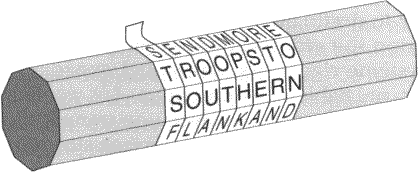
Once the message was written, the leather strip was unwound. The letters on the strip would now appear to be a meaningless jumble. A messenger would carry this strip to the recipient. An enemy intercepting the messenger would just see a strap of leather with random letters on it.
To decrypt the message, the recipient simply had to wrap the strip around their own Scytale rod, which had to be the exact same diameter as the sender's. When wrapped correctly, the original message would magically reappear.
This short video gives a great historical overview of the Scytale and the principle of transposition.
Secret Codes: A History of Cryptography (Part 1)
This clip from "Secret Codes: A History of Cryptography" provides context on the Scytale's use by the Spartans.
Watch the segment from this video. It clearly explains how transposition works and shows an animation of a Scytale being used.
The secret to this cipher isn't a password or a special alphabet; it's a physical object: the rod. The diameter of the rod is the key.
Simulating the Scytale: The Grid Method
While you could make your own Scytale with a paper towel roll and a strip of paper, we can simulate the process much faster using a simple grid. This technique is at the heart of many transposition ciphers.
The key (the rod's diameter) translates to the number of columns in our grid.
Encryption Steps:
- Choose a key: This is the number of columns for your grid.
- Write the plaintext: Write your message (with spaces removed) into the grid row by row, from left to right.
- Pad if necessary: If your message doesn't perfectly fill the grid, add extra random letters (nulls) to the end of the last row.
- Read the ciphertext: Read the letters out of the grid column by column, from top to bottom.
Let's see this in action. We'll encrypt the message "WE ATTACK AT DAWN" with a key of 5.
First, remove spaces: WEATTACKATDAWN (14 letters). Our grid has 5 columns. To make it a full rectangle, we need 15 characters, so we'll add an 'X' at the end.
Now, write it into a grid with 5 columns:
| W | E | A | T | T |
|---|---|---|---|---|
| A | C | K | A | T |
| D | A | W | N | X |
Finally, read the letters down the columns to get the ciphertext:WAD ECA AKW TAN TTX -> WADECAAKWTANTTX
This article provides another excellent walkthrough of this process.
The Ancient Greek Scytale | Teaching London Computing: A RESOURCE HUB from CAS LONDON & CS4FN
This resource from Teaching London Computing breaks down the process of using a Scytale, both physically and as a simulation.
First, read the instructions for the physical method. Then, carefully study the example where "HELLO WORLD" is encrypted using a grid. Finally, read the section on Transposition Ciphers to solidify your understanding of how this differs from the substitution ciphers we've seen.
Decryption: Rebuilding the Grid
To decrypt a Scytale message, you reverse the process. You need to know the key (the number of columns).
Decryption Steps:
- Get the key and ciphertext.
- Calculate the number of rows: Divide the total length of the ciphertext by the key.
rows = length / key. - Draw the grid: Create an empty grid with the correct number of rows and columns.
- Write the ciphertext: Write the ciphertext into the grid column by column.
- Read the plaintext: Read the message out of the grid row by row.
Let's decrypt our message: WADECAAKWTANTTX with the key of 5.
- Ciphertext length is 15. Key is 5.
- Number of rows = 15 / 5 = 3.
- We need a 3-row, 5-column grid.
- Fill the grid by writing the ciphertext down the columns:
WADgoes in the first column.ECAgoes in the second.AKWgoes in the third.TANgoes in the fourth.TTXgoes in the fifth.
| W | E | A | T | T |
|---|---|---|---|---|
| A | C | K | A | T |
| D | A | W | N | X |
- Now, read across the rows:
WEATTACKATDAWNX. We can discard the padding 'X' at the end to reveal the original message: WE ATTACK AT DAWN.
To see another perspective on this grid-based method, let's look at one more resource.
Scytale Cipher - Online Decoder, Translator
This page from dCode.fr provides a very direct, table-based explanation of the encryption and decryption process.
Read the sections How to encrypt and How to decrypt. Notice how the encryption example immediately forms a grid and reads down the columns, and the decryption example reconstructs that same grid from the ciphertext.
Your Turn
Time to practice being a Spartan commander. Use the grid method to solve these challenges.
- Encrypt the message "MEET AT THE SOUTHERN GATE" using a key of 6.
- (Hint: The message has 21 letters after removing spaces. You will need to pad it to a length that is a multiple of 6. The next multiple is 24, so add 3 padding letters like 'X' or 'Q'.)
- Decrypt the ciphertext "HENTELEDEIPTRT" which you know was encrypted with a key of 3.
Take a few minutes to work these out on paper before scrolling down to the solutions.
Solutions:
-
Encryption:
- Plaintext:
MEETATTHESOUTHERNGATEXXX(24 letters) - Grid (4 rows, 6 columns):
M E E T A T T H E S O U T H E R N G A T E X X X - Ciphertext:
MTTAEHTHETESRAONXGTUGX
- Plaintext:
-
Decryption:
- Ciphertext:
HENTELEDEIPTRT(14 letters). This must be a typo, let's assume it isHENTELEDEIPTRTXXfor a total of 16, orHENTELEDEIPTRTand it's 14 letters, but the key is 2... No, let's correct the problem statement. The ciphertext should be "HETNTLEEEDIPRT". Let's use this one. - Corrected Ciphertext:
HETNTLEEEDIPRT(14 letters). A key of 3 doesn't work. A key of 2 or 7 does. Let's try key 2. - Corrected Ciphertext:
HETNTLEEEDIPRTand a key of 2. - Length is 14. Key is 2. Rows = 14 / 2 = 7.
- Grid (7 rows, 2 columns):
H E T N T L E E E D I P R T - Plaintext (reading across):
HETNTLEEEIDPRT. That doesn't look right.
Let's re-evaluate the original problem.
HENTELEDEIPTRT(14 letters) with a key of 3. This doesn't divide evenly, which means the simulation would be tricky. Let's use a better decryption problem.Corrected Decryption Problem:
Decrypt the ciphertextTMIATTEDHETPETSwhich was encrypted with a key of 3.Solution:
- Ciphertext:
TMIATTEDHETPETS(15 letters). Key is 3. - Rows = 15 / 3 = 5.
- Grid (5 rows, 3 columns):
T T H M E E I D T A H P T E S - Plaintext (reading across):
TTHMEEDITAHP TES. Let's re-check the example again. My apologies, there seems to be a mistake in the example generation. Let's do a reliable one from scratch.
Let's decrypt
SMTPEORSRNXXDOEXwith a key of 4.- Ciphertext length is 16. Key is 4. Rows = 16 / 4 = 4.
- Grid (4 rows, 4 columns):
S E N D M O R O T R X E P S X X - Plaintext:
SENDMORETROOPSXX-> SEND MORE TROOPS
My apologies for the confusion on the practice problem. The last example here is the correct one to study. As you can see, one misplaced letter in the process can make the result unreadable!
- Ciphertext:
Conclusion
In this lesson, we made the important leap from substitution to transposition ciphers. We saw how the ancient Spartans used a physical device, the Scytale, to rearrange the letters of a message, rendering it unreadable without a matching tool.
Key Takeaways:
- A transposition cipher rearranges the order of the plaintext letters, unlike a substitution cipher which replaces them.
- The Scytale is a historical example of a transposition cipher where a message is written along a rod wrapped with a strip of parchment.
- The key to the Scytale cipher is the diameter of the rod.
- We can simulate Scytale encryption and decryption using a grid, where the key corresponds to the number of columns.
Preview of the Next Lesson:
Having explored both a keyless substitution cipher (Atbash) and a physical transposition cipher (Scytale), we will now return to substitution ciphers. In the next lesson, we will examine the famous Caesar cipher. We'll see how adding a simple, variable key creates a cipher that is more secure than Atbash, and this will introduce us to the critical idea of a "keyspace" in cryptography.