Hello! Welcome to our next lesson.
In our last session, we established a crucial result: spontaneously breaking a global continuous symmetry inevitably leads to the appearance of massless Goldstone bosons. You'll recall from the preview that we're now going to ask a pivotal question: what happens if the spontaneously broken symmetry is a local gauge symmetry?
Today, we will answer this question by studying the Abelian Higgs mechanism. This is one of the most profound ideas in modern physics. We will see that when a local U(1) gauge symmetry is spontaneously broken, the massless Goldstone boson we would have expected vanishes from the spectrum. Instead, the gauge boson itself acquires a mass by "eating" the would-be Goldstone boson. This mechanism is the blueprint for understanding how the carriers of the weak force, the W and Z bosons, get their masses in the Standard Model.
Our learning goal is to apply this mechanism to a U(1) gauge theory, demonstrating precisely how the gauge boson becomes massive and how the Goldstone boson is eliminated.
From Global to Local: The Abelian Higgs Model
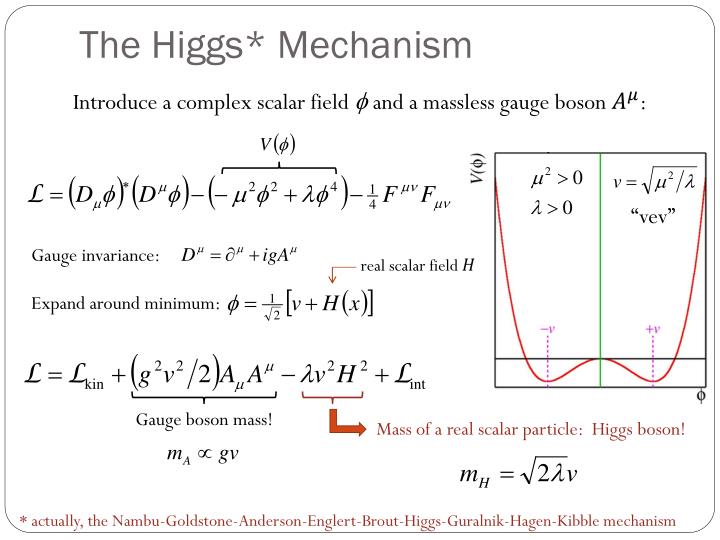
Let's begin with the Lagrangian for a complex scalar field with a potential that induces spontaneous symmetry breaking, which we studied in the last lesson. We will now couple this field to a U(1) gauge field (like the photon). This is achieved by promoting the global U(1) symmetry to a local one, , where is the charge of the scalar field.
This promotion requires two steps you're familiar with:
- Replacing the ordinary derivative with the covariant derivative .
- Adding the kinetic term for the gauge field itself, , to allow it to propagate.
The resulting Lagrangian describes the Abelian Higgs model:
where the potential has the "Mexican hat" shape that drives spontaneous symmetry breaking:
with . We have written the potential in a form that makes the minimum clear. The constant term can be dropped as it doesn't affect dynamics.

Spontaneous Symmetry Breaking in a Gauge Theory
The crucial difference from the global symmetry case is that all points on the circle of minima, , are now physically equivalent. They are all connected by a local gauge transformation, and since gauge transformations represent a redundancy in our description, they describe the same physical state.
To see the particle spectrum, we must expand the fields around a chosen vacuum state. Let's pick a point on the circle of minima, say being real and positive. We can write the field in "polar coordinates" to represent fluctuations around this vacuum:
Here:
- represents fluctuations in the radial direction (up the walls of the potential). We expect this to be a massive particle.
- represents fluctuations in the angular direction (along the flat bottom of the valley). In the global case, this was our massless Goldstone boson.
Now, let's see what happens when we substitute this into the Lagrangian. The most important term is the scalar kinetic term, .
The following text from David Tong's lecture notes provides a clean and rigorous derivation of the particle spectrum. We will follow its logic closely.
Please read the subsection 'The Abelian Higgs Model' (Section 2.3.1). Focus on the steps from equations (2.94) to (2.101). Pay close attention to how the covariant derivative term, |D_\mu\phi|^2, is expanded and how the gauge field A_\mu and the phase field \theta(x) are combined.
As you saw in the reading, the kinetic term becomes:
The full Lagrangian (ignoring constant terms and focusing on terms quadratic in the fields for now) is approximately:
From this we can immediately identify:
- A kinetic term for : .
- A mass term for : . This gives the Higgs boson a mass .
The truly novel part is the last term, involving and .
The Disappearance of the Goldstone Boson
The phase field only appears in the combination . This structure is the key to the Higgs mechanism. We can now exploit the gauge freedom of the theory to eliminate the field entirely.
We are free to make a gauge transformation:
Let's choose a specific gauge function . In this gauge, the phase of the scalar field is gauged away to zero. This is known as the unitary gauge.
Let's define a new field . The term in the Lagrangian becomes:
Crucially, the field strength is invariant under this redefinition, since .
In this unitary gauge, the field has vanished completely! The final Lagrangian for the physical fields and (to quadratic order) is:
We see a term , which is precisely a mass term for the vector boson , with mass-squared .
The would-be Goldstone boson has been absorbed, and the gauge boson has become massive.
The following video provides an excellent conceptual and graphical explanation of this process.
Particle Physics (2018) Topic 16: The Higgs Mechanism and Spontaneous Symmetry Breaking
This clip from Alex Flournoy's lecture series provides an intuitive picture of the Higgs mechanism. It connects the visual of the Mexican hat potential to the mathematical result we've just derived.
Please watch from 26:26 to 56:40. Pay special attention to three key ideas: The visual representation of the Mexican hat potential and how the U(1) symmetry corresponds to rotation around the hat (26:26 - 30:05). How the curvature of the potential corresponds to mass: steep curvature for the massive Higgs boson (\sigma) and zero curvature for the massless Goldstone boson ( heta) (30:05 - 40:43). The central idea: how the original gauge symmetry allows us to 'gauge away' the Goldstone boson, which is 'eaten' by the gauge field to provide its third polarization state (46:40 - 56:40).
Conservation of Degrees of Freedom
Let's do a quick check to see where the degrees of freedom went. This is a crucial consistency check that the learner with your background will appreciate.
-
Before Spontaneous Symmetry Breaking:
- 1 complex scalar field : 2 degrees of freedom ().
- 1 massless U(1) gauge field : 2 degrees of freedom (two transverse polarization states).
- Total: 4 degrees of freedom.
-
After Spontaneous Symmetry Breaking (in unitary gauge):
- 1 real scalar field (the Higgs boson): 1 degree of freedom.
- 1 massive vector boson : 3 degrees of freedom (two transverse and one longitudinal polarization state).
- Total: 4 degrees of freedom.
The degrees of freedom match perfectly. The degree of freedom of the would-be Goldstone boson was not lost; it was absorbed by the gauge field to become its new longitudinal polarization mode, which is required for any massive vector particle.
This elegant counting is explained very clearly in the following resource.
These notes from Vadim Kaplunovsky give the most straightforward explanation of the degree of freedom counting.
Read the short section that begins 'To see what happened to the would-be Goldstone boson, let’s count the degrees of freedom...'. It clearly contrasts the particle states and degrees of freedom in the unbroken and broken symmetry regimes.
A Note on Superconductivity
Given your background in condensed matter physics, you might find it interesting that this mechanism was first understood in that context. The theory of superconductivity (Ginzburg-Landau theory) is a non-relativistic version of the Abelian Higgs model. Inside a superconductor, electron pairs form a charged condensate (analogous to our ). This "breaks" the U(1) gauge symmetry of electromagnetism, causing the photon to acquire an effective mass inside the material. This massive photon is responsible for the Meissner effect—the expulsion of magnetic fields from a superconductor, which only penetrate a short distance (the inverse of the photon's effective mass). The physics is identical.
Conclusion
Key Takeaways:
- When a local gauge symmetry is spontaneously broken, Goldstone's theorem is circumvented.
- The Lagrangian of the Abelian Higgs model describes a complex scalar field coupled to a U(1) gauge field with a potential that induces SSB.
- By expanding the fields around the non-zero vacuum expectation value, we find that the gauge boson acquires a mass term .
- The would-be massless Goldstone boson is shown to be an unphysical degree of freedom that can be eliminated by choosing the unitary gauge.
- This process is often described as the gauge boson "eating" the Goldstone boson. The Goldstone boson provides the third (longitudinal) polarization state required by a massive vector particle, ensuring the conservation of degrees of freedom.
You have just worked through the simplest example of the mechanism that gives mass to the fundamental particles in our universe.
Preview of the Next Lesson:
We are now ready to tackle the real deal. In the next lesson, we will generalize today's discussion from the Abelian U(1) group to the non-Abelian group of the electroweak theory: SU(2) x U(1). We will introduce the concepts of weak isospin and hypercharge and construct the gauge structure of the Standard Model before symmetry breaking. Then, we will apply the Higgs mechanism to this more complex theory to see how the W+, W-, and Z bosons acquire their masses, while the photon remains massless.