Hello! Welcome to the final lesson in our module on the path integral formulation of quantum field theory.
In our previous lesson, we saw how the path integral formalism in Minkowski spacetime provides a powerful machine for calculating scattering amplitudes. By relating the generating functional to S-matrix elements via the LSZ reduction formula, we could derive the Feynman rules for any interacting theory directly from its Lagrangian.
So far, our entire approach has been geared towards particle scattering, which takes place in real time. Today, we will shift our perspective and explore a profound connection that emerges when we make a formal change to the time variable. This will not only provide a more mathematically sound definition of the path integral but will also link QFT to a completely different branch of physics.
Our learning outcome for this lesson is to explain the relationship between quantum field theory in Euclidean spacetime and statistical mechanics.
The Problem with the Minkowski Path Integral
Let's briefly revisit the path integral in the form we've been using:
The presence of the in the exponent, , makes the integrand a rapidly oscillating complex phase factor. From a mathematical standpoint, integrating such a function over an infinite-dimensional space of fields is a notoriously ill-defined problem. The convergence of the integral is not guaranteed.
Physicists developed a clever mathematical trick to handle this: they rotate the time axis into the complex plane. This procedure, called Wick rotation, not only tames the integral but also reveals an astonishing connection to statistical physics.
Wick Rotation and Euclidean Spacetime
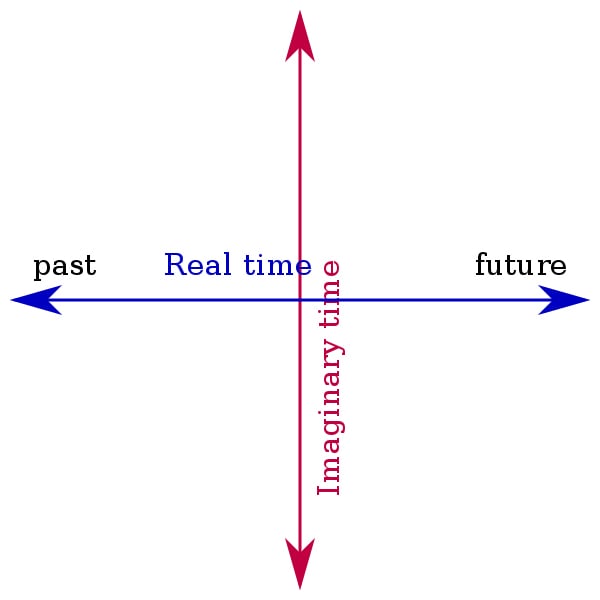
The Wick rotation is an analytic continuation of the time coordinate to imaginary values. We define a new "Euclidean time" coordinate (sometimes written ):
This isn't an arbitrary choice. The specific direction of rotation (into the lower-half complex plane) is chosen to ensure that the quantum time-evolution operator, , becomes a decaying exponential, , which has much better convergence properties.
To see the formal justification for this, let's watch the beginning of the following lecture.
Quantum Field Theory I - Lecture 6
This video from IFT-UNESP explains the formal details of Wick rotation, showing how we analytically continue time into the complex plane and, crucially, why we choose a specific direction for the rotation.
Watch from the beginning to 15:02. Focus on the concept of analytic continuation for the time evolution operator and the argument that the operator remains bounded only if the rotation is into the lower-half of the complex time plane. This justifies the specific 'Wick rotation' we perform.
This rotation has a profound effect on the geometry of spacetime. The Minkowski spacetime interval is:
After the Wick rotation, , so . The interval becomes:
This is the standard line element in a 4-dimensional Euclidean space. The time coordinate is now on an equal footing with the spatial coordinates. The Lorentz symmetry SO(3,1) of Minkowski space is analytically continued to the rotation group SO(4) of 4D Euclidean space.
The Euclidean Path Integral
What does this do to the path integral? Let's consider the action for a scalar field:
The exponent in the path integral is . Under Wick rotation, the integration measure , and time derivatives .
This expression can be written as , where is the Euclidean action:
Here, and .
Notice two critical changes:
- The factor of in front of the action is gone.
- The kinetic term in the Euclidean action is positive-definite. For a typical potential , the entire is real and bounded from below.
The path integral now takes the form:
This is the Euclidean path integral. The integrand is now a real, positive, and exponentially damped function, which is much better behaved mathematically.
The following notes provide a very clear and direct explanation of this transformation.
Introduction to Quantum Field Theory
These classic lecture notes by John Cardy concisely explain how the Wick rotation transforms the path integral.
Please read section 2.1 'Imaginary time path integrals and statistical mechanics' (page 8) and the short paragraph on the Euclidean action in section 3.1 'Field theory action functionals' (page 11). Focus on how the action S becomes the Euclidean action S_E and how the path integral measure changes from exp(iS) to exp(-S_E).
The Deep Analogy: QFT and Statistical Mechanics
The form of the Euclidean path integral, , is immediately reminiscent of the partition function in classical statistical mechanics for a system in thermal equilibrium:
where is the Hamiltonian (energy) of a configuration, is Boltzmann's constant, and is the temperature.
This reveals a profound analogy:
| Quantum Field Theory (Euclidean) | Statistical Mechanics |
|---|---|
| Field configuration | Microscopic state (e.g., spin configuration) |
| Path integral | Sum over all possible states |
| Euclidean action | Hamiltonian / Energy |
| Generating functional | Partition function |
| External source | External field (e.g., magnetic field ) |
The following reading elaborates on this analogy in more detail, including a fascinating insight about the role of coupling constants.
Euclidean Time and Discretization
This document draws out the QFT/StatMech connection in detail, formalizing the mapping between their key components.
Read the section 'QFT / StatMech Analogy' (pages 12-14). This section is crucial. Focus on the direct mapping and also note the insightful point about how coupling constants in QFT can play the role of temperature in the statistical system after a field rescaling.
Test your understanding!
Consider a classical theory of a scalar field in a 3D volume at temperature . The energy of a field configuration is given by the Hamiltonian . The partition function is .
Now, consider a quantum field theory for a scalar field in 3+1 dimensional spacetime, with Lagrangian .
After performing a Wick rotation, what is the Euclidean action of the QFT? By comparing the resulting Euclidean path integral with the statistical mechanics partition function, what are the QFT analogues of the statistical mechanics parameters and ? What plays the role of the temperature ?
Show answer
-
Find the Euclidean Action:
We start with . After Wick rotation (, , ), we get:
So, the Euclidean action is . -
Compare the Exponents:
The statistical mechanics Boltzmann factor is .
The Euclidean QFT path integral weight is . -
Identify Analogues:
The QFT is a problem in 4 Euclidean dimensions, while the statistical system is in 3 dimensions. By comparing the terms in the integrands, we can see that the QFT parameter is analogous to the statistical parameter , and the QFT coupling is analogous to the statistical coupling . The overall factor of in the statistical system corresponds to the overall factor of 1 (or if we restore units) in the QFT expression.
An Intuitive Picture: From One to Many
The analogy can be made more concrete: a quantum theory in D spatial dimensions is equivalent to a classical statistical mechanics theory in D+1 Euclidean dimensions.
The most intuitive example is a single quantum harmonic oscillator (0 spatial dimensions). Its path integral describes the quantum fluctuations of a single particle over time. After Wick rotation, this path integral can be shown to be equivalent to the partition function of a chain of classical masses connected by springs in 1 dimension (the Euclidean time dimension). Quantum fluctuations in time become thermal fluctuations along the classical chain.
The following video provides an excellent visualization of this specific example.
Quantum Field Theory I - Lecture 6
To build a strong intuition for this mapping, let's see how a single quantum harmonic oscillator, after a Wick rotation, describes a system that is much more familiar from classical statistical mechanics.
Watch the segment from 45:35 to 58:43. The key idea here is to see how discretizing the Euclidean action for a single quantum oscillator leads to the energy function of a chain of classical coupled oscillators. This transformation from a (0+1)-dimensional quantum system to a 1-dimensional classical statistical system is a core result of the analogy.
This generalizes directly: a 3+1 dimensional QFT, describing the quantum fluctuations of fields throughout spacetime, becomes equivalent to a 4-dimensional classical statistical field theory.
Why is this Analogy So Useful?
This correspondence is one of the most powerful tools in modern theoretical physics.
-
Mathematical Rigor: As mentioned, Euclidean path integrals are well-defined. Many formal results in QFT are proven first in Euclidean space and then analytically continued back to Minkowski space.
-
Finite Temperature QFT: The analogy is not just formal. A quantum field theory at a finite temperature is exactly described by a Euclidean path integral where the imaginary time dimension is periodic (compactified into a circle) with period . This allows us to use QFT to describe systems like the quark-gluon plasma or the early universe.
-
Computational Power (Lattice QFT): The analogy is the foundation for most non-perturbative QFT calculations. Since the Euclidean path integral looks like a statistical mechanics problem, we can use tools from that field. Specifically, we can discretize 4D Euclidean spacetime into a lattice and compute the path integral numerically using Monte Carlo simulations (like the Metropolis algorithm you may have encountered). This is precisely the methodology of Lattice QFT, a topic we will explore in detail in a later module. Given your experience with simulations, you can see how this opens a path to computing QFT observables from first principles.
-
Conceptual Unification: It allows for a massive cross-pollination of ideas. For example, the theory of phase transitions and critical phenomena in statistical mechanics, governed by critical exponents and universality, has a direct counterpart in the behavior of quantum field theories. The renormalization group, a central tool in QFT, is also indispensable for understanding critical phenomena.
Conclusion
Today we have uncovered a deep and surprising connection between two pillars of physics. By performing a Wick rotation on the time coordinate, we transformed the oscillatory, difficult-to-define Minkowski path integral into a well-behaved Euclidean path integral.
Key Takeaways:
- Wick Rotation () transforms Minkowski spacetime into Euclidean spacetime and makes the path integral mathematically well-defined.
- The oscillatory factor becomes a real, damped weight factor , where is the Euclidean action.
- The Euclidean path integral for a QFT is formally analogous to the partition function of a classical statistical mechanics system in one higher dimension.
- This correspondence is not just an analogy but a powerful computational and conceptual tool, forming the basis for Lattice QFT and providing deep insights into phenomena like phase transitions and finite-temperature field theory.
This lesson concludes our module on path integrals. You've seen how this formalism can be used to calculate scattering amplitudes in Minkowski space and, through today's work, how it can be re-imagined to connect with statistical mechanics.
Preview of the Next Module:
We are now equipped with both the canonical and path integral formalisms. In our next module, we will venture into the heart of the Standard Model by studying Non-Abelian Gauge Theories and QCD. We'll begin by generalizing the simple U(1) gauge symmetry of QED to more complex, non-commuting symmetries like SU(N). This will lead us to the Yang-Mills Lagrangian and the intricate, self-interacting nature of particles like gluons.