Hello! Welcome to the next lesson in our QED journey.
In our last session, we performed a complete calculation of the unpolarized, squared matrix element for pair annihilation, . During that calculation, we frequently used expressions like and as convenient, Lorentz-invariant shorthands for kinematic quantities.
Today, we're going to formalize and generalize this idea. Our goal is to explain the concepts of Mandelstam variables (s, t, u) and use them to express scattering amplitudes in a Lorentz-invariant way. These variables provide a powerful and universal language for describing 2-to-2 scattering processes, revealing deep connections between seemingly different reactions.
1. Introduction to Mandelstam Variables
Let's consider a generic 2-particle-to-2-particle scattering process:
where are the four-momenta of the incoming particles and are the four-momenta of the outgoing particles. The masses of these particles are .
The dynamics of this collision are entirely determined by the incoming energy and the scattering angle. However, these quantities depend on the reference frame. The Mandelstam variables are a set of three Lorentz-invariant scalars, meaning they have the same value in any inertial frame, which makes them ideal for theoretical calculations.
Let's begin with a quick video overview of their definition and physical meaning.
Mandelstam Variables in Quantum Field Theory (QFT)
The video 'Mandelstam Variables in Quantum Field Theory (QFT)' from the channel Pretty Much Physics provides a concise introduction to what s, t, and u are, why they are useful, and their physical interpretations.
Watch the video from the beginning to 03:29. Focus on: The definitions of s, t, and u in terms of the four-momenta. The fact that they are Lorentz scalars. The relationship between them, which implies only two are independent. The physical meaning of \sqrt{s} as the center-of-mass energy and of t and u as four-momentum transfers.
2. Formal Definitions and Properties
As you saw in the video, the Mandelstam variables are defined as:
The equalities on the right-hand side follow from four-momentum conservation, . Since they are constructed from scalar products of four-vectors, they are manifestly Lorentz invariant.
The Sum Rule
A crucial property is that , , and are not independent. They are related by a simple sum rule. Let's derive it.
We start by summing the definitions:
Expanding the squares gives:
We can group the terms:
From momentum conservation, . Substituting this in:
Since , this simplifies to the final result:
This elegant relation shows that any 2-to-2 scattering process is fully described by just two independent kinematic variables, for which we can choose any pair from .
The following resource provides a compact summary of these definitions and the sum rule derivation.
The document 'Mandelstam Variables' by Vadim Kaplunovsky provides a concise, formal introduction. We've just worked through the derivation it presents.
Please read the first page of this document. It reinforces the definitions and the sum rule we just derived, setting the stage for their application.
3. Expressing Amplitudes with s, t, and u
The primary utility of Mandelstam variables is that any Lorentz-invariant scalar product of the four-momenta can be expressed as a linear combination of s, t, u, and the squared masses. This allows us to write scattering amplitudes , which are themselves Lorentz scalars, in a frame-independent and simplified form.
Let's see how this works. We can rearrange the definitions of s, t, and u to solve for the momentum dot products:
- From , we get:
- From , we get:
And so on. All six possible dot products between the four momenta can be written this way.
The 'Mandelstam Variables' document provides a complete list of these relations and applies them to specific QED processes.
Read the second and third pages of the document. Focus on: The set of equations (6), which express all six scalar products (p_i \cdot p_j) in terms of s, t, u, and masses. The concrete examples for e^-e^+ o \mu^-\mu^+ and e^-e^+ o \gamma\gamma. Notice how these relations simplify when masses are equal or zero.
Let's revisit the result from our last lesson on pair annihilation, . The squared amplitude was:
Here we used and . The third variable is , which is simply the squared center-of-mass energy. The sum rule is . This expression is manifestly Lorentz invariant, depending only on these scalar variables. This is the power of the formalism: it packages all the complex, frame-dependent kinematic information into a few simple invariant quantities.
4. Channels and Crossing Symmetry
The Mandelstam variables do more than just simplify notation; they reveal a profound physical principle known as crossing symmetry. This principle states that the scattering amplitude for different, but related, processes can be obtained from a single analytic function .
What does it mean for processes to be "related"? We can obtain a new process from an old one by "crossing" a particle from the initial to the final state. When we do this, the particle becomes its own antiparticle, and its four-momentum changes sign: .
Let's examine our generic process . This is called the s-channel. The variable is the squared total energy in the center-of-mass frame. For this process to be physically possible, we must have enough energy, so . In this process, and represent momentum transfers and are typically negative.
Now, consider crossing particle 3 to the initial state and particle 2 to the final state. This gives the process:
This is called the t-channel. What are the Mandelstam variables for this new process? Let's call them .
- The squared CM energy is .
- The momentum transfer is .
- The other momentum transfer is .
So, the t-channel process is described by the same amplitude function , but evaluated in a different kinematic region where plays the role of the squared CM energy () and is a negative momentum transfer.
Similarly, crossing particle 4 to the initial state and particle 2 to the final state gives the u-channel process, , where is the squared CM energy.
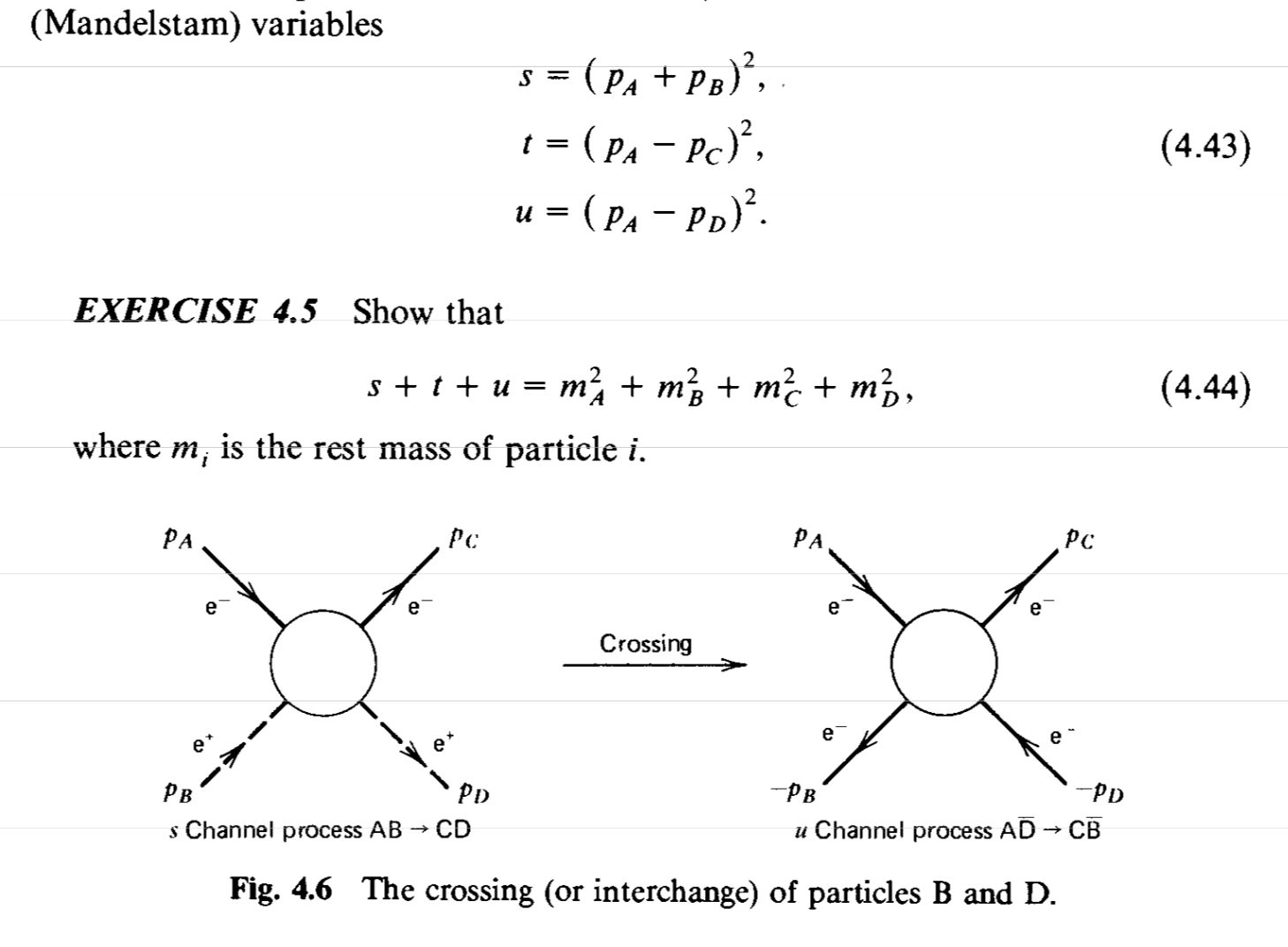
A fantastic, concrete example is the relationship between Møller scattering () and Bhabha scattering ().
Chapter 2 Relativistic kinematics
The following excerpts from 'Chapter 2 Relativistic kinematics' provide a more detailed discussion of crossing symmetry, including the physical interpretation of negative-momentum states as antiparticles.
Please read section 2.3 'Crossing symmetry' (starting on page 14). Pay attention to: The definition of s-channel, t-channel, and u-channel reactions (Figures 2.5, 2.6). How a particle with 4-momentum -p is interpreted as an antiparticle with 4-momentum p. The example relating Møller and Bhabha scattering (Figure 2.9).
Test your understanding!
We've calculated the amplitudes for Compton scattering () and pair annihilation (). How are these two processes related by crossing symmetry? Identify which is the s-channel and which is the t-channel.
Let be the Compton process.
Show answer
Let's start with Compton scattering as our s-channel process: .
The Mandelstam variables are:
- (CM energy squared)
- (Momentum transfer)
- (Momentum transfer)
Now, let's cross the incoming electron to the final state and the outgoing electron to the initial state. An electron in the final state is an antiparticle in the initial state (positron), and vice versa.
- in initial state in final state.
- in final state in initial state.
The resulting process is . This is positron-photon scattering, which is physically identical to electron-photon scattering.
Let's try a different crossing. Let's cross the incoming photon and outgoing electron . Since the photon is its own antiparticle, we get:
. This is pair annihilation!
In this new process, the squared CM energy is . For the original Compton process, this was . Therefore, pair annihilation is the t-channel reaction corresponding to the s-channel Compton scattering process. The single analytic function describes both!
Conclusion
In this lesson, we have formalized the Mandelstam variables and explored their profound implications. They are not just a notational convenience, but a fundamental concept in relativistic scattering theory.
Key Takeaways:
- The Mandelstam variables are Lorentz-invariant scalars that kinematically describe a 2-to-2 scattering process.
- They are defined as , , and .
- Only two are independent, as they obey the sum rule .
- Any scattering amplitude can be written as a function , making its Lorentz invariance explicit.
- Crossing Symmetry: A single analytic function describes three different "channels" of scattering (, , and ), which correspond to different physical processes related by crossing particles between initial and final states.
Preview of the Next Lesson:
We have now mastered the calculation of the Lorentz-invariant amplitude and how to express it elegantly. The next step is to connect this theoretical quantity to a physical observable: the cross-section. In our next lesson, we will numerically compute the total cross-section for 2→2 scattering in φ⁴ theory by integrating the differential cross-section, which is proportional to . This will be our first step into the computational part of this course, where you can apply your programming skills.